The Meeting You Should Have Cancelled Six Months Ago (and Why You Didn't)
By Atiba de Souza
You already know which one it is
You already know which one it is.
It is on your calendar this week. Same faces. Same hour. Somebody shares a screen nobody reads. Somebody says we should take that offline. Everybody leaves without a decision they could not have made in a thread.
You knew six months ago. You have not cancelled it. And you cannot tell me the exact reason you are keeping it, because there is no reason. There is a sentence you repeat, and you have never once tried to break the sentence.
That is not a scheduling problem. It is a thinking problem, and it is the same one that keeps bad campaigns, bad products, and bad hires alive long past the point where anyone still believed in them.
The question I ask before I commit to anything
Everything I build gets run through the same gate. I ask it before we commit. I ask it again while we are executing.
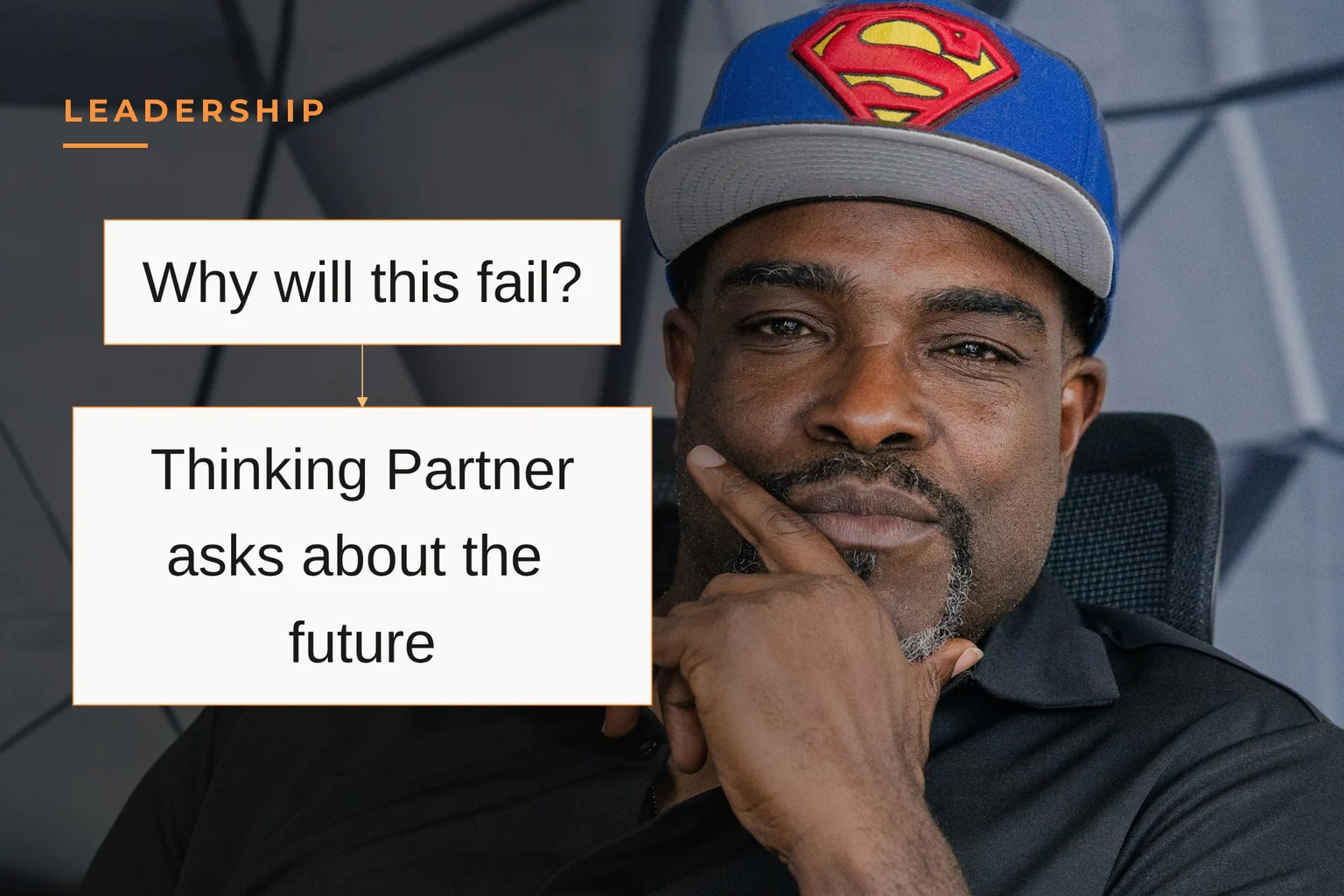
Why will this fail?
Why This Will Fail: one question, asked before you commit and re-asked as you execute. Why will this idea fail? Five bias lenses, two opposed voices, and the output is not a mood. It is a written list of concrete failure modes, each one carrying a disposition.
Most people default to the rosy case. We look at the reasons the thing will work, we walk out with a good feeling, and we build a plan that survives only if nothing goes wrong. This is the opposite pass, run with the same seriousness, so you can see what you have to plan for, mitigate, or be prepared for, because it could tank the entire thing.
What makes this more than a generic pre-mortem is the split. One question, two deliberately opposed voices. The Thinking Partner asks it about the future: what kills this at scale, three weeks out, at the second order? What does it look like when it succeeds on its own terms and still loses? The Project Manager asks the same question about execution: what breaks when we actually run it? Both voices carry the same five lenses, so nothing gets asked from one direction only.
Disposition: what you decide to do about one named failure mode. Plan for it, mitigate it, or be prepared for it. A failure mode with no disposition is a mood with a label on it.
For a standing meeting, those three dispositions land as three decisions: keep it, change it, or kill it. Not soon. On the calendar, this week.
Don't ask if the meeting works. Ask why it will fail.
Run the standing meeting through all five lenses. Not the meeting you might create someday. The one already on your calendar. Run every lens, including the ones you think do not apply, because the lens you skip is usually the one holding the meeting up.
Optimization bias. The Project Manager asks: are we making it better instead of asking whether it should exist? Shorter agenda. Tighter timebox. A new tool that promises to make it async. All of that is optimization, and none of it is the question. Now the Thinking Partner: three weeks from now, when the optimization works, what do you actually have? A shorter meeting that is still pointless. A broken thing, running beautifully. This is the lens most people live inside, and it is the one that convinces them they are already working on this.
Conflation. You confuse the thing with its signal. Attendance reads as alignment. A status update reads as a decision. Notes going out reads as the work moving. Ask the room one clean question: what did we decide here that could not have been decided in writing? The same lens catches a second swap, and this one is about you. You confuse what you said with what you meant. Hold that. It comes back in a minute.
Self-serving bias. The meeting exists because it serves someone in the room. Usually the person who runs it. It is their visibility, their grip on what is happening, their quiet proof that they are on top of it. That is not a crime. It is also not a reason. Ask who this protects. If the answer is a person and not the work, you have found the meeting's real purpose, and you have also found the conversation you are about to have.
Sunk cost. We have had this meeting for years. Cancelling it now feels like admitting those years were wasted, and you would be admitting it in front of the people who sat through them with you. That is the actual fear, and it is bigger than a calendar edit. Here is the honest version: the years were spent, not wasted. They bought the standing, the relationships, the shared context that made the meeting useful once. The only open question is whether you spend the next several the same way, same faces, still not deciding anything. The cost of cancelling is embarrassment. The cost of keeping is the same embarrassment, paid weekly, plus the meeting.
Groupthink. Nobody cancels it because nobody wants to be the one who says it. The room agrees the meeting is useful because the room is polite, and everyone is waiting for someone else to go first. This one has a mechanism, and the mechanism is order. The person whose meeting it is cannot be the one who asks why it will fail, because the room will hear the leader's answer and calibrate to it. So the question goes to a role, not a person: one name, every time. The newest person in the room answers first. The person who runs the meeting answers last. What the room hears first is not the powerful voice, and what it hears last is not a verdict. Change the order and the politeness drains out of the answer.
Now assign a disposition to each one, in writing:
- Optimization bias: usually kill or mitigate, because the reason is gone and no agenda brings it back.
- Conflation: mitigate, by asking the room what got decided here that could not have been decided in writing.
- Self-serving bias: plan for it, by having the conversation with the person before the decline goes out.
- Sunk cost: be prepared for it, because the embarrassment arrives on its own schedule either way.
- Groupthink: be prepared for it, by changing who answers, and in what order.
What I got wrong about the reason we were waiting
My wife and I had a reason, and we said it for years. We will do it once the kids leave. Clean sentence. Sensible. Everybody nods. And we never once argued the other side of it, which is the whole method and the part we skipped.
Then we went.
At the place we went, someone named Erik applauded us for actually going, and then he told us what he does. He works with people whose one day never came.
I say this to people all the time: I wish I had done this ten years sooner. The trip was not the turn. The reason was. We will do it once the kids leave turned out to be exactly backwards. The move would have been better for the kids than staying was. Ten more years of waiting on that same reasonable sentence would have produced the same regret with less life left to spend on it.
That is the sunk cost lens made flesh. It is also the story sentence, and every meeting has one. We will look at it after the launch. We will revisit it next quarter. The team needs the touchpoint. Write your sentence down. Then argue the opposite case with the same seriousness you just used to defend it. If the opposite side is stronger, the reason was a story, and you have been paying rent on a story.
Before you blame the room, re-read what you said
I was recording a Loom demo, walking through what Athena does inside Slack, when I told her the November event was cancelled. Then I wrote one more line: TrueMD and Jiffini are dead. What I meant was that the partnership between them was dead. What I said was that they were dead.
She did exactly what I said. Twenty-five TrueMD cards closed. Two Jiffini cards closed.
One misspoken line closed twenty-five cards. Two more closed on the next word. She understood exactly. He was the one who had said the wrong thing.
My first reaction, on camera, was to tell her she misunderstood. Then I caught it. She had not misunderstood anything. I had misspoken.
That is conflation in the wild, the second half of the lens from a minute ago. I swapped what I meant for what I said, and the person on the other end of the instruction was about to pay for it. Before you blame a misunderstanding, re-read what you actually said, not what you meant.
The loss keeps running while you decide
When the job is getting someone to show up, the instinct is to sell them what they gain by coming. That is the rosy case with a price tag on it. The move that works is to name the loss that is already running every month they do not come, and then add four words: and don't even know it. An unnoticed loss cannot self-correct, which is exactly why it keeps running.
Scarcity does not have to live in the event. It can live in the loss that keeps going while they decide.
Your meeting is that loss. Every week it takes something the room will not get back, and because nobody ever writes the number down, the loss continues and nobody can see it. It will not correct itself. Unnoticed losses never do.
What matters most, and when to leave it alone
Most of this collapses into one move, and it is the part people skip: write the reason down, then argue the opposite case with the same seriousness. The five lenses are the structured version. The opposite case is the method. If you do nothing else, do that.
This is not only a meeting problem. It is a campaign that stopped earning attention. A product line nobody will kill. An automation doing exactly what you told it to do, forever, because that is what you told it. Same question, different calendar entry.
And one meeting on your calendar should stay. The load-bearing one. The one where a real decision gets made, where a dependency actually resolves, where cancelling it just moves the cost into everyone's inbox and out of the cheapest room you have. Run the question on it, assign the disposition, and it will tell you to keep it. That is the framework working, not failing.
| Inconsistent use | Consistent use |
|---|---|
| One lens, usually the one that flatters you | All five, every time |
| Asked once, at the kickoff | Asked twice: before you commit, and while you execute |
| The output is a mood in the room | The output is a written list of failure modes |
| Each failure mode stays a worry | Each failure mode gets a disposition |
| The reason lives in somebody's head | The reason is written down and argued against |
| A person asks, so the room answers to them | A role asks, so the room answers honestly |
The part nobody warns you about
Cancelling is not a calendar edit. The self-serving lens just named a person whose visibility, grip, or standing is riding on that meeting, and you are about to take it away. They will not experience this as a scheduling decision. They will experience it as you removing the room where they matter.
So do not send a decline and hope it reads as strategy. Sit down with them first. Name what the meeting gave them, because it was real. Then name what replaces it: where their judgment still decides something, where their standing still comes from. You are not removing their voice. You are moving it to a room that produces decisions instead of minutes.
Here is what Monday actually looks like. The hour opens on nobody's calendar. Somebody notices before you announce it, and for a week or two the work the meeting was covering for becomes visible. Decisions that were never made. Dependencies nobody owned. A status nobody is tracking. That visibility is the point. It is also the cost, and it arrives before the benefit does. Plan for it, or the first uncomfortable Monday puts the meeting back on the calendar.
So the decision, per meeting, this week:
Keep it. The load-bearing one. Write down why, and re-ask the question at the next review.
Change it. The reason still exists but the room is wrong. Cut the attendees, change the owner, move the decision out of the room and into writing, and keep only the part that earns its hour.
Kill it. The reason was a story. Write the sentence down, argue the opposite, and if the opposite wins, have the conversation with the person it protected. Then take the hour back and let the work that was hiding show up.
That is not ten minutes. That is a conversation, an uncomfortable Monday, and a few weeks where things are more visible than they were. It is still cheaper than another six months of the same meeting, with the same faces, still not deciding anything.
<!-- cluster-links:begin -->Related reading
<!-- cluster-links:end -->Questions