The Task You Keep Rescuing Is the Task You Will Do Forever
By Atiba de Souza
Five years, one room, one sentence
For five years I told my 26-year-old daughter she was on the wrong path. She kept going. My rule with her never changed: when you are ready, you come to me, I will help you, but I am not chasing you.
Then she showed up at one of my AI workshops. She brought two of her siblings with her.
She rebuilt a task she had been spending three hours on, several times a week, into something that runs in thirty seconds. Then she said it out loud, in the room, to everyone. All I could say back was the only true thing I had: that is what I told you five years ago.
Three hours, several times a week. That was the task. One afternoon of doing it herself, in a room full of other people, turned it into thirty seconds. The telling was never the missing piece. The room was.
Here is the part I had to sit with. Five years of me being right bought me nothing. One afternoon in a room full of other people did what every conversation we had could not. The lesson she would not take from her father, she took from a room.
The rescue is chasing in a better suit
Now watch me on a normal Tuesday.
Someone brings me work that is not finished. There is a hole in it. I see the hole immediately. I know exactly how I would fix it. So I take it back, fix it, and hand it back. They thank me. I feel useful.
That moment is the entire problem. It looks like generosity. It is repossession.
You did not save the work. You bought back the thinking you said you were handing over.
Chasing and rescuing are the same instinct in different clothes. Both say: I will make this go right, right now, because I can. With my daughter I chased by telling. With a team I chase by fixing. Same hand reaching for the same wheel. And here is the part that stings. It was never about trust. Rescuing is just the fastest way to feel competent again.
The half-built bridge you never get to see
This is the part of the article that matters most, because every fix downstream of it depends on you seeing it.
When I want to know how someone actually thinks, I do not ask for the finished package. I go after the abandoned work. The ideas they started and dropped when the next fire landed. The drafts nobody edited.
A tidy deliverable is the part of someone's thinking that survived editing. Principles and frameworks show up in the abandoned work, not the finished work. Asking for the package gets you the logic. Asking for the half-built bridges gets you the thinking, and the emotion, and the pattern underneath it.
What a person consistently does is visible only across their unfinished attempts.
So ask yourself when you last saw a half-built bridge from one of your people.
You have not. Because you keep finishing them before they exist. Every unfinished thing that lands on your desk gets polished by you and handed back as a deliverable. You have spent years reading the edited version of your own team's thinking, then concluding they cannot handle it. Of course they cannot. You have never let an attempt survive long enough to find out.
Delegating thinking: handing over the judgment, not the steps. The other person owns the decision, the standard, and the outcome. You keep the vision, and the question you ask before you walk away.
Delegate thinking, not tasks
That is the whole of Delegation Leadership, and it is one sentence: delegate thinking, not tasks.
The usual advice stops earlier. Write it down. Hand it off. Check the work. That gets the task off your desk. It does not get the thinking out of your head, which is exactly why the task comes back to you the second it gets hard.
The worldview stands on three legs. I rank them, because treating them as equal is how people quit.
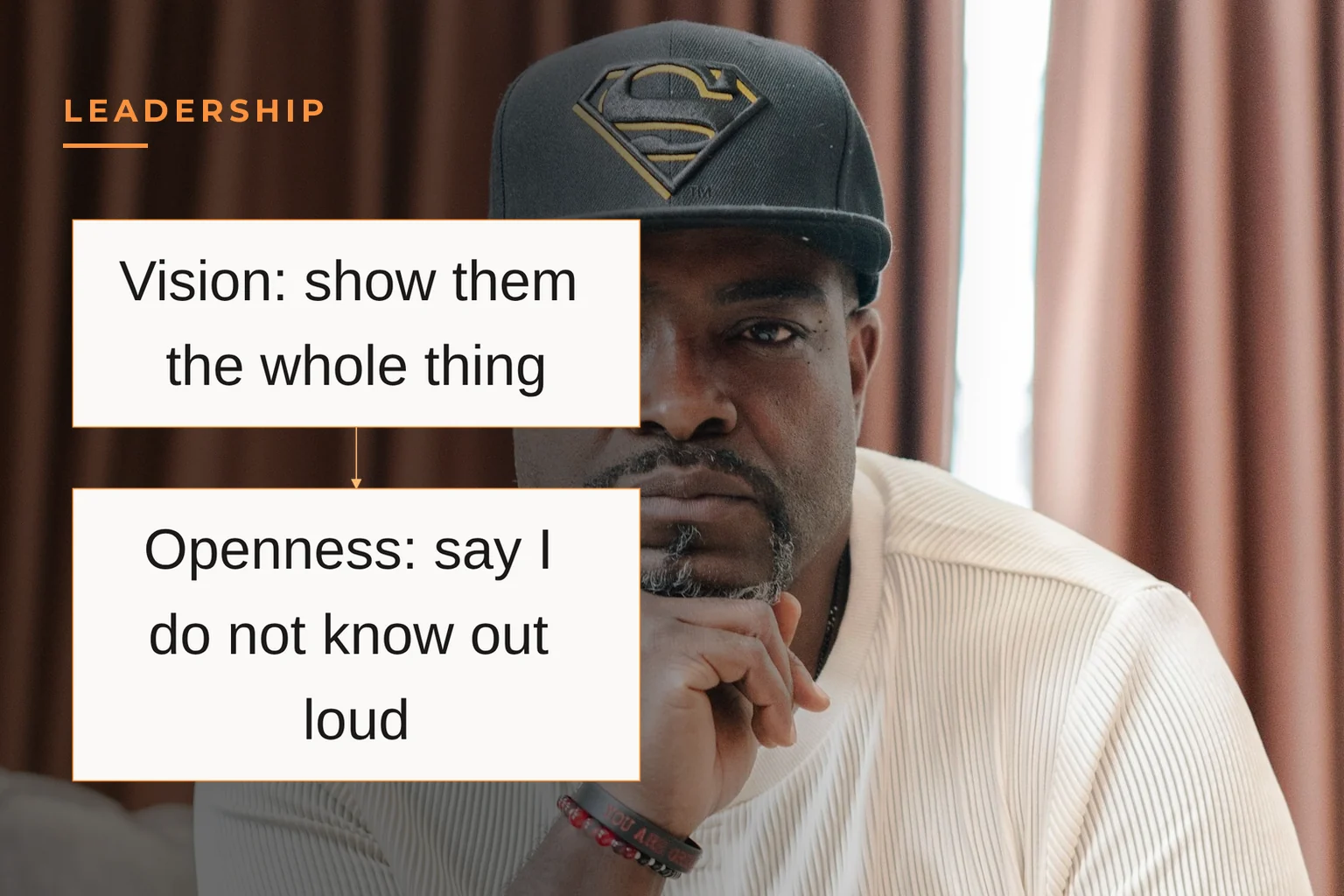
Vision is the cheapest. It is also what makes the other two possible. Nobody owns a decision inside a thing they cannot see.
Openness is the most expensive. It is the leg leaders quietly hop past, and it is the one that decides whether the other two are real or theater.
Asking great questions is the one that does the work. When the unfinished thing arrives, the rescue is a reflex. The question is a decision. What would you do next? What do you need from me? How will you know it worked? What version of this would you defend?
The mechanic underneath all of it is the CASE Method. This piece is about the layer below the mechanic, the layer that decides whether the mechanic survives a bad Tuesday. And the strange reward for asking instead of answering: you end up coaching yourself, because eventually you are the only person in the room holding a question and nobody left to hand it to.
The leg nobody wants to stand on
Vision costs you the time it takes to say it out loud. Openness costs you the thing you have been trading on since the day you got good at this.
Here is the moment. A decision is on the table and you do not know the answer. The person across from you knows more about this piece than you do, and they are waiting to hear what you think. The easy move is to say something confident. Anything. You have a habit of being the one who is right, and breaking a habit in public has a price.
So say it anyway. Out loud. To someone who reports to you: I don't know.
Watch what happens in your body when you imagine that. The heat in the chest. The urge to add a qualifier, then a guess, then a small instruction that takes the edge off the admission. That reflex is the thing you are rewiring, and it does not go quietly. The first few times, the silence is loud enough that you will want to fill it with anything at all.
Here is what you are afraid of. That they will think you are a fraud. That the person who signs off on everything does not know, and that once they see you do not know, the whole arrangement gets thinner.
Here is what actually happens. The person in front of you exhales. If you can say it, they can say it, and the half-built bridge just moved one step closer to your desk. A team that cannot say "I am stuck" to you will never say "I disagree" with you either. And the failure you most want to hear about early is the one they will only bring you if they are not busy performing for you.
If you fix nothing else this year, fix this leg, because the other two do not survive without it. You cannot ask a great question from behind a performance. The question only lands if the person answering it believes you will still respect them after they tell you the truth.
The jerk who said the thing
Now the harder story, because it costs me something to tell it.
A business owner I worked with, and a mentor, was a man I did not like. I will be plain: an absolute jerk. He was standing in front of a room of overachievers, people like us who cannot stop doing the thing we are good at, and he said the most profound thing I have heard on the subject.
Every 120 days, replace yourself. Anything you are doing now, in 120 days, stop.
I want to be honest about what happened in me next, because the instinct arrived before the insight did.
The instinct was to file the sentence under the man. He was wrong about plenty. He was arrogant about the rest. And if I let him be wrong about everything, I get to keep my Tuesday exactly as it was, my desk exactly as it was, and my story about myself exactly as it was. Discount the messenger and the sentence walks out of the room with him, free.
That trade is the whole danger, and it is quiet enough to call discernment. What you actually did was protect the identity that every one of those jobs still runs through.
The sentence did not need my respect for him to be true.
So I did it. For years. And here is the part people underestimate: there is a lot of work I used to do that I no longer have any clue how it gets done.
That is the finish line. Not the handoff. The forgetting.
What it costs, and why you will take it back anyway
Let me say the thing the process articles skip.
You are not afraid your people will fail. You already know they will. You are afraid of the bill, because when it breaks in their hands it still has your name on it. Your client. Your deadline. Your reputation.
The bill arrives either way. Every task you keep on your own desk is a bill that lands later, larger, at the worst possible moment. You are only choosing which one you pay.
And the cost is not time. It is identity. You are the person who gets it done. That is how you got here. Letting something be worse than you would have done it, on purpose, for longer than is comfortable, does not feel like leadership. It feels like loss.
You will relapse. Some Tuesday something catches fire, you reach in, and you call it triage. Fine. The rule is that you name it out loud when you do it. Named, it is a decision. Unnamed, it is how you lead.
Two places to not do this:
Not where the failure is unrecoverable. A promise you already made to a client. Money that is not yours to lose. Anything where the damage does not stay in the building.
And not with the person who just walked in the door and has no context. Start with the person who has done it correctly for a year and is bored. The failure has to be small enough to be tuition.
The same Tuesday, two ways
| Inconsistent | Consistent | |
|---|---|---|
| What you hand over | the task and the steps | the judgment and the standard |
| What you keep | the outcome and the blame | the question |
| When unfinished work arrives | you finish it | you ask what they would do next |
| When it breaks | they learn you will fix it | they learn where the edge is |
| What you say when you do not know | something confident | I don't know, what do you see |
| In 120 days | it still runs through you | you cannot describe how it gets done |
| What they become | a helper | an owner |
120 days from this morning
Pick the thing. Right now. The one task on your plate you have quietly decided you will own forever.
Write down today's date. Add 120 days. That is the day you stop. Not the day you hand it off. The day you cannot describe how it gets done.
Then run all three legs on that one thing.
Show them the whole picture, so the decision is not a guess inside a fog. That is vision, and it is the cheap part.
Then say what you do not know, out loud, before they ask. Not after they catch you. First. That is openness, and it is the part that costs you. It is also the only thing that buys you the truth for the next 120 days, because a person who has heard you admit a gap will bring you the gap in the work.
Then ask the question instead of giving the answer, and stay quiet long enough for their answer to be worse than yours. Watch it be worse. Do not reach in. That is the discipline, and it is the part that does the work.
And for the person you have been telling for years, the one who will not hear it from you: stop telling. Put them somewhere they can do the thing themselves, in front of other people, and be in the building when they turn around.
One afternoon in a room did for my daughter what five years of her father could not.
I was right the whole time. It was never mine to deliver.