The Conversation You're Avoiding Doesn't Need a Script. It Needs a Sparring Partner.
By Atiba de Souza
The meeting still sitting in your queue
You know the one. The direct report whose performance you've been "monitoring." The client you should have fired two renewals ago. The cofounder conversation about the thing neither of you has said out loud. You tell yourself you're waiting for the right moment.
You're not. You're waiting until the outcome is certain, and outcomes in a conversation with another human are never certain. That's the actual thing you're avoiding. Not the words. The not-knowing what comes back at you.
Most leaders solve this the wrong way. They open AI, type "help me write what to say when I tell my head of sales he's off the account," and get a paragraph back. Polished. Reasonable. Useless the second the actual person says something the paragraph didn't anticipate.
That's the whole failure in one move. You asked for a script. You needed a rehearsal.
What happened in my own hiring pipeline
Every candidate we screen answers the same set of questions on video before anyone talks to them live. The point is to hear the person before we meet them.
We started noticing the videos were nearly identical. Same phrasing. Same structure. Same examples. Candidates had fed our questions to AI, gotten an answer back, and read it on camera.
One candidate's written answer arrived with the AI's own closing line still pasted at the bottom, an offer to draft more follow-up answers if needed. Nobody scripts that in. It's the fingerprint the shortcut left behind, and it's the only reason we caught it at all.
Before that submission, we were quietly comparing one AI's output against another AI's output and calling it a hiring process. The fix was a timer: the candidate sees the question for the first time at the moment they have to answer it. That's not a hiring hack. It's the entire design principle behind rehearsing a hard conversation. The value was never in the polished line. It was in watching what a person does when they don't get to prepare the line in advance. A pre-written answer to a question you haven't heard yet proves nothing. Neither does a script for a conversation the other person hasn't had yet.
The conversation isn't hard because of what you'll say. It's hard because you don't know what happens after you say it, and that's precisely what a rehearsal can show you before the room does.
The order window and the colleague
Here's the distinction that decides whether AI helps you or just hands you a nicer script.
Ask AI a bare question, "what do I say when I fire someone," and it can only answer the question you asked. It has no idea who you are, who this person is, what's actually at stake, or what you're afraid will happen. It hands you the item you ordered. Nothing more.
Role brain: the context you give a model about who you are, who the other party is, and what's actually on the line. It's what turns the model from a vending machine dispensing the thing you asked for into a colleague who argues back about whether you're asking for the right thing at all.
Give AI a role brain, and the exchange changes shape. Instead of "write me a script," you say: "You are my CFO. I'm about to tell him the Q3 numbers don't support his headcount request. He's going to push back with the hiring commitments he made to his team last month. Play him. Don't let me off easy." Now it isn't handing you an order. It's arguing with you, the way the real person will.
The default behavior of any model is to answer the question literally asked. That's not a flaw you route around with a cleverer prompt. It's the starting condition, and changing it is a setup job you do once, not a trick you perform every time.
The moment I learned it could do more than I asked
I needed a section of a Zoom recording cut, Rob's part removed. I opened a session with Athena, my AI partner, to ask how that would be done. I was asking for the procedure. Ask a search engine that question, or a normal assistant, and you get back a set of steps: open the timeline, find the timestamps, split the clip, export. Correct, and still your editing job, sitting in front of you, untouched.
She didn't give me steps. She went and found where Rob started talking, found where he stopped, cut the video, and handed me the finished file. I didn't know she'd be able to do that. I was asking for instructions and got the actual work back instead.
That's the shift the hard conversation needs too. Stop asking how. State what you actually want, and keep asking for things you assume it can't do. "Give me a script for the layoff conversation" is asking how. "Be the employee, react the way she actually will, don't soften it for me" is stating the outcome. The gap between those two requests is the entire gap between a document you read from and a rehearsal that changes how you walk into the room.
Running it through the Agentic AI Diagnostic Sequence
This isn't a one-off trick. It's the same diagnostic I use to decide whether and how to build any AI into real work, applied to the piece of work you keep sitting on.
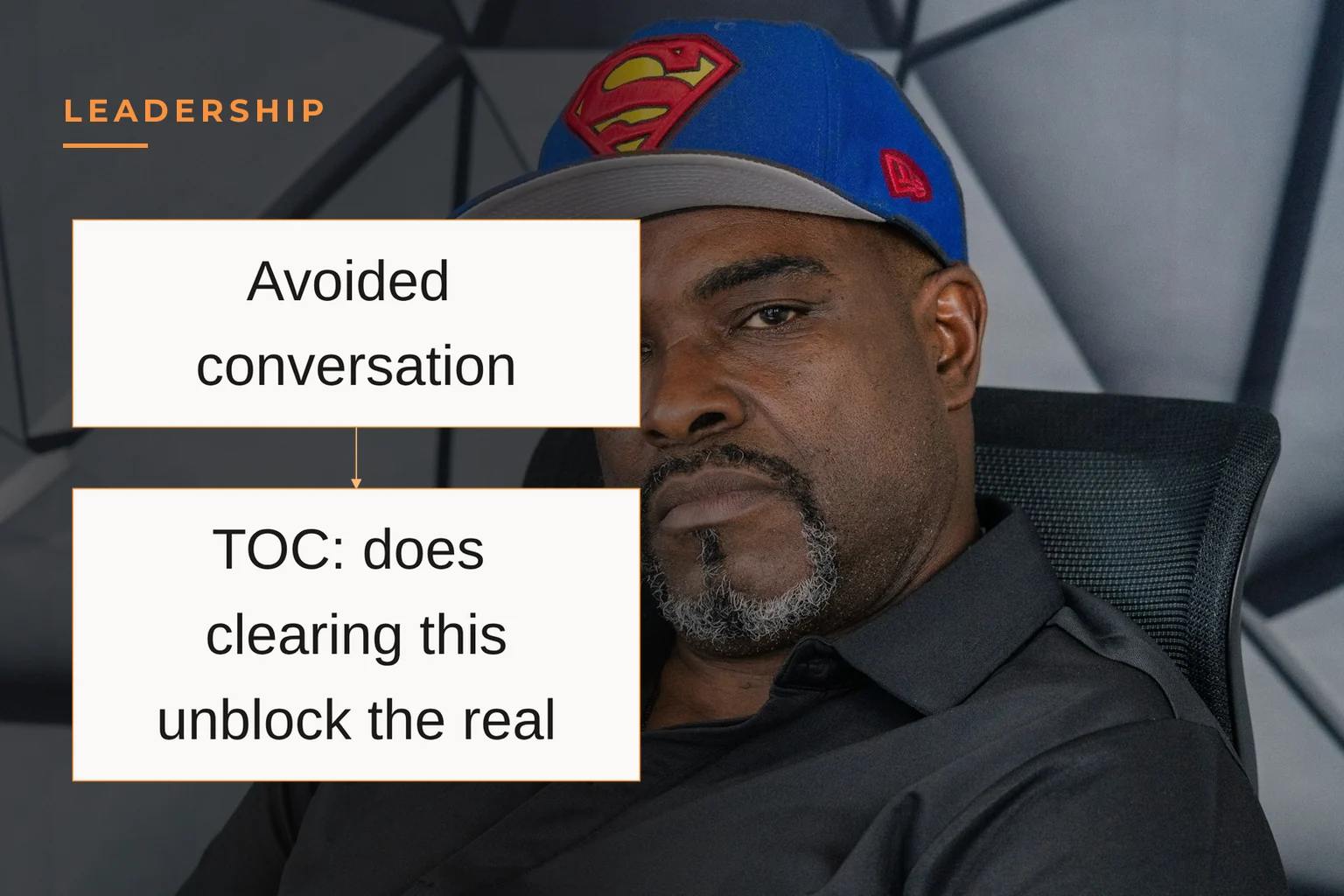
Step 1, Constraint (TOC). Before you rehearse anything, ask what this conversation is actually blocking. Is the avoided conversation the binding constraint, or is it a symptom of one somewhere else, a role that shouldn't exist, a strategy nobody actually committed to? If clearing this conversation doesn't unblock the real bottleneck, you're polishing the wrong lever, and the rehearsal is expensive procrastination with better production values. This is also where you decide how much rigor the thing deserves. A termination or a board disclosure earns the full sequence. Correcting someone's tone in a Slack message does not. If you find yourself building a diagnostic canvas for a two-line correction, stop, you've confused the tool with the problem.
Front-end triage, before Step 2. Run it through Eisenhower.
| Important | Not Important | |
|---|---|---|
| Urgent | Q1: do now, rehearse today | Q3: question why it's urgent at all, or hand it off |
| Not Urgent | Q2: schedule it, this is almost certainly where your avoided conversation lives | Q4: eliminate |
Q2 is the honest diagnosis. It's important, nothing is forcing it, so it doesn't happen. Not busyness, not timing. Rehearsal is how you manufacture urgency on your own terms, before a Q2 item turns into a Q1 crisis, the resignation you didn't see coming, the client who walks without a call.
But check Q4 before you go further. Some conversations you've been avoiding don't deserve a rehearsal, they deserve elimination. The feedback that doesn't matter anymore because the project ended. The confrontation that exists only because you're conflict-avoidant, not because anything is actually at stake. If it's genuinely Q4, don't build a role brain for it, delegate it, drop it, or let it go. Rehearsing a conversation that should never happen is just procrastination with a better rehearsal partner. This is also where "match the rigor to the stakes" actually lives, not as a caveat you read at the end, but as the filter you run before you build anything.
Step 2, Role. For what survives triage, define who plays what. You hold the leader role. AI holds the counterpart role, played straight, with the role brain you gave it.
Step 3, Work Type. Strategic work, deciding whether and why to have this conversation at all, stays yours. Tactical work, sequencing, tone, what to say first, is where AI sparring earns its keep, but it doesn't get the final call. Analytical work, surfacing the objections this specific person will actually raise given their incentives and history, is where AI is genuinely strong.
Step 4, AI Employee concept. Its job description isn't scriptwriter. It's adversarial counterpart, an employee whose only function is to make you uncomfortable in a safe room before the real room does it for free.
Step 5, PRD. Write down, even just to yourself, what a successful rehearsal produces. Not a clean line you're proud of. The moment you get flustered. If you never get surprised, you haven't rehearsed the conversation, you've rehearsed the version of it you already wanted to have.
Step 6, Build. Run it. More than once. Tell it to escalate the pushback each round instead of settling. And know what this step does not do: it does not make the outcome certain. You will still walk into the real room not knowing exactly what comes back at you. The rehearsal doesn't remove that. It just means the first time you feel the discomfort of the unknown answer isn't in front of the person whose answer actually matters.
Rank these before you touch the tool
The role brain is the whole thing. Everything else in this sequence is scaffolding around that one move. If you skip context and go straight to "write me the script," none of the rest matters, you're back at the order window.
The elimination check is the second most important thing here, and the one people skip because it feels like giving up rather than deciding. It isn't. Recognizing a Q4 conversation and killing it is a harder call than rehearsing it, because rehearsing feels like progress and eliminating feels like avoidance. It usually isn't. Ask yourself honestly which one you're doing.
The full six-step sequence, with the org chart and the PRD, is for conversations with real weight. It is overkill for the rest, and building it for the rest is its own form of avoidance, a very sophisticated way of not having the conversation while looking productive.
Watch for one more failure mode. The rehearsal that was supposed to get you to the real conversation can quietly become the new way you avoid it. Four nights of practicing the fight is not progress if the meeting still isn't on the calendar. Put a deadline on the rehearsal, not just on your patience.
| Inconsistent: script request | Consistent: role-brain rehearsal |
|---|---|
| "Write what I should say to fire him" | "Be him. React the way he actually will. Don't let me off easy." |
| One clean paragraph, read once | Multiple rounds, escalating pushback |
| Applied to every avoided conversation, regardless of stakes | Filtered through TOC and Eisenhower first, some conversations get eliminated, not rehearsed |
| Success = it sounds good | Success = you get surprised at least once, and you still don't know exactly what happens next |
Related reading
<!-- cluster-links:end -->Questions