He Left With the Perfect To-Do List. Zero Percent of It Got Done.
By Atiba de Souza
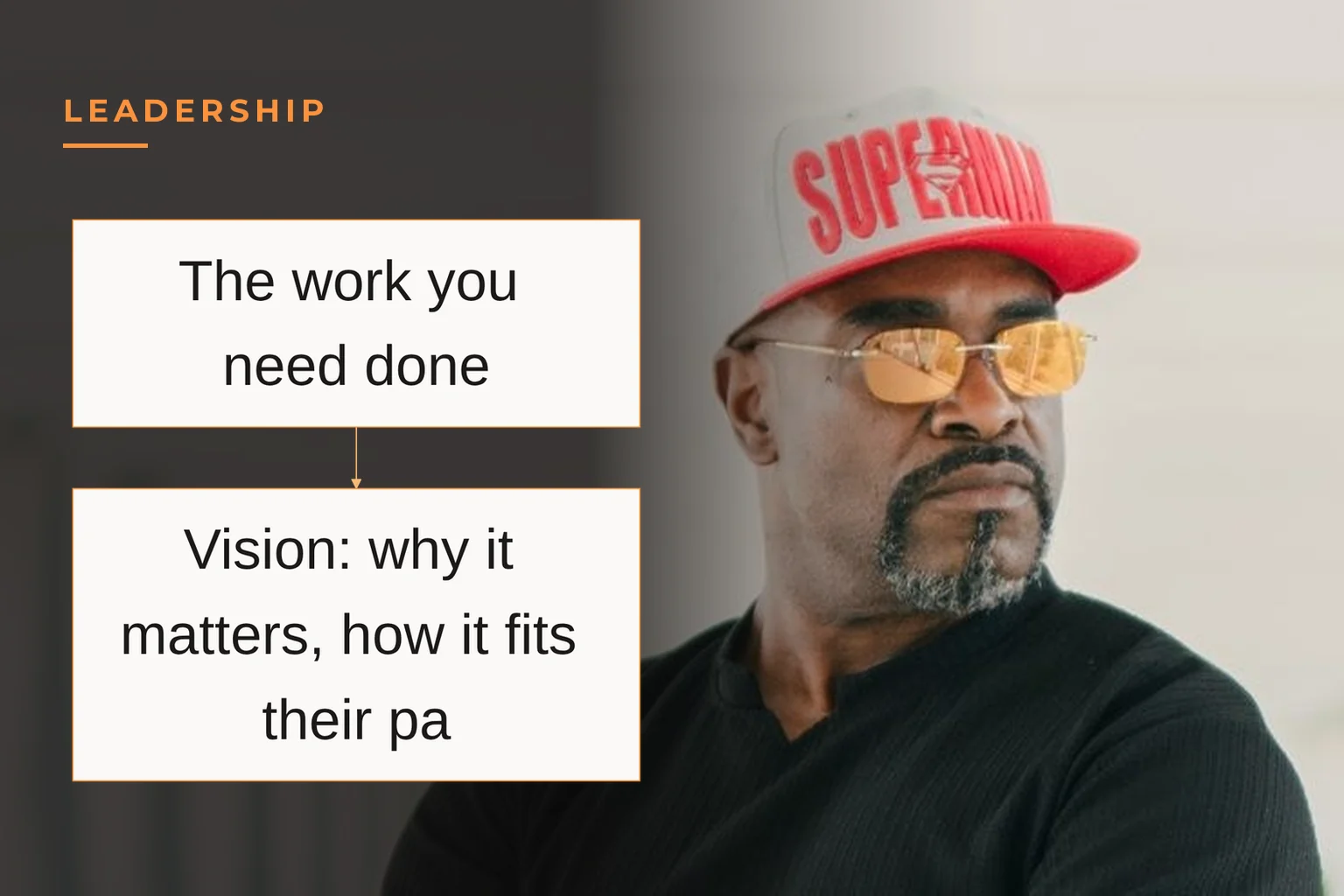
The list that lost
A doctor I was working with was planning an open house. Before he left for a week and a half of vacation, he gathered his team and handed them a list. The open house was four or five weeks after he got back. Here is everything that has to be ready by then. This, this, that, this.
Then he got on a plane.
Guess how much of it got done. All of it? Half? Drop your guess before you read on, because the guess tells you something about how you delegate.
Zero. Zero percent of the list.
He came back frustrated, and I would have been frustrated too. So I asked him one question. What did you tell them?
He said, "I gave them the to-do list."
There it is.
His team wasn't lazy. They did all of the work they knew they were paid for. The list never beat it. It couldn't. It had no reason attached, no place in the picture, no way to compete with work that already had a claim on their day. So it lost, quietly, every single day he was gone.
The failure wasn't in the team. It was in the handoff.
Zero percent. Not because the team didn't care. Because a list with no why has no rank, and unranked work always loses to the work people know they are paid for.
What survived the editing
Here is what nobody tells you about a to-do list.
A tidy deliverable is the part of someone's thinking that survived editing. Everything that made the list make sense got cut on the way to a clean bullet: the why, the tradeoff, the thing you were worried about, the reason it has to happen now and not in six months.
So the thinking isn't in the package. The thinking is in the half-built bridges. The version you started and dropped. The two options you killed and the reason you killed them. Principles and frameworks show up in the abandoned work, not the finished work. Ask someone for the package and you get the logic. Ask for the half-built bridges and you get the thinking, and you get the emotion attached to it, which is the part that tells you what they actually care about.
And one abandoned bridge isn't a personality. What a person consistently does is only visible across the unfinished attempts, plural. One dropped idea is an anecdote. A pile of them shows you the pattern: what they keep circling, what they keep killing, what they never start.
Which brings me to the thing I want you to sit with. The doctor didn't just hand over a list. He had never shown that team a half-built bridge in his life. They had no pattern to read. They had a list.
Delegation: transferring the thinking that makes the work make sense, not the tasks that make up the work. If the person on the other end can't decide inside it without you, you didn't delegate it. You rented it.
Delegation Leadership: delegate thinking, not tasks
This is the model underneath The Delegation Trap. The CASE Method is the mechanic. This is the worldview that makes the mechanic work.
Delegation Leadership has three legs, and they are the same three things a leader is, aimed at a team: vision, openness, great questions. The destination is ownership, where a person treats the outcome as theirs instead of treating the task as yours.
Three legs, and every one of them will cost you something. I'm going to put the cost next to the leg, because a framework handed over without its price is a framework you'll abandon the first busy week.
Vision is the rank
A team can't prioritize what it can't place. Vision is not a motivational speech. It is the information that lets someone put your request next to the work they already do and decide which one wins today.
The doctor's team never got that. They got tasks. So when the day got busy, the tasks had nothing to stand on.
Now the objection, and it isn't stupid. You don't have time to explain. Writing the why costs you the evening you were going to spend on something else, the payoff doesn't show up for weeks, and nobody thanks you for it. The list takes minutes and feels like progress. That's the trade on the table: the cheap thing now, or the expensive thing later. The doctor paid for it with an open house.
If you sit down to write the why and it isn't there, go look at what you abandoned. Your principles are in the dropped drafts, not the polished deck. You'll find the reason faster in the wreckage than in the summary.
Openness is the half-built bridge
This is not a feelings exercise. It's an information exercise.
Openness means showing the part you haven't solved. The tradeoff you're still weighing. The risk you're carrying. The reason you're doing it this way and not the obvious way. That's the half-built bridge, and it has two halves that both matter: the logic of it, and the emotion attached to it. The thing you're worried about looking foolish for. The reason the safe option makes your stomach tighten. That second half is data. Withhold it and your team gets your conclusions without your judgment.
Here's what it costs. You get to be wrong in front of people who take direction from you. Someone hears the uncertainty and takes the safe road. Someone takes your dropped idea and runs somewhere you didn't want it to go. In some rooms, openness gets collected and used later. Know your room. I'm not going to tell you it's a free move, because it isn't.
And one honest moment isn't openness. It's a gesture. Your team cannot build a model of how you decide from a single data point. They need the pattern, which means months of it, including the attempts that went nowhere, which is exactly the pile you'll be tempted to delete.
Great questions make them coach themselves
The first two legs get your thinking into the room. This one keeps it there after you leave.
Instead of answering, ask. What would you do here? What would make that wrong? What am I missing? You are not withholding the answer to be clever. You are building the muscle that will be in the room when you aren't.
The cost here is speed, and it's a real cost. You will ask, and they will hand you something worse than the answer you already had. You then have to let it stand and watch it be worse. The muscle gets built on bad answers. If you step in every time the answer is bad, you didn't build a muscle, you built a habit of waiting for you.
The result, when it comes, is the thing every leader says they want and few build: a person who coaches themselves.
The market will sell you the wrong version of this
Eight weeks before I wrote any of this, I went to Claude Code with an operating problem, not a software one. I wanted the agency to work three weeks a month and take the fourth off. I wanted to know what would have to be true for that to hold.
It never gave me the plan.
It kept asking me questions. About my philosophies. My frameworks. How I thought. What came out of it wasn't the plan. It was a brain of me. Then the project manager side started sending me a morning brief of what actually needed doing across every project, and my mind went quiet for the first time. Not because I was done. Because I didn't have to hold all of it anymore. It was all there, and it was an extension of my brain, this thing we now call Athena.
I went in for a plan and came out with my own thinking, outside my head, where other things could work with it.
And here's what I know now that I didn't know then: buying one of the assistants on the market would have cleared the routine work I was already not doing and left the level that moves the needle exactly where it was. In my head.
Tools that take tasks off your plate make the plate lighter. They don't move the thinking. The plate was never the problem.
Inconsistent vs consistent
The framework isn't hard to understand. It's hard to keep doing. This is the table to check yourself against, because nobody applies this wrong on day one. They apply it wrong on the busy day.
| Applied sometimes, when the week is calm | Applied consistently, including the busy week | |
|---|---|---|
| Vision | The why shows up when you remember it, and vanishes when you're behind | The why is at the top of the handoff every time, including the boring handoffs |
| Openness | One honest moment, then back to finished packages | A steady stream of half-built bridges, including the abandoned ones |
| Questions | Ask when there's time, answer when there isn't | Ask first, especially when asking is slower |
| What the team learns | That your requests are instructions | How you decide, so they can decide without you |
| While you're away | The list decays and the paid work wins | The judgment stays in the room |
| What it costs you | Nothing now | Slower now, exposed now, uncomfortable now |
When not to do this
This is the shortest section on purpose, because it's the smallest part of the idea.
Not every task deserves the full treatment. If the work is single step, reversible, and needs no judgment, book the room, send the file, forward the intro, just hand it over. No vision required. Building a speech around a two-minute task is theater, and it trains people to wait for a speech before they act.
The model is for work that requires a decision when you're not in the room. That's the line. Everything above it gets the thinking. Everything below it gets the list.
If you only do one thing
Vision carries most of the weight. If you do nothing else this month, write the paragraph before the list. Why this, why now, how it connects to what they already get paid for. That single move is the difference between the doctor's vacation and a team that runs while you're gone.
Now the part I can't hand you a clean answer for.
The objection nobody says out loud is this one: if they can do the thinking, what am I for? Handing over the thinking feels like handing over the reason you're the leader. I can tell you your job moves up a level, set the vision, stay open, ask the questions, and that it's a promotion. I can tell you that and you still won't feel it for a while. For the first stretch you'll be slower, less sure, and watching someone do a thing you could do faster. That feeling doesn't evaporate because I named it. You just get to decide what it means while it's sitting there.
Ask and it stays slow. Don't ask and you're back on the plane with a list, and the list is going to lose.
<!-- cluster-links:begin -->