Nobody Was Signing Up. They Asked Me for Tracking Codes.
By Atiba de Souza
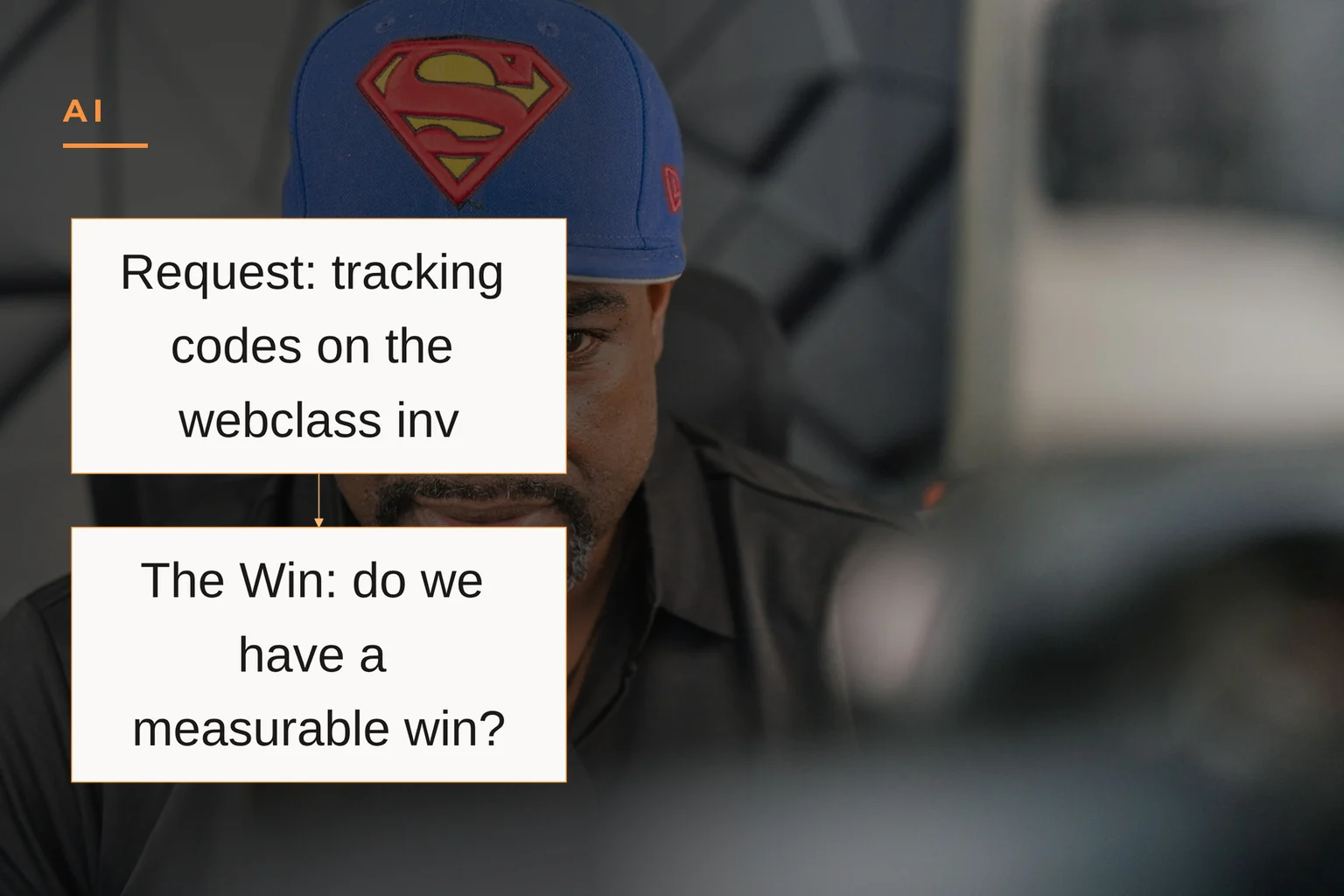
The Request
A few months ago, two members of my marketing team came to me with a specific ask. They each wanted their own tracking code on the webclass invitations, so we could see which of them was driving more clicks.
I said no.
Not because tracking is wrong. Because nobody was signing up. Knowing where a click came from when the click leads to an empty room is not measurement. It is decoration. And decoration on a stage that is not losing you anybody is the most expensive kind of busy there is.
So I asked the question I now ask almost every week: where is the actual constraint?
2 team members asked me for tracking codes while sign-ups were at zero. That is not a discipline problem. That is what a team does when nobody has named the constraint.
The Word the Whole Thing Turns On
The Constraint: the one step in the customer journey that is actually losing people right now. Not the step that is easiest to measure. Not the step that is most fun to work on. The step that is costing you the customer.
Those two were not being lazy. They wanted proof their work was working, which is a reasonable thing to want. The problem was never their intent. It was the stage they pointed it at. Nobody was signing up, so knowing where clicks came from would prove nothing. The constraint was further along the journey than the click, and nothing we built at the front of it was going to move it.
They measured the thing in front of them. It is what any of us do when nobody has said which step is failing.
The Framework: the 7 Practices of Effective Marketing
I teach the 7 Practices of Effective Marketing as a sequence, not a menu. The first three are the ones that decide whether an asset should exist at all: The Win, Thinking Steps Not Tactics, and Narrow the Focus. Skip them and everything downstream is motion, and motion is easy to mistake for progress right up until the quarter ends.
Here is each one, plus the part nobody puts in the slide.
1. The Win
Every game has a way to score, and everyone playing knows what scoring looks like. Marketing is no different. Before any work begins, the win has to be defined in terms that can be measured. Not "build the presence." Not "get the name out." A measurable outcome, for the specific people you need to move. If your win is clicks or general awareness, you have defined a scoreboard for a game that is not the one you are playing.
Now the cost. Naming the win removes your team's undefined output, and undefined output is where visible effort lives. A vague mandate lets everyone produce something that looks like progress. A defined win makes output refusable, including work someone stayed late for. When a person hears "this does not trace to the win" about a thing they sweated over, it lands as judgment. It is not judgment. It is the win doing its job. But they will not feel that on day one, and you should not expect them to.
You pay too. The moment the win is written, you cannot hide behind a busy team. You are on the hook for a number.
The replacement artifact: one sentence with a number in it, at the top of the brief, written for the people who actually need to sign up. Review that sentence instead of reviewing volume.
2. Thinking Steps Not Tactics
The instinct is to jump straight to funnels, ads, launches, campaigns. That is backwards. Before a tactic is considered, the logical steps required to reach the win get mapped in order. Tactics are how you execute a step. They are not a substitute for the step. A webinar is not a strategy. A content calendar is a list of tactics wearing a strategy's coat.
The cost of this one is exposure. Ask "which step does this serve?" and you find out fast whether the map exists. When it does not, the honest answer is "I don't know," and the person in the room who is supposed to know is usually you. That is the real reason teams skip the question. Approving the tactic and keeping the meeting pleasant is cheaper in the moment.
It also puts work already in flight under a light it was not built for. Some of it will not survive, and someone will have to say so.
The replacement artifact: an ordered list of steps from where you are to the win, with dependencies named. Written down. Read at the start of a piece of work, not at the end when the work is already built.
3. Narrow the Focus
At any moment there is usually more than one important thing competing for the team. Narrowing is not picking the shiniest one. It is picking the one that touches the constraint you just named, and writing down what you are deliberately not doing so nobody quietly does it anyway.
This one hurts in public. Naming one constraint and parking the rest feels like loss because it is loss. Somebody's idea just got shelved in front of them. If you have ever watched a person hear "not this one" about work they care about, you know the temperature in the room drops.
So do not soften it and do not skip it. Say what is parked, out loud, and say why. Parked is not deleted. Seen is not chosen.
The replacement artifact: one constraint, named and written, plus a parking list that gets read out loud.
Now Run the Request Through It
Back to the tracking codes. Three questions, in order.
The Win. Sign-ups. There are zero. Not clicks. Not impressions. Not awareness. The people we need are the specific people who would sign up for the webclass, and none of them did. A win that does not name those people is not a win, it is a mood.
Thinking Steps Not Tactics. Click-source tracking is not a step in the journey. It is a measurement bolted onto an early step. The step losing people was further along.
Narrow the Focus. Does click-source tracking touch the constraint? No. Run it to the end: even if the tracking worked perfectly, even if we knew exactly which of the two drove more clicks, sign-ups would still be zero.
Decision: no tracking. Not until the constraint is named.
And look at what a yes would have produced. Two people optimising a stage that was not the bottleneck, competing over clicks while the room stayed empty. They would have worked hard. They would have had data. Nobody would have signed up.
The Second Story, Which Was Mine to Own
July, on TrueMD's marketing lane. I own marketing for the three-founder venture, and my team was building its LinkedIn presence and assets.
Work started getting dropped. Assets started appearing that made no sense to me. Not badly made. Off. I would look at something and think, why in the world are we saying this?
So I traced it back, expecting to find a performance problem on my team.
Most of the people doing the work had never been told what TrueMD actually is. Only a subset knew. I had assumed everyone did.
That is the whole trace. Dropped tasks and off-target assets, and underneath them a group of people who could not have aimed correctly because nobody had written down the target.
Had I written down what TrueMD is and walked the whole team through it before any work started, the dropped tasks would not have dropped and the wrong assets would never have been produced.
So before your team produces anything for a new venture, write down what the venture is and confirm every person working on it has read it. Not the subset you happen to speak with. Every person. Then ask them to say it back to you in their own words. That answer tells you more than any dashboard, and it costs you one meeting.
All marketing is communication. My team was not failing to produce. They were producing against a message I had never finished writing.
The Answers Teams Bring, and How to Test Them
Ask your team where more clients come from and watch what arrives. Three answers dominate: a new service, more awareness, better sales conversion.
Test each one by imagining it completely solved and asking what would actually change.
A new service. Adding a service does not create customers. It creates something else nobody knows exists. You have added an item to a list nobody is reading.
More awareness. A million of the wrong people knowing your name changes nothing about the constraint. Awareness pours volume into whatever step is already broken, and it makes the failure bigger and faster.
Better sales conversion. You cannot have a sales conversation without leads, so a sales-conversion answer is usually a lead answer in disguise. Ask where a lead stops moving, and whether the answer is a sales problem at all.
None of those are stupid answers. They are the answers you get from a team that has been asked for output instead of asked for a question.
The Two Teams, Side by Side
| Inconsistent | Consistent | |
|---|---|---|
| The win for a new venture | A presence to build and assets to produce | A measurable outcome for the specific people who need to sign up |
| A tactic request from the team | Add the tracking code and see where clicks come from | Ask which step of the journey it serves before it gets built |
| When sign-ups are at zero | Measure the stage before the one that is losing people | Name the step that is losing people and work there |
| A new venture's first brief | Work starts and the definition stays in the founder's head | What the venture is, written down, read by every person on the work |
| What the leader reviews | The calendar | The win, the steps, the named constraint |
What Replaces the Calendar
Content is visible. A question is not.
You have now seen the three costs. The win makes output refusable. The step question puts you in a room without a map. The constraint makes you say no, out loud, to people you like.
Small costs, and they compound. Together they take away the only evidence of effort anyone outside your team can see. So if you remove the calendar and put nothing in its place, your team will go back to producing, and they will be right to. You will have told them what you actually value.
The replacement is not inspiration. It is artifacts. The written win. The mapped steps. The named constraint, plus the parking list, read out loud. Put those where the calendar used to be and review them the way you used to review output. That is the leadership choice in all of this, and it is a choice about what you look at, not what you say.
Here is how to know where you stand. Pull your team's last three pieces of work. For each one, write down the win it served, the step it executed, and the constraint it touched. If you can fill in all three, you have a marketing team. If you cannot, you have a team that is being measured on the wrong thing, and the next conversation is not about more content.
It is about better questions.
<!-- cluster-links:begin -->