Stop Asking AI to Make Your Offer Sound Good. Ask It to Prove Nobody Needs It.
By Atiba de Souza
The Videos That Gave Themselves Away
I screen job candidates by sending everyone the same interview questions to answer on video before we ever talk live. The point is to hear the person before I meet them.
The videos started coming back identical. Same structure, same phrasing, same rhythm of answer. People were feeding my questions to AI, probably pasting in the job description too, and reading back what it handed them.
One candidate didn't even bother deleting the tell. Their written answer had AI's own closing line still pasted at the bottom, offering to draft more follow-up responses.
Here's what that screening stage had quietly become: one AI's answers being compared to another AI's answers, while I believed I was reading people. Nobody catches it, because nobody's looking for it. The fix wasn't complicated. Put a timer on the answer, so the question gets seen for the first time at the moment it has to be answered. No pre-digesting. No polish borrowed from a machine that has never met the job.
That failure isn't about hiring. It's about every offer you've ever asked AI to help you write.
The Question You're Not Asking It
Most people use AI on their offer the same way my candidates used it on my questions: they feed it the polished version and ask it to make the polish shinier. Better headline. Tighter value prop. More persuasive close. AI is extremely good at this, which is exactly the problem. It will hand you back something that reads well and proves nothing, the same way it handed my candidates an answer that sounded like a person and was actually a template.
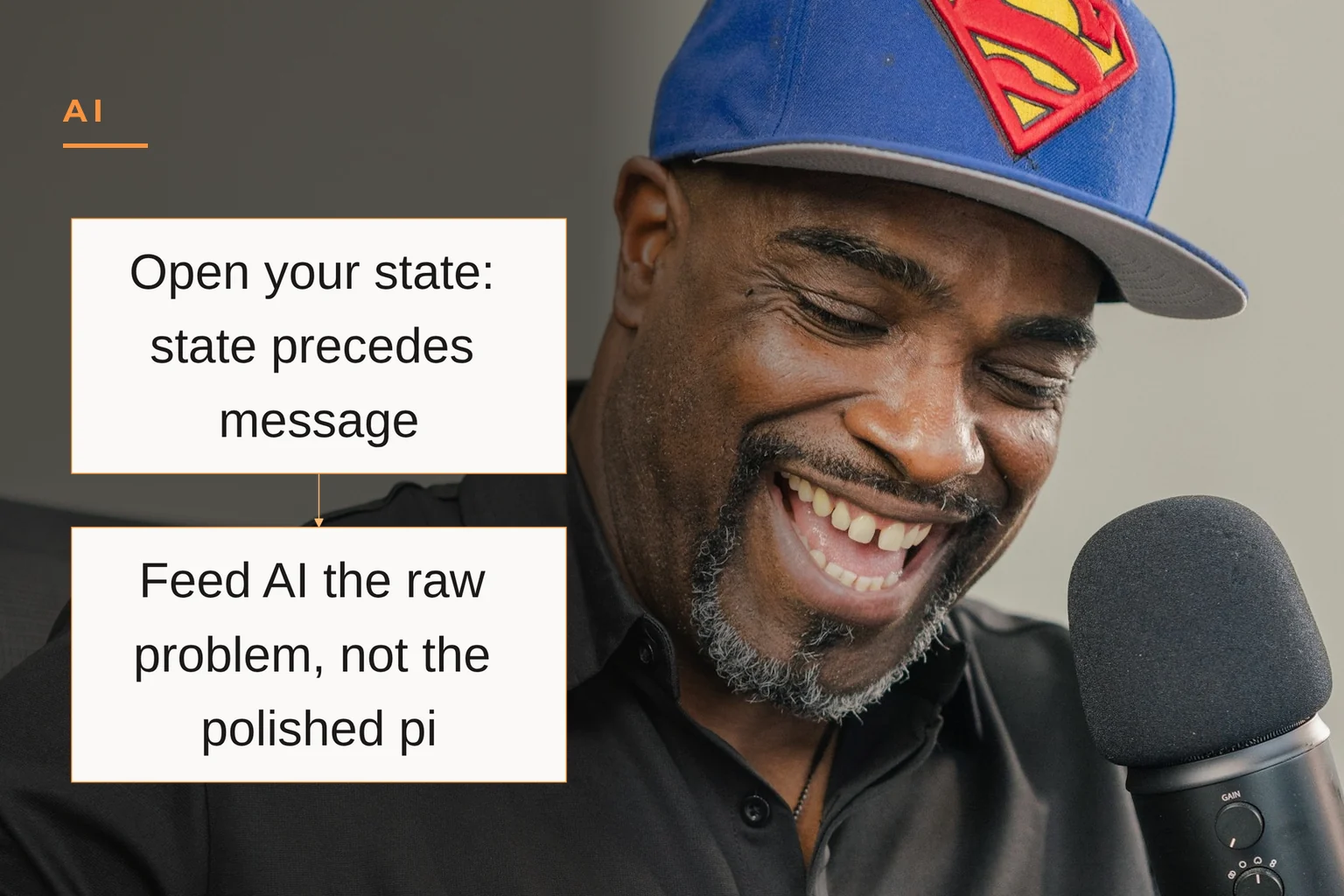
The first of Atiba's Selling Principles is state precedes message. You cannot move a mind whose state is closed. Attention and openness are physiological before they're rational. Everyone teaches this about the buyer. Nobody applies it to the seller sitting at the keyboard, asking AI to help.
If you open that chat window already certain the offer is right, and you only ask AI to help you say it better, your state is closed before the first prompt goes in. You're not testing the offer. You're decorating a decision you already made. The message AI gives you back will be persuasive to exactly one person: you. Everything below is one principle, worked through a framework, worked down into a disposable tactic. Get that order backward, lead with the tactic instead of the state, and the tactic is worthless.
State precedes message: the mind has to be open before it can be moved, and that openness is decided before a single word of the pitch is written or read. Skip it, and you're not testing anything. You're rehearsing.
Assistant vs. Second Brain
An AI assistant clears your inbox, drafts your copy, formats your deck. It buys you time. What it does not do is touch the work where the needle actually moves, because the tasks it took off your plate were mostly tasks you weren't doing carefully anyway. That's why the time it hands back always feels smaller than the pitch promised.
Challenging your own offer is needle-moving work. It lives at the level a second brain operates at, not the level an assistant operates at. An assistant will happily make your value prop sound better. A second brain would stop and ask whether your state is even open enough to hear the answer if the offer fails the test.
Inconsistent vs. Consistent: The Table That Actually Matters
The gap isn't between selling the offer and challenging it. Almost everyone will challenge an offer once, usually right after a slow month, when it's convenient and the sting is already there. The gap is between doing that once, and doing it on a cadence whether or not it's convenient.
| Challenging the offer occasionally | Challenging the offer on a cadence |
|---|---|
| Only runs the test after growth already stalled | Runs the test before you'd think to, on a schedule |
| State stays closed: you're looking for confirmation the slump will pass | State opens on purpose, before you know the answer |
| Feeds AI the polished pitch, hoping it agrees | Feeds AI the raw problem, expecting it might not |
| Treats a survived test as proof, forever | Treats a survived test as good, for now |
| Screens buyers by who fits your assumed profile | Lets willingness to pay override the assumed profile |
The left column is not laziness. It's a closed state dressed up as due diligence. The right column is the same test, run whether or not you feel like hearing the answer.
The Man Who Didn't Know How to Turn On His Computer
At one of my recent US events, Darvin asked whether a coffee-shop owner who has no idea what AI is could even be a target for a two-day AI training. The obvious answer, if you're building your ICP off who "looks" like a buyer, is no. Go find people already using AI. That's the safer bet on paper.
I pointed to a man who had already come. His entire experience with AI, in his own words, was signing up for the course. Another attendee that year showed up with a brand-new computer and asked how to turn it on.
Two days later, the beginner put a number on it: a hundred thousand dollars this year. I'm explicit about where that number came from, because it matters more than the number itself. It didn't come from the thing he built in the room. It came from the rewiring of how he now thinks about solving problems.
Judged on where he started, that man was the least likely person in the building to get anything out of it. He was also the proof of what the offer actually solved. The problem was never "how do I use this AI tool." It was "how do I stop being stuck the way I've always been stuck." That problem doesn't check for prior AI experience. It doesn't care what's on your resume. Screen for the ICP you assume, and you screen out the buyer who actually needed you.
The number that mattered wasn't the hundred thousand dollars. It was that he was the one attendee I would have screened out on paper, if I'd trusted the profile instead of testing the problem.
Principle, Framework, Tactic: The Disposable Part Is the Move, Not the Order
Atiba's Selling Principles run in a fixed order for a reason: lead with the principle, then the framework, then the tactic. The principle here is state precedes message. The framework is the Selling Principles themselves, applied to yourself before you apply them to a buyer. The tactic is whatever specific move opens your state and puts the offer in front of an honest argument.
One tactic that works: before you show AI your polished pitch, show it the raw problem, undressed, no positioning language attached. Then tell it directly: argue that this isn't a real problem. Tell me who wouldn't pay for it and why. Force the challenge to land on the naked problem, not on copy you've already fallen in love with, the same way a timer forces a job candidate to meet the question fresh instead of reciting something rehearsed.
If a different tactic gets you the same honest confrontation, use that one instead. The tactic was never the point, and swapping it for a better one changes nothing upstream. What can't be swapped is the order: you do not get to skip to the tactic because the principle feels obvious. It's obvious and it's the part everyone skips.
What Matters Most Here, and What Doesn't
Rank these if you only have time for one: the willingness-to-pay test outweighs the demographic profile every time. Knowing your buyer's job title, income, or industry is nearly worthless next to knowing whether the problem is real enough that a stranger reaches for their wallet. Darvin's question only produced an answer worth having because the least "qualified" attendee had the most real problem.
And know when to leave this alone. If you already have paying customers renewing and referring, you don't need to put your working offer through an execution every quarter. This exercise is for before you build, or when growth has gone quiet and you suspect the offer, not the marketing, is the leak. Run it on a live, validated business and you'll manufacture doubt you don't need.
The node that matters most in that flow is the one most people would delete: sit with the answer even if it kills the offer. That's not a process step, it's the cost. The fear underneath all of this is simple and worth saying out loud: you might find out the offer you've already invested months in doesn't hold up. That's a real cost, not an imagined one. But the candidate with the pasted AI closing line found out the hard way, in front of the one audience that mattered. Better you find out from your own AI, on your own Monday, with your state open before you asked, than your buyer finds out for you.
Questions