Your Automation Didn't Forget the Audience. You Never Introduced Them.
By Atiba de Souza
The blunder happened in my own house
In July 2026, on TrueMD's marketing lane, my team was building the LinkedIn presence and the assets. I own marketing for the three-founder venture. Work started getting dropped. Assets started appearing that made me stop and ask, out loud, why in the hell are we making this. It didn't fit. It didn't make sense.
So I traced it back. It wasn't a lazy team. It wasn't a broken process. Most of the people doing the marketing did not know what TrueMD actually is. Only a subset did. I had assumed everyone did. Nobody had ever told them.
Sit with that. The work didn't fail because the team was bad. It failed because the team was building a company nobody had described to them.
Now add the tool you are probably already using. If that same team had a fully automated content engine, what would it have produced? The same wrong assets. More of them. Faster. On brand. On schedule. Nobody catches it until the numbers get weird, and the numbers take a while to get weird, because the machine is very good at looking busy.
Automation did not forget the audience. It faithfully reproduced the fact that nobody had ever introduced them.
That is the whole problem in one line. The machine is not the villain. The machine is a mirror with a deadline.
The do differently is not glamorous. Write down what TrueMD is, and confirm every person working on it has read it, not just the subset I happen to speak with. Define the Win before anyone opens a tool: what does this marketing lane have to produce, measured, before assets get built. Put a dated follow-up on any assignment big enough to overwhelm.
And here is why that is harder than it sounds. Writing down what your company is feels insulting when you are the founder. You have said it many times. You assume everyone knows. I assumed everyone knew. Repeating the obvious in front of the team feels like a status loss, like admitting the room was not paying attention or that you failed to lead. The operational cost is small: one written definition, one confirmation that each person read it, one dated check-in. The status cost is bigger, and that is why leaders skip it. Then the team builds a company nobody described to them, competently.
Automation is a tactic, and tactics go second
Tactic: how you execute a step. It is not a substitute for the step itself. Automation is a tactic.
3 of the 7 Practices must exist before automation is touched: the Win, the thinking steps, and a narrowed focus.
I teach the 7 Practices of Effective Marketing. Three of them do the load-bearing work here, and all three come before a tool gets touched.
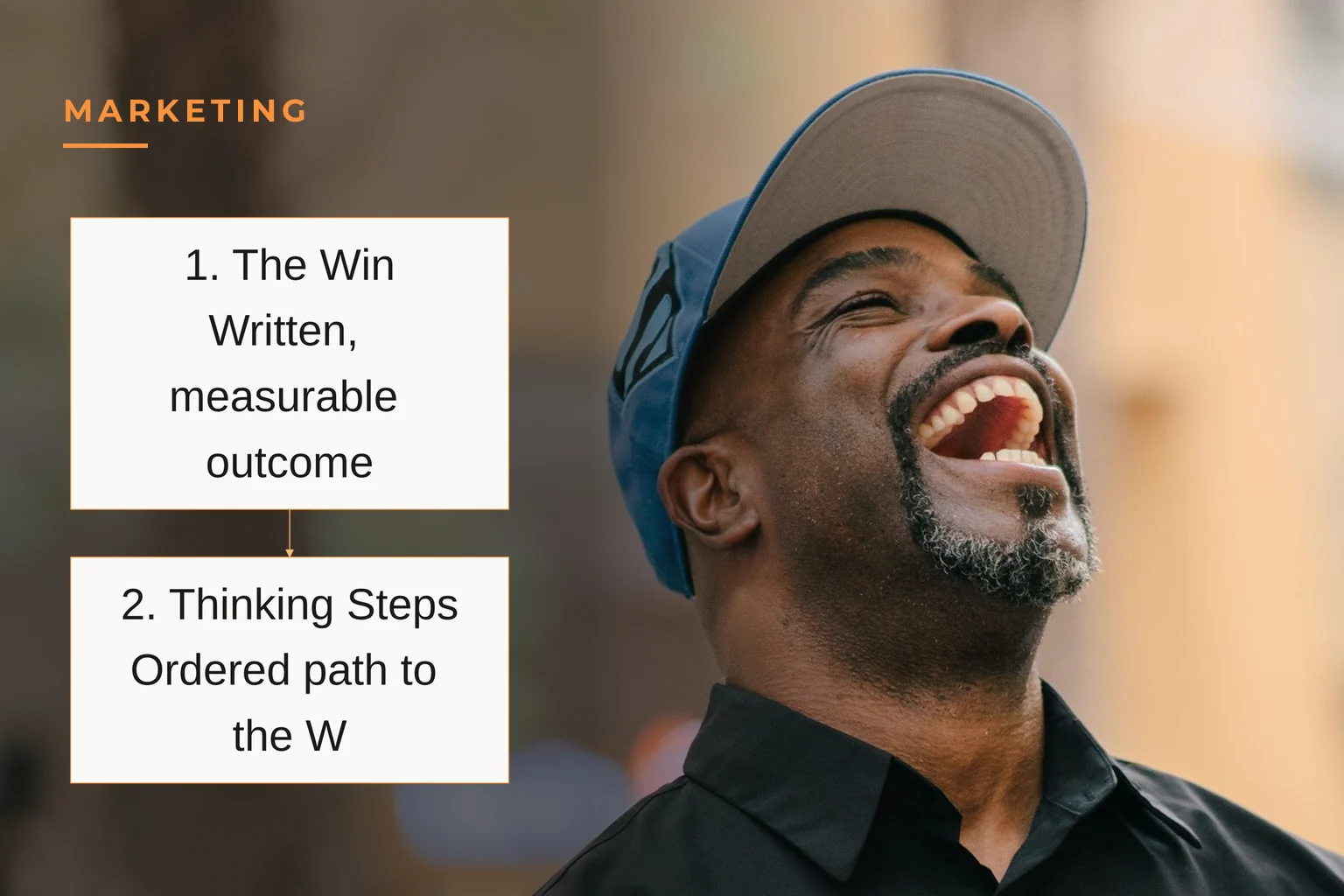
Practice 1 is The Win. Every game has a way to score, and everyone playing knows what scoring looks like. Marketing is no different. Before any work begins, the Win has to be defined in terms that can be measured. Without it, there is no way to tell whether a project succeeded, no way to course-correct, and no way for anyone, human or AI, to evaluate the work being produced. Read that last part again. Human or AI. The machine cannot judge the work if you never gave it the scoreboard.
Practice 2 is Thinking Steps Not Tactics. The instinct in marketing is to jump straight to tactics: funnels, ads, launches, campaigns. Automation is the newest item on that list and the most seductive, because it feels like leverage. It is backwards. Before any tactic is considered, the logical steps required to reach the Win have to be mapped out in order. Tactics are how you execute a step. They are not a substitute for it. Skipping this is the most common reason marketing feels busy and goes nowhere. Automating before this is how it goes nowhere faster, in higher volume, with better typography.
Practice 3 is Narrow the Focus. At any moment there is usually more than one important thing. The practice is to narrow the focus before a tactic is chosen. Its output is a narrowed focus: the one important thing the next step must serve. The decision it forces is simple: does this tactic serve that focus, or is it another important thing pulling the team in a different direction? If you cannot answer, you are not ready for the tactic.
Rank these if you are triaging. The Win matters most. It is the scoreboard. Thinking Steps is second. It is the route. Narrow the Focus is the guardrail. Automation is the last box. If you only fix one thing, fix the Win.
Here is the stop/go test I use before automation is touched:
- No written Win? Stop.
- No ordered steps from the current state to the Win? Stop.
- No narrowed focus? Stop.
- All three exist? Then pick the tactic, including automation, and let it execute a step you already mapped.
No written Win, no ordered steps, no narrowed focus equals do not touch the tactic.
Then I went into a 1:1 to correct someone, and the fault was mine
I was grooming Mekka into the head-of-marketing seat at MMR. I went into a 1:1 to correct where she was aiming. She wanted custom links to attribute web-class sign-ups, on a web class that had almost no sign-ups to attribute.
She was building precision measurement for a signal that barely existed. I could have corrected the tactic. Instead I asked why she was aiming there. The foundational assignment I had given her when she started growing into the role was to map every funnel, every stage and step in every funnel, and the KPIs at every stage. It overwhelmed her. She never did it. I never went back to check. We got busy on other things, and I forgot I had ever asked.
So I said it out loud, to her: that was me.
That is the hardest sentence in this article. Not because it is complicated. Because it costs you something to say it in front of the person you were about to correct.
And here is why it matters more than the 1:1. The same missing map showed up again on the September 12 TrueMD event, where the marketing plan was built before anyone knew the registration goal. Same hole. Different room. That is what an unbuilt foundation does. It does not stay in one person's inbox. It resurfaces at the next event, and the next, and every time it looks like a different problem with a different person's name on it.
So when someone on your team is measuring the wrong thing, check first whether the foundation you assigned them was ever built. Put a dated follow-up on any assignment big enough to overwhelm. An assignment without a check-in is a hope, not a task.
The test I run before I trust a tactic
When someone tells me the problem is awareness, I don't argue. I ask them to imagine it completely solved. A million people know your name tomorrow. Now what actually changed? If the honest answer is "nothing, we still don't have the step that turns attention into a conversation," then awareness was never the constraint.
Automation gets the same test. Imagine the automation is done. Perfect. Running. What actually changed?
If your answer is "now the assets exist," you did not solve a problem. You decorated one.
Here is the move underneath all of it. Stop answering "where do more clients come from" with a new offer or more eyeballs, and go find the step that is actually missing. Adding a service does not create customers. It creates something else nobody knows exists. A million of the wrong people knowing your name changes nothing about the constraint. And you cannot have a sales conversation without leads, so when someone says "our problem is sales conversion," it is usually a lead problem in disguise.
Automation is the newest version of the same dodge. It is the new "add a service." It is the new "more eyeballs." When the real answer is a missing step, a tool will never be the answer, no matter how good the tool is.
Why you will not do this on Monday
You already know the fix. Write down what the company is. Confirm every person who touches the work has read it. Define the Win before you turn on the tool.
Here is why you won't, and I want to say it plainly, because pretending otherwise is how articles like this become wallpaper.
Writing down what your company is feels insulting. You are a founder. You have said it many times. You assume everyone knows. I assumed everyone knew. That assumption was the entire bug, and it hid inside me while my team built the wrong things competently.
Saying "the foundation was never built, and that was me" feels worse. It costs you the little story where the problem is somebody else's execution. It asks you to stand in front of a person you were about to correct and take your own name off the accusation. Most leaders would rather manage the performance problem and keep the story. That is the comfortable path, and it is the one that guarantees the same hole shows up at the next event.
And narrowing the focus costs you the options you love. Saying no to the fun tactic, the new channel, the thing a board member mentioned, is a real loss. That is why Narrow the Focus is a guardrail. Everyone agrees with it in theory and nobody likes it on a Tuesday.
So the resistance is not a knowledge gap. It is a status cost plus operational rewiring. The rewiring is not a slogan. It is three repeatable mechanics: one written definition that every person confirms they read, dated follow-ups on any assignment big enough to overwhelm, and a pre-tool gate before automation is touched. That is the unglamorous work. You will want to skip it because the tool is more fun. Do not.
The two ways to run the same team
| Inconsistent team | Consistent team | |
|---|---|---|
| First move | Opens the tool | Writes the Win |
| Who knows the product | A subset, the ones you talk to | Everyone who touches the work has read the one-pager |
| What automation does | Produces the wrong assets, faster and on schedule | Executes a step you already mapped |
| When an asset looks off | You go hunting for the person | You check the brief, then the foundation |
| What "faster" buys | More wrong things, sooner | More shots at the same Win |
| What gets measured | Output | The Win |
| Next event | The same hole, a new name on it | The map is already there |
The framework at a glance
Before you touch automation this week, open one document and write the Win. Then write the ordered steps. Then write the one focus. Send it to every person who touches the work and ask for confirmation they read it. Put a dated follow-up on your calendar for the assignment you have been avoiding.
If you cannot do that, do not turn on the tool. The tool will not introduce your audience to your company. That is your job, and it always was.
<!-- cluster-links:begin -->Related reading
<!-- cluster-links:end -->Questions