Your Homepage Is Asking the Question Everyone Already Knows How to Refuse
By Atiba de Souza
The kiosk that taught me the whole thing
Years ago I ran the bakery's shops and kiosks in a US mall. Before I fixed anything, I walked the whole mall and watched every kiosk and shop work the floor.
Two failure modes, over and over. The kiosk staff on their phones got ignored, obviously, nobody interrupts a person who isn't paying attention to them. But the Bath & Body Works staff who chirped "can I help you?" the second someone walked in got the exact same result: a reflex "no thanks," including from people who genuinely wanted help. The line was polite. It was correct. It was also the one line every shopper already has a rehearsed answer to, loaded and ready before they even hear it.
So I taught my staff something different. Stand. Wave at the motion your eye naturally catches. Say hello. And then wait. Not everybody's eye caught the cupcakes. But when it did, when it held, that's when you spoke, and you didn't ask "can I help you." You asked: "would you like a tour of our flavors?" Nobody in a mall has ever been offered a tour. There's no scripted refusal for a question that's never been asked. It forces the brain to actually process the words instead of firing the reflex.
Your homepage is the kiosk. Most of them are doing one of those two dead things right now.
The principle: state precedes message
You cannot move a mind whose state is closed. Attention and openness aren't a courtesy the visitor extends you if you're persuasive enough. They're physiological. A mind that hasn't opened does not hear your message, it hears noise it's already trained itself to skip.
State: the visitor's readiness to receive a message, not their interest in the product. It is set before a single word of copy is read, and no amount of good copy fixes a closed one.
Here's the layering, and it matters before you touch a single word on the page: the principle comes first, always, and it doesn't change. Everything else, the exact headline, the exact CTA, the order you reveal proof, is a tactic in service of that one principle, and tactics are disposable. The kiosk's "wave, then wait, then ask" is one expression of state-precedes-message. Your homepage's headline is another. Swap the tactic all day. The principle underneath either holds or the whole page fails, regardless of how clever the tactic is.
The line that matters most in this whole piece:
Your homepage does not lose the sale by saying the wrong thing. It loses the sale by saying the right thing to a mind that was never open to hear it.
Trust is the gate, and the homepage is the wave, not the tour
The reason "can I help you" fails isn't that it's a bad question. It's that trust is the gate every purchase has to pass through, and generic doesn't clear the gate. Small signals get overlooked one at a time, a vague headline, a stock photo, a CTA that could belong to any company in your category, until one of them registers as "this isn't for me," and the gate closes. Nothing you say after that matters, because they've already left.
The homepage's job isn't to make the sale. It's the wave and the hello. The sale is the tour, and you don't get to offer the tour until the eye has actually caught and held.
The two homepages
| Talks to everyone (fails) | Talks to the one who stopped (works) |
|---|---|
| Headline could sit on any competitor's site | Headline names the exact buyer and the exact thing they're stuck on |
| CTA appears before any proof this page is for them | CTA appears only after something on the page has earned a held look |
| One message, blasted at every visitor | Message sequenced to what actually caught their eye |
| Success measured by traffic | Success measured by how many stayed and moved |
Test it on yourself before you test it on them
I once sat with Marianne, looking at a doctor's profile. She told me he clearly had authority and expertise, because he posted a lot of educational content. I asked if everyone who posts educational content is therefore an expert. She said yes, of course.
So I tested it against her own skin. Post an educational piece about how to perform heart surgery, every day for seven days, or I kill you next Tuesday. She refused instantly. She doesn't know anything about heart surgery and would rather die than post about it. Which meant the rule she'd just stated wasn't a rule. She was the exception she'd assumed was everyone else.
Run that same test, the one Marianne failed, on your own homepage. You believe broad, everyone-friendly copy is the safe choice. Fine, apply the rule to yourself the way I made her apply hers: would you stop, read, and click "get a demo" on a homepage that speaks to "businesses of all sizes across every industry"? You wouldn't. You'd scroll past it the same reflex way your buyer does. If you won't respond to your own opening line, you're not the exception to that rule. Neither is your visitor.
Name what this actually costs you
Narrowing your homepage's headline to one specific buyer's one specific stuck point feels like turning away business. That's the fear, stated plainly: if I speak to one person, I lose everyone who isn't that person. It's the same fear behind "can I help you," which is engineered to apply to the widest number of people who walk through the door. Wide feels safe. Wide is also why the reflex "no thanks" fires on almost everybody, including the people who actually wanted help.
The real cost isn't reach. It's admitting, on this page, right now, that you are not selling to everyone. It's doing the work of knowing your buyer specifically enough to write one line only they would stop for, which most leaders haven't done, because it's easier to write a line that offends no one and moves no one.
When not to do this
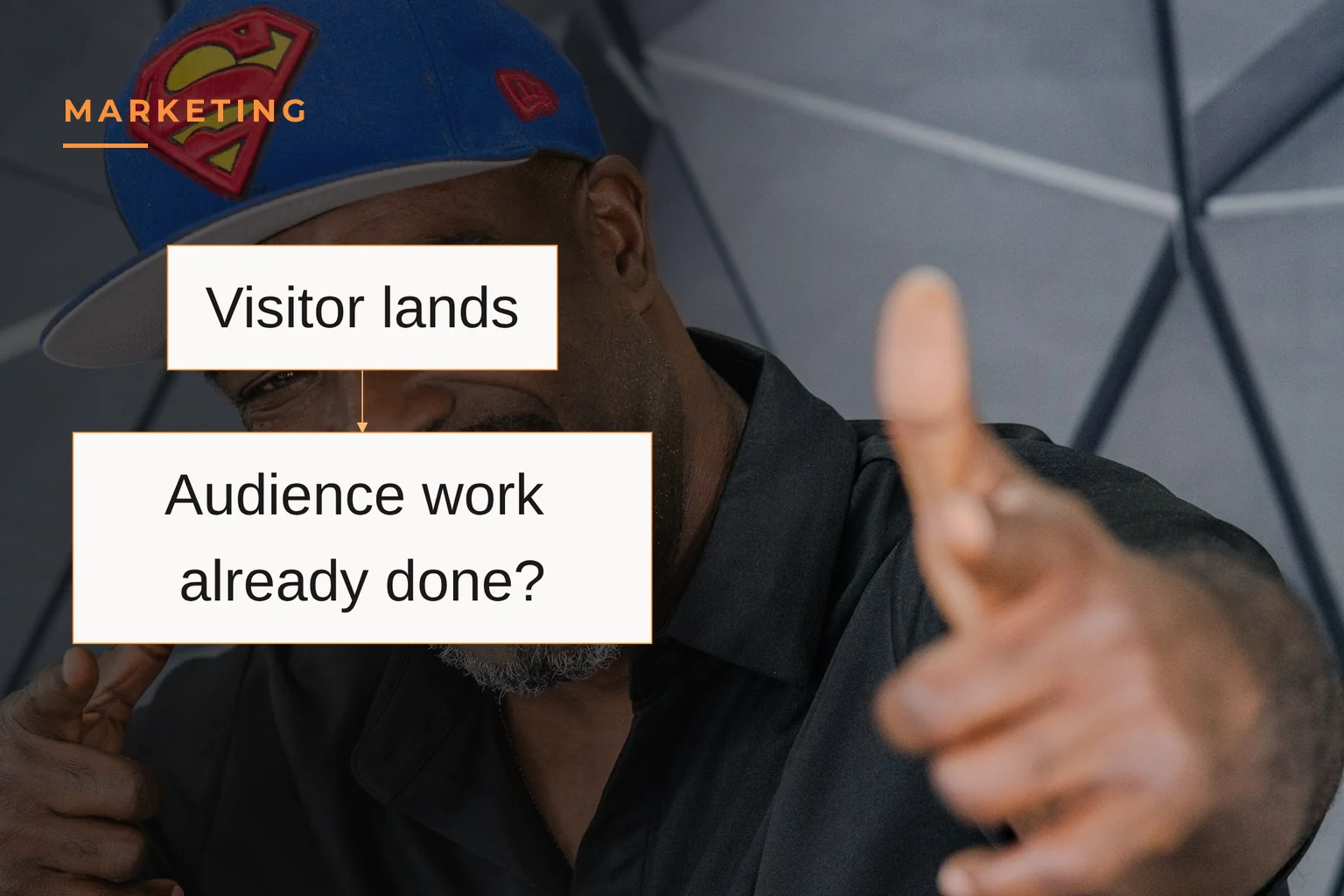
This only works if you already know who's supposed to stop. If you haven't done the work to know your buyer's actual stuck point, sharpening your headline just makes you guess more confidently, with fewer words. The principle, state precedes message, doesn't care how sharp your words are if you've aimed them at the wrong buyer entirely. Do the audience work first. Get the principle right for the wrong buyer and you've just built a more elegant miss.
The diagram only resolves cleanly down the right-hand path. The left branch is where most homepages actually live: state stays closed, the visitor never comes back, and no amount of better copy downstream fixes it. That branch is the whole reason the "when not to" caveat exists.
Monday
Read your H1 out loud as your actual buyer, mid-scroll, three tabs open. If it could sit on any competitor's homepage, that's your "can I help you," the line they already know how to refuse. Rewrite it so specifically to one buyer's one stuck point that anyone who isn't that buyer thinks it's oddly narrow. That reaction, from the wrong person, is how you know you finally wrote something for the right one.