Two Hundred People, Six Jobs, and the Only Constant Was Me
By Atiba de Souza
The seats stayed empty
One of our stores needed six people to cover all the shifts.
Over two years, I hired and lost 200 people trying to fill those six seats. Every time it went sideways I changed something. A different ad. A different screening. A different pitch. A different energy in the interview. I was certain the next tactic would hold.
It never did.
Then one day I sat still long enough to ask the question I had been avoiding. I had changed the people. I had changed the tactics. What had not changed, not once, in two years, was me. I was the constant. And if I was the constant inside a problem that never moved, then I was the problem. I had been running a hiring problem that was actually a leadership problem, and hiring harder was never going to touch it.
Two years. Six seats to cover. Two hundred people hired and lost. Same six seats, still open. The hiring was never the variable. I was.
That is a story about me. It is probably also a story about you, and you already suspect which part.
Most leaders hear a story like that, nod, agree with it completely, and then go post the job again.
The hire is the most expensive way to avoid the work
Hiring is not the problem. Hiring as a substitute for knowing what the job actually is, that is the problem.
An open req feels like motion. It feels like you did something about the thing that is hurting. Defining the role does not feel like motion, because defining the role forces you to answer a question you have been circling: what does this person take off me, and why can I not describe that clearly today?
When a problem repeats across every person and every tactic you try, stop changing the variables and identify the constant. It is usually you.
Same empty seat, two readings
| Inconsistent leadership | Consistent leadership |
|---|---|
| Post the role, figure out the job later | Name the constraint and the decision rights before the req opens |
| Everything routes to the founder | The org chart says who owns what thinking |
| Values live on a slide | Values settle decisions when you are not in the room |
| Success is "it feels better" | Success was defined before the work started |
| Nobody has a number | Everyone has a KPI |
| The founder is the answer | The founder installed the answering |
Both columns describe the same Monday. Only one of them changes what happens by Friday.
What you are actually shopping for
Here is the uncomfortable part. When you do not understand a role yourself, you are not shopping for a person. You are shopping for a rescuer.
Nobody arrives and takes a whole function off your hands. That is not a candidate problem, it is a physics problem. The part you cannot describe is the part that comes back to you, along with the new hire's salary and the six months it takes to find out.
And urgency makes it worse, because urgency makes you overestimate fit. When you need the answer to be yes, you stop evaluating and start hoping. That is how 200 people move through six jobs.
The framework
Organizational Independence: building a company that can think without you.
It runs as three questions in sequence, with a learning loop returning to the start.
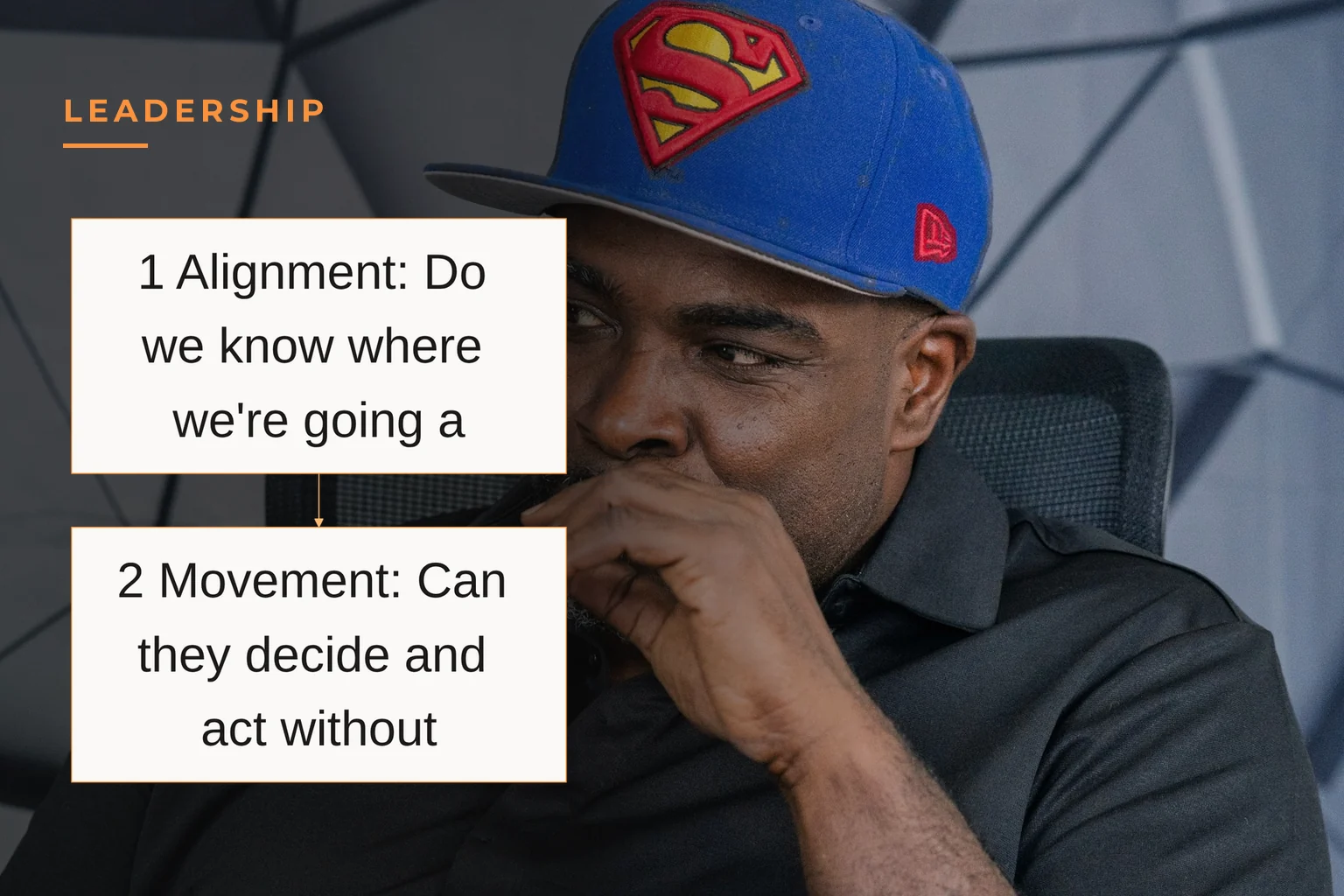
1. Alignment. Do we know where we're going and what we own? Under it sits a clear and compelling vision of the future, an org chart that says who owns what thinking, and the Theory of Constraints, which says focus on the Big 3.
This is the one that decides everything else. If you only do one thing from this piece, do this. You cannot delegate work you have not defined, and you cannot define work when you do not know what it is for.
2. Movement. Can they decide and act without me? Values that guide decisions. Frameworks, simple ways to think and act. Culture, a team that improves together.
This is where the bottleneck actually breaks, because this is the difference between people who wait for you and people who decide. It is also the slow one. It is habits, not a memo.
3. Measurement. Can we tell if we were right? Start past the end. Define success, then work backward. Everyone has a KPI, so there are clear signals for progress.
Measurement is the cheapest to start and the least useful on its own. A number nobody aligned to is just noise with a dashboard.
Then the learning loop, returning into alignment. Almost nobody installs it. It is the part where what you learned changes the vision, the org chart, and the Big 3. Without it, your framework becomes a plaque.
The seven and a half hours
Earlier in the year there had been a staff purge, meant to have removed work that was not worth doing. The intent was right. The execution missed.
Marianne was spending seven and a half hours a week doing engagement on Facebook, and it was yielding one response a week. On inspection, it was the same person who had replied several times before. Seven and a half hours of real work, producing effectively nothing.
Meanwhile the business could not figure out how to fill the top of its funnel, and Sophia needed help she was not getting.
Read that again slowly, because this is the part that turns. It is the same mistake as mine, wearing different clothes. The purge changed a variable, the people, and it felt like the problem was handled. What never got examined was the constant: hours already being spent, aimed past the constraint instead of at it. That is me changing the ad and keeping the hiring. Somebody looks at the week, sees the same gaps, and reaches for the only lever that feels available. Hire.
Except the hours already existed. They were just pointed past the constraint instead of at it. Nobody moved them, because nobody had named the constraint out loud.
For every recurring task on your team, ask what it produced last month in outcomes rather than in hours. Then check whether those outcomes are the same one repeating. You will find at least one Marianne.
The cost nobody puts on the slide
You read all of that. You agreed with all of it. And there is a real chance you will still post the job this week.
Not because you are lazy. Because the alternative is scarier than the hiring.
If you stop being the person who answers every question, something might drop. That is the fear, and it is not really an operational fear. It is an identity fear. You built this thing by being the one who figures it out. Writing down who owns what thinking means admitting there are parts of your own business you cannot currently describe, and that costs you something you have been quietly protecting.
Then there is the labor. You have to move decisions you made by instinct at 11pm into a document at 2pm. You have to watch someone decide something differently than you would and not correct them. That is the rewiring, and it takes months, not a weekend. Some weeks it will feel like you are getting worse at your own job before you feel like you are getting better at leading one.
So start small enough that you can survive the discomfort. Write the constraint in one sentence. Not the list of everything that is hard, just the one thing actually limiting the goal. Expect the first three versions to be symptoms. Then write who owns what thinking for the three decisions that land on your desk most often. If you cannot write them, that is the finding, not the failure. That is the part of the business still living inside your head, and now you know which part.
And yes, there is a time to hire. If a role can be described in one sentence, including who it reports to, what it owns, and the number it moves, hire. Do it today. The trap is not hiring. The trap is a requisition standing in for a decision you have not made.
You are the bottleneck. Which is good news, because the bottleneck is the only variable you fully control.
Stop changing the people. Build the thing that thinks without you. A stronger organization. A freer you.
<!-- cluster-links:begin -->Related reading
<!-- cluster-links:end -->Questions