Your Pricing Page Answers Every Question Except the One That Matters
By Atiba de Souza
The cake nobody called me about
Around 2007 to 2008, thirteen years into owning a bakery and gift-delivery service known for elaborate multi-tier cakes, I got invited to a young cousin's birthday party at a bouncy-house venue.
On the drive over, I assumed they had bought a supermarket sheet cake. Nobody had called me. Not a text, not a "hey, can you do a thing." So I filled in the blank the way we all fill in blanks, with the boring answer.
Then the cake came out. A beautiful three-tier Lightning McQueen.
I want to be honest about what I felt, because it is the whole point. I was not impressed. I was offended. Family. They knew exactly what I did for a living. And they had paid someone else.
I could have carried that grudge for years. I nearly did. Instead I pulled an aunt aside and asked what they paid.
She told me. And that number is the lesson of this piece.
$65 paid, to a friend of a cousin. Over $300 would have been my price, family discount included.
If they had called me and told me their budget was $65, I would have never done the cake for them. Not out of spite. I cannot make that cake for that money.
Not everyone who needs your product is your customer for your business.
Had I taken the offense at face value, I would have carried a grudge about loyalty. The real answer was duller and harder. My own family had never been able to buy from me at my price. They did not choose someone else over me. They chose a number they could afford.
Your pricing page is doing the same thing to you right now, and it does not even have the excuse of a family discount.
The question your page never asks
Your pricing page answers how much. It answers what is included. It answers how to start.
Here is what it does not answer, and what the person reading it is actually holding in their head: is this number inside the budget my problem has already given me?
That question is not about you. It never was. And no amount of layout will answer it, because the answer does not live on your page. It lives in the buyer's situation, and it was set before they ever opened your tab.
Two people can look at the same number and one of them is already gone. Not because your page was unclear. Because the problem they walked in with had a ceiling, and your number sits above it.
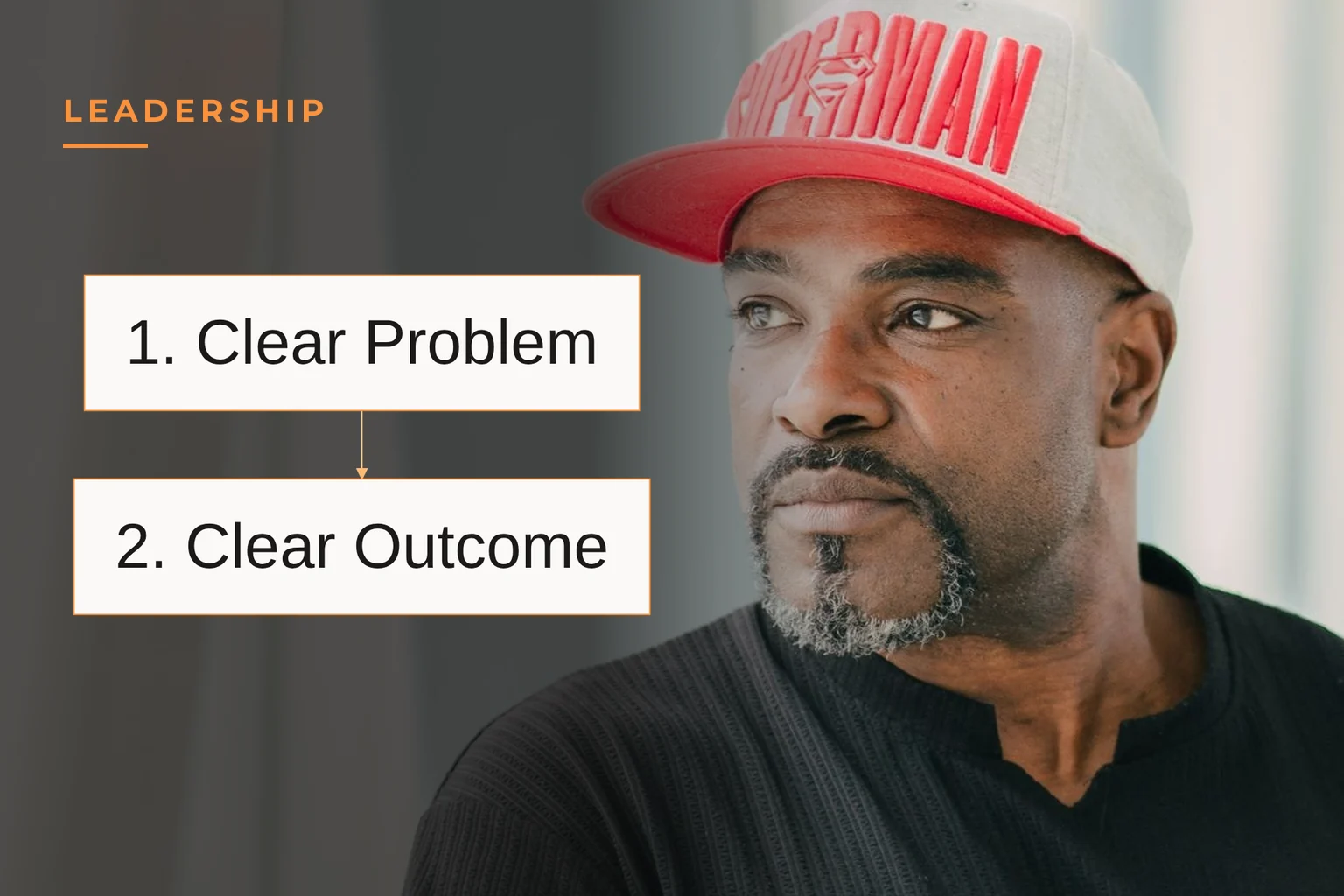
The method I use on every offer: Clear Problem, Clear Outcome, Willingness to Pay
Three questions, in this order. Not a menu. An order.
- Clear Problem. The specific broken thing, in the buyer's words. Specific enough that they nod before you finish the sentence. "We help businesses grow" is not a problem. It is a category.
- Clear Outcome. What the world looks like after, in their terms. Not your feature list. Their Tuesday.
- Willingness to Pay. The ceiling their problem has already set in their head, before they ever reach your page.
Here is the definition I want you to use, because this is the term that gets thrown around loosely and then quietly ignored:
Willingness to Pay: the number already sitting in the buyer's head before they open your page. Not a market average, not a negotiation position, not what you wish it was. It is the ceiling their problem has already given them, and it was set before you showed up.
Read that twice. Nothing on your page creates it. Your page can only meet it, miss it, or hide from it.
What step three will cost you
A clean process handed over like it runs itself is a lie. So let me say the quiet part right here, at the exact step where you will want to skip.
You will write the real number and the real "who this is not for," and then you will watch people leave. Some of them were never yours. That will not make it feel better that week.
The fear is not "my page is unclear." The fear is "if I say this out loud, I lose the lead, and the lead is how I prove I am doing my job." That is the actual resistance, and no template fixes it.
The cost is real. Your lead count drops. The number on the dashboard goes down, and you have to explain that losing people is the mechanism, not the failure.
The rewiring is harder. You stop counting who showed up and start counting who fits. You become willing to be the price nobody at the party could reach, and to call that a fit problem instead of an insult. And the hardest version of it: your own family, literal or figurative, may not be able to buy from you. If you need everyone who needs you to also afford you, you will price like someone who needs to be loved, and the business will pay for it.
Then there is the guilt about charging. The guilt is misplaced when the price matches the promise. Greed is charging the high-water mark and delivering fog. Charging for what you actually do is the only way you keep being able to do it.
None of that is a reason to soften the answer or to dodge the question. It is the reason most pages never ask it.
Then decide which document you are writing
Run all three and you produce one of two things. Writing to someone who is buying gives you an offer. Writing to someone who is deciding gives you a proposal. Those are different documents and the difference is not cosmetic.
Your pricing page is an offer. Your deck is a proposal. Do not let the second one do the first one's job.
Rank your own parts, because they are not equal weight
The order never changes: Clear Problem, then Clear Outcome, then Willingness to Pay. What changes is how much weight each one carries.
The heaviest: willingness to pay. It is the disqualifier. Get it wrong and the other two are decoration. But being the disqualifier is not a reason to move it to the front. You cannot ask the budget question until the buyer has a problem and an outcome to price against. You ask it last, and you let it kill the deal.
Second: clear problem. A vague problem gives the buyer no ceiling to compute against. If they cannot name what is broken, they cannot tell you what fixing it is worth. Your problem statement is what sets their budget.
Last: everything visual. The tiers, the anchoring, the "most popular" badge, the founding-customer discount. Real, useful, and paint. Do not repaint a page that has never answered the budget question.
Two prices, and nothing in between
Here is the handle I want you to carry out of this piece.
There are only two prices that matter in any market: the most expensive and the cheapest. Everything between them is invisible.
Nobody walks around knowing the fair market rate for a three-tier cake. They know what they can spend, and they know what the fanciest thing costs. The middle is fog. If you live in the fog, you are asking the buyer to do work they will not do.
And price, speed, and quality are one system. Move any one of them and the other two have to move. You cannot quietly be the fastest, the cheapest, and the best. Pick which side you are fixing first and let the other two follow. That is why "what should I charge" is the wrong question. The right one is "which of the three am I fixing first."
The last part is the one that stings. Choosing to be the most expensive is a claim about quality that the buyer hears whether you say it out loud or not. Your number talks. And if you take the high-water mark, you now owe exactly what you promised, because the price already said you would. The price is the promise. Delivery is just the proof.
Inconsistent page vs consistent offer
| Element | The inconsistent page | The consistent offer |
|---|---|---|
| The price | A number with a hedge, "starting at" | A number tied to a named outcome |
| The problem | A category: "we help businesses grow" | The specific broken thing, in the buyer's words |
| The outcome | Features, sorted by tier | The buyer's Tuesday, before and after |
| The budget | Assumed. Everyone is welcome. | Met where it already is, or named as out of range |
| Speed and quality | Unstated, so the buyer invents them | Stated, because the price already claimed both |
| The close | "Contact us" | "Here is who this is not for" |
The framework at a glance
When not to do this
- Do not run this if you genuinely cannot afford to lose anyone yet. The output of the willingness-to-pay question is often "these people were never my customer," and if you need every lead, you will not say that out loud, and the method quietly stops working.
- Do not run it before you have asked. The moves are worthless without the fact. If someone who obviously needed what you sell bought elsewhere, find out what they paid before you conclude anything. That is the thing I would do differently. I would have asked first and been offended second.
- Do not run it on a page whose problem statement is still a category. You will just price fog very accurately.
The one line to add this week
Your pricing page is not failing because it is unclear. It is failing because it answers a question about you and ignores the question about them.
So write one line. It has three parts, in this order, because a price without a problem and an outcome is just a number with a font.
- The problem, in public. "This is built for [the specific person] who [the specific broken thing]." If you cannot fill that in without falling back on a category, you are not ready for the next two.
- The outcome, in public. "When we are done, [their Tuesday], not [your feature]." Say it the way they would say it to a friend, not the way you would say it on a slide.
- The willingness to pay, in public. "It is priced for [the buyer whose problem supports this number]. If your budget is [the number], this is not for you yet." That last sentence is the one that costs you. Write it anyway.
That is the whole page. Problem, outcome, price, and the honest name of who it is not for. No tier badge does that work for you, and no redesign rescues a page that skips it.
Then get ready for the drop.
The people who leave were never able to buy at your price. That is not a loss you explain away. That is the page finally telling the truth.
Questions