Your Next AI Will Sound Exactly Like the Employee You Fired
By Atiba de Souza
The Room Went Quiet in Vegas
A doctor came to my four-day intensive in Las Vegas in June. Halfway through those four days, he was building an AI employee to take over part of the job of a staff member he had fired the week before, because the person never seemed to understand what was needed.
The room was quiet. Everyone working. And he said it out loud, cleaned up for print:
"It's responding exactly like the employee I fired last week."
He had removed the human. He had replaced the human with software. The software came back with the same result.
Then he saw it, in the middle of the room: the common factor was how he gave instructions. Maybe it was his fault, not theirs.
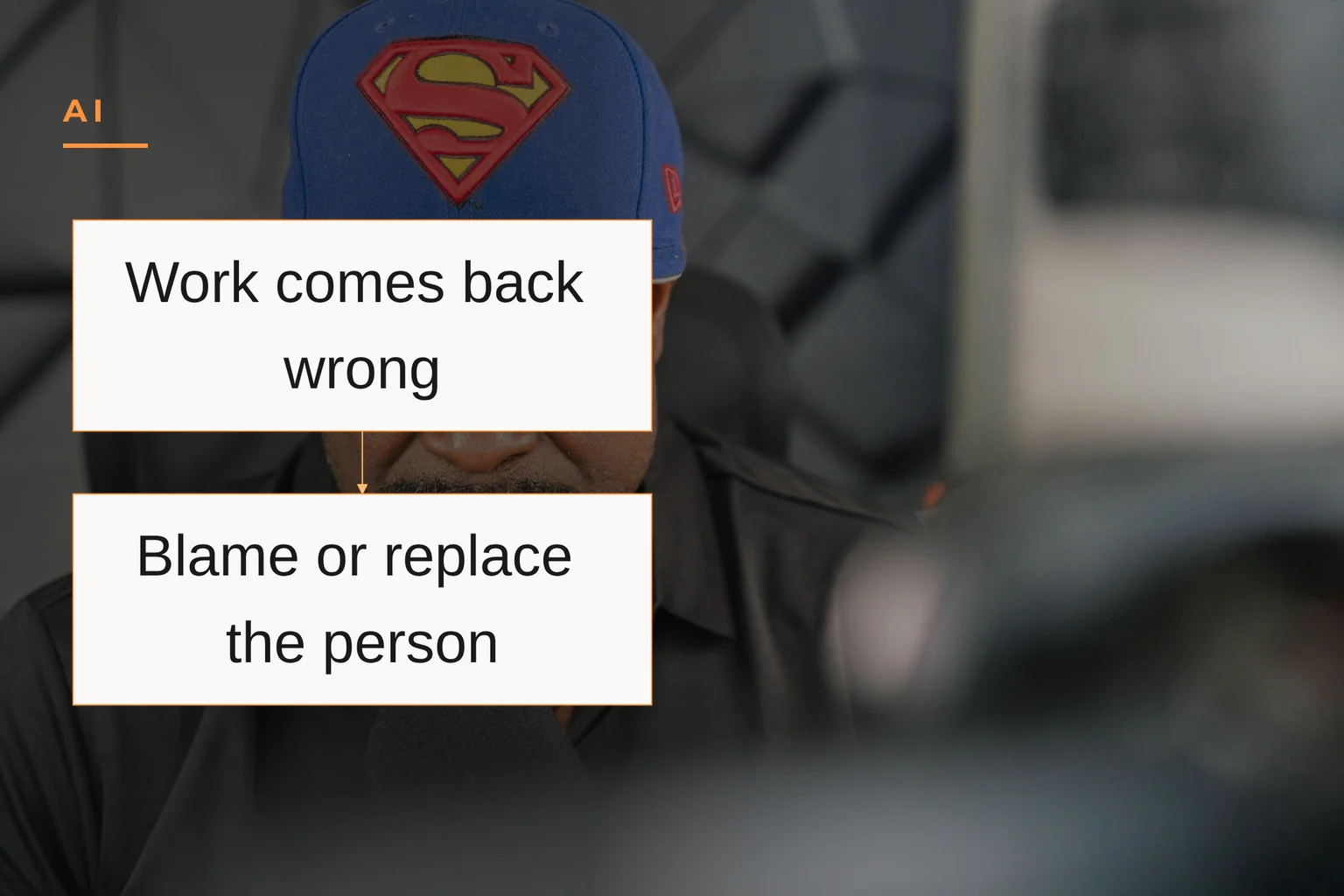
Without that AI, he would have kept blaming the people he hired and handed the same instructions to the next hire. The rule that came out of that room is the rule this piece runs on: when delegated work keeps coming back wrong, from people or from AI, rewrite how you ask before you replace who you ask.
Rank the Parts, Because You Have a Business to Run
I rank my own work. You have a business to run, and I am not going to hand you six equal sections and call it depth.
One idea carries this entire piece: delegate thinking, not tasks. The table, the diagram, the second story, the warnings, all of it is scaffolding for that one move.
The second most important thing is the cost of switching, because that is where most leaders quietly decide not to. I get to it further down. Do not skip it.
Everything else is minor. Read it after you have decided whether you are willing to pay.
The Framework Has a Name: Delegation Leadership
I call this Delegation Leadership. It is the model underneath everything I teach about teams, and it starts with a correction to how the word gets taught.
Most delegation advice sounds like "write the SOP, hand it off, check the box." That is task transfer. It is useful. It is not leadership, and it is not what builds someone who can run without you.
Delegation Leadership says delegate thinking, not tasks. Here is the word the whole piece turns on:
Delegation (Delegation Leadership): the transfer of a decision, not a task. If the person doing the work still has to come back to you to know what "right" looks like, you handed off labor and kept the thinking. That is a queue, not delegation.
Read that again and check your own week against it. Every time someone brings you a decision they could have made, you did not delegate. You queued.
The model rests on three things a leader is, not three things a leader does: vision, openness, and asking great questions. Vision is the outcome you can describe before you can prove it. Openness is the willingness to be told you are the common factor. Great questions are the muscle that never stops working. The role-gap move later in this piece is the same idea aimed at a person's job.
And here is the first decision rule, the one that keeps you from repeating a bad hire or a bad agent:
When delegated work comes back wrong, from a person or from AI, rewrite how you ask before you replace who you ask.
That is not a soft suggestion. It is the difference between a leader who keeps buying new people to run the same broken brief and a leader who fixes the brief once.
Four days in a Vegas room. Eight weeks with a coding agent. Three weeks on, one week off. None of those was a software problem.
Performing Is Real. It Is Just Not the Game.
Be fair to performing.
Performing is drafting, summarizing, formatting, pulling the numbers, cleaning the list. AI does it well. If you are using AI to get through the routine layer of your day faster, you are not doing anything wrong.
You are just not doing anything new.
Here is the line that should land like a brick. If I had bought one of the assistants on the market instead of building, I would have cleared the routine work I was already not doing and left the level that moves the needle exactly where it was. Cleared work I was already skipping. The needle untouched.
That is the perform trap. You feel faster. You sound faster. Your team sees a leader with better tools. And the thing that decides whether your business is different in three years sits in exactly the same place it sat last year.
Inconsistent delegation vs. consistent delegation
| Inconsistent delegation | Consistent delegation | |
|---|---|---|
| What you hand over | The steps | The decision |
| What you keep | The judgment | The standard |
| What you say | "Here is how to do it" | "Here is what has to be true" |
| What you ask the AI | "Draft this. Summarize this. Fix this." | "Here is my operating problem. Interrogate me." |
| When it comes back wrong | You replace the person | You rewrite the ask |
| What it builds | A faster version of your bottleneck | Someone who can run without you |
| The destination | More output from you | Ownership in them |
The Second Story: I Asked for a Plan and Got a Brain
Eight weeks before I wrote this, I went to Claude Code with an operating problem, not a software problem. I wanted the agency to work three weeks a month and take the fourth week off. My question was simple and enormous: what would have to be true for that to hold?
It never produced the plan I came for. It kept asking me questions. About my philosophies. About my frameworks. About how I thought. For weeks.
What it produced was not a plan. It produced a brain of me. Then the project-manager side started sending me a morning brief of what actually needed doing across every project, and my brain went quiet, because it no longer had to hold any of it.
That thing is what we now call Athena.
Notice the turn, because it is not the one you would guess. I asked for a deliverable and did not get one. You would have called that a failed experiment early and gone back to drafting emails.
Not getting the plan was the win. The tool refused to perform, and the refusal is why I ended up with something that thinks alongside me instead of something that types for me.
One gets output. The other gets leverage you cannot buy.
What It Will Cost You, Because You Are About to Talk Yourself Out of It
I am not going to pretend this is a clean process you execute on Monday morning. That would be dishonest, and you would feel it even if you could not name it.
Four costs, in the order they will hit you.
Performing gives you a receipt. You can point at the drafts, the summaries, the deck that got done in an hour. Thinking gives you a better question, and a better question does not show up on your calendar as an accomplishment. You will feel unproductive while doing the most productive work of your year.
Your job security is built out of being a bottleneck. Be honest. If you are the only person who can hold the whole picture, you are indispensable. Delegating thinking means building something that can hold the picture without you, and part of you does not want that. That part is not evil. It is scared, and it is normal. Name it before it drives.
Being interrogated is uncomfortable. When the tool asks about your philosophy, you find out whether you have one written down anywhere. When the AI answers exactly like the person you fired, you find out you were the problem. That is a bill you cannot un-see. The doctor paid it in front of a room, which took something.
It is slower at first. Noticeably slower. You are rewriting how you ask, not just what you ask for, and rewiring a habit costs weeks of feeling clumsy. That is the price. I am not going to dress it up.
If reading that list made you tired, good. That means you are paying attention instead of collecting a framework.
Every Role Has a Gap No Single Person Can Fill
Here is the move that changes the picture, and I use it with staff, not just with AI.
Stop thinking about AI as a replacement for a person. Start thinking about it as something that fills the strategic, tactical, or analytical gap inside the role each person holds.
I know how that sentence lands on the person hearing it. "Gap" sounds like "the gap is me, and the thing being hired is coming for my chair." That fear is rational, and a leader who ignores it gets compliance instead of ownership. So the burden sits on you, twice. You have to say alongside, not replace. Then you have to prove it with what you actually hand over. A promise without a changed brief is just a nicer layoff notice.
Every role has those gaps. You have never once hired a human being who was strong everywhere the job needed strength. The strategic thinker is often weak on the tactical follow-through. The person who is excellent with the analysis is often the person who will not make the call. That is not a flaw in the hire. That is the shape of a role.
So the question stops being "who can I replace with AI" and becomes this decision:
Which strategic, tactical, or analytical gap can AI fill so the person in the role can do the part only a person can do?
That is the difference between an agent standing in for somebody and an agent working alongside somebody. And here is the warning that keeps it from becoming a fantasy: superhuman power without good judgment just makes bad decisions faster. Faster is not better. It has never been better.
Vision, Openness, and Great Questions
The spine of all of this is three things a leader is: vision, openness, and asking great questions.
Openness is the word I use. Not vulnerability. Openness is the willingness to be told you are the common factor. It sounds noble in a keynote and it is expensive on a Tuesday. Openness is not a trait you announce. It is a habit you prove, every time the work comes back wrong, by rewriting your own ask before you go looking for someone to blame.
That is the rewiring the model demands, and it is why this is harder than it reads. You are not adding a tool. You are changing instructions you have given for years, and some of those instructions are the reason people think you are good at your job. Changing them will feel like losing something before it feels like gaining anything.
The doctor had vision. He wanted something true about his business. But what saved him a second bad hire was openness, because he let the evidence point at him before it pointed at anybody else. Vision plus great questions, in a loop, with a tool that did not get bored.
You already know how to do this with people. You do it in a good one-on-one when you stop giving answers and start asking what they think should happen.
The Two Loops
One loop repeats the same brief and calls it a people problem. The other fixes the ask once and builds someone who can run without you.
The Decision
Two actions, one for each story. Use them this week.
Open a coding agent. Describe the outcome your business needs rather than the software you want. Keep the conversation running for weeks instead of expecting an answer in one sitting. That is how Athena happened, and most of those eight weeks did not look like progress.
And when delegated work keeps coming back wrong, from a person or from AI, rewrite how you ask before you replace who you ask.
That is Delegation Leadership in one move: transfer the decision, keep the standard, and let the person own the outcome. Do it twice this month and you will know more about your own operation than a year of performing ever taught you.
<!-- cluster-links:begin -->