The Right Way to Use AI So Your Team Gets Smarter, Not Smaller
By Atiba de Souza
The question every leader asks and nobody says out loud
You brought AI into the business. Then, late at night, the real question showed up.
Does this mean I need fewer people?
That is the fear. Name it, because it is in the room whether you say it or not. If the tool can do the work, the work must not need the people. So you start doing math you cannot show anyone, and your team can feel you doing it. They get quieter. They stop proposing things. They start protecting their jobs instead of doing them.
Here is the thing I want you to see. AI does not shrink teams. The way a leader uses AI shrinks teams. Those are two different forces, and most people have them fused into one sentence.
AI does not shrink your team. A team that never got to think for itself does. The tool only amplifies which one you built.
That is not comfort. It is a diagnosis, and it tells you which direction to build in.
The word the whole thing turns on
Delegation: transferring thinking, not tasks. If the person you handed it to still has to come back and ask you what to do next, you moved a task. They never got the thinking. That is the delegation trap.
The thesis underneath all of my leadership work is blunt. Delegate thinking, not tasks. Most delegation advice tells you to write the SOP, hand it off, and check the box. That produces a team that executes and never decides. Then AI lands on that same team and you find out which one you built. A team that only executes is the team a tool replaces. A team that decides is the team a tool makes dangerous.
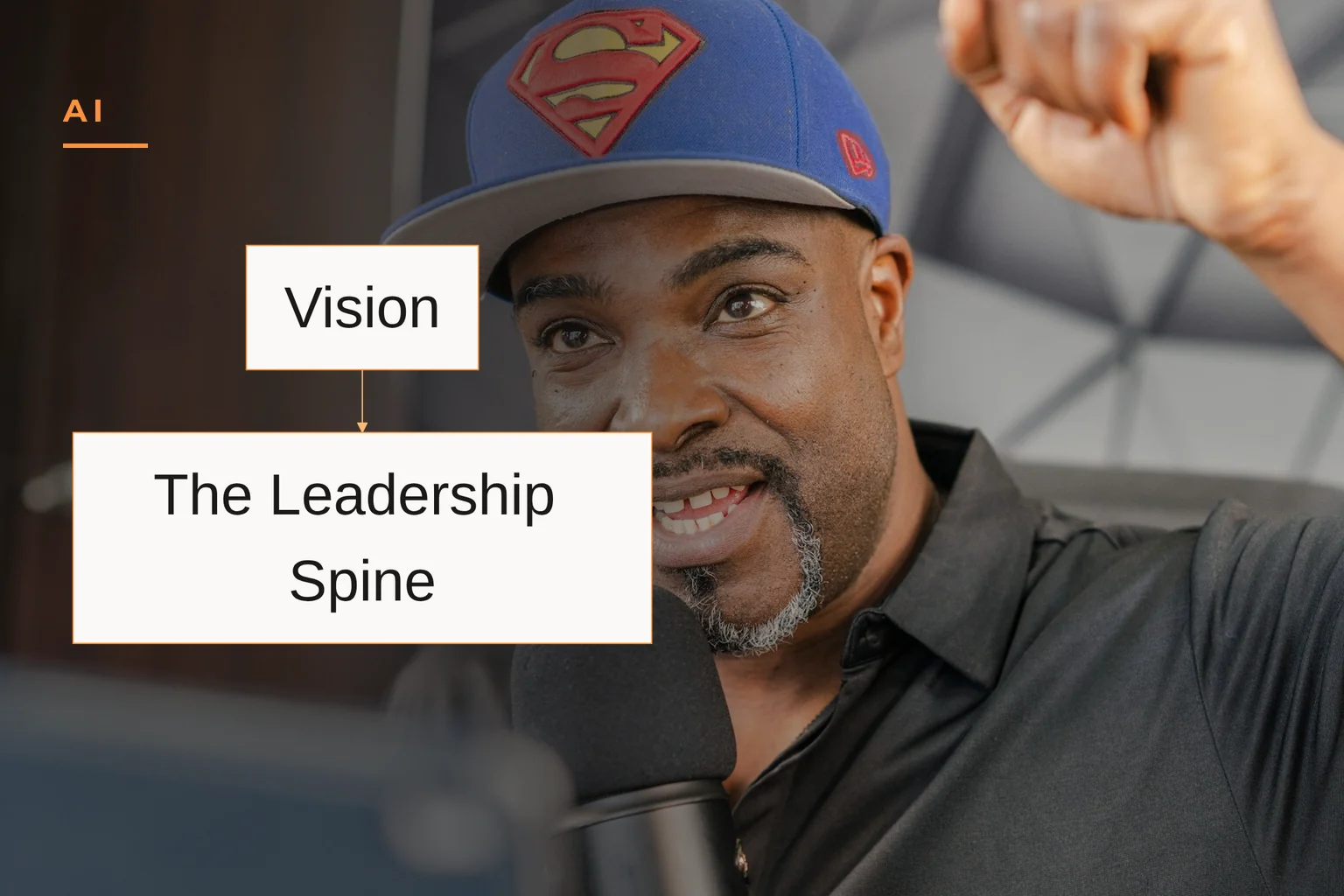
Delegation is one branch of something bigger. The parent is the Leadership Spine: vision, openness, and asking great questions. Vision is where you are going. Openness is being willing to be seen not knowing. Great questions are the engine. Aim all three at a team and you get people who think like owners. That is the destination. Ownership. Not compliance. Not throughput.
Run AI through that spine and the question stops being "how do we do more with fewer?" It becomes "how do we decide better, faster?"
The same tool, two teams
| Inconsistent use of AI | Consistent use of AI |
|---|---|
| AI writes the answer, the team delivers it | The team uses AI to get sharper, then decides |
| The leader prompts, the people receive | The people prompt, the leader asks what they learned |
| Mentioned once in a launch meeting | Shows up monthly, small and repeatable |
| Value measured in tasks removed | Value measured in decisions improved |
| Leader keeps the thinking, hands off the typing | Leader hands off the thinking, keeps the vision |
| The team gets quieter | The team gets louder |
Read the right column again. None of it is about volume. All of it is about who gets to think.
CASE Method is the mechanic. The spine is what you are. Ownership is what your people become. AI sits at the far end and multiplies whichever one you actually built.
I asked for an operating plan and got a brain instead
Eight weeks in, I brought Claude Code a problem that was not a software problem. I wanted my agency to run three weeks a month and take the fourth off. I wanted to know what would have to be true for that to hold.
It never gave me the plan. It asked me questions. About my philosophies, my frameworks, how I thought. Over and over. I kept waiting for the deliverable.
What came back was a brain of me. We call it Athena.
Then the project manager side started sending me a morning brief of what actually needed doing across every project.
"And then all of a sudden, my brain went quiet. ... I didn't have to keep it all in my head anymore. It was all there."
Stay with how strange that ending is. I did not build a machine that did my work. I built a machine that held my thinking, and the effect landed on the inside of my own head. That is the opposite of shrinking. My capacity got bigger because the ceiling moved.
Had I bought one of the assistants on the market, I would have cleared the routine work I was already not doing, and left the level that moves the needle exactly where it was. The tool was never the variable. What I handed over was.
If you take one instruction out of my story, take this one:
Open a coding agent, describe the outcome your business needs rather than the software you want, and keep the conversation running for weeks rather than expecting an answer in one sitting.
I did not get an answer in one sitting either. I got a brain.
The client who could not install it
I have been teaching AI to a pharmacy owner of seventeen years who is opening a wellness clinic, since June. In August I opened a workshop by asking every attendee where AI is still a struggle for them.
She was in that room. A few months earlier she could barely get Claude installed.
Today she burns through her $100 a month plan every single week. And when she talks about it, she says the value coming back is far more than the $100.
$100 a month, exhausted every week. The same person who could barely get Claude installed a few months ago now spends the whole plan and says the value back is far more than the $100. That is not a cost line. That is a return.
Notice the arc I did not get. The usual ending is that someone struggles with the install, decides the tool is not for them, and quietly stops opening it. Nobody would have blamed her. She runs a business that has nothing to do with technology.
The turn is that the struggle was never about capability. It was about the size of the first step. She kept showing up to a class, kept asking questions, and comfort arrived on its own.
Which brings the analogy, and it is the most useful thing in this article if you are the one who has to lead the change.
The move: from feeling you must learn everything about AI, to just attending the monthly web class and workshop and asking questions.
Keep the first step small and repeatable. Do not hand your team a curriculum or a mandate to master AI. Hand them a standing hour once a month where they show up and ask questions. Comfort with AI does not come from mastering the technology. It comes from showing up and asking.
And flip your measurement. When someone on your team burns through their plan, congratulate them, and have them say out loud what the spend is returning. That sentence is the testimonial. It is also the exact antidote to the fear you walked in with.
What matters most, and what to skip
If you do only one thing, do the questions. Not the tools, not the prompts, not the stack. Ask your people what they tried, what surprised them, what they would decide differently. That one habit is what moves thinking down the org chart, and thinking is what makes a team bigger than it was.
Openness is second. Vision is third, only because most leaders already carry some. But be clear about this. A team asked great questions by a leader who will not admit not knowing will learn to perform answers instead of give them.
Now the part most articles skip. Here is when NOT to hand over the thinking.
When it is genuinely a task. Recurring, low stakes, reversible work is a task. Automate it, hand it off, stop giving it your attention.
When a wrong call cannot be undone. Nobody should be learning to decide on the one question that closes the company.
And never hand over the vision. The thinking you delegate is how to get there and what to do next. The thinking you keep is where we are going. Delegate vision and you have handed away the one thing that makes you the leader of these people.
Here is why the habit above is harder than it reads. Your hand moves toward the answer before your mouth forms the question. You have answered this kind of thing in four seconds for years. Asking the question instead means sitting in a silence where everyone is waiting for you to be the smartest person in the room, and you are not being that. That is the rewiring. It does not feel like leadership. It feels like losing.
It is not losing. It is the cost, and I will name it plainly next.
The cost nobody mentions
Handing over thinking means you stop being the person with the answer. That is a real loss, not a process change. Your value used to be that you remembered all of it and knew what to do. You built a career on being the smartest person in the room about your own business.
That identity has to be rewired, and rewiring hurts. You will feel the pull to take the decision back. You will catch yourself answering before anyone finishes asking. That grip is the old job. It will hurt to open your hand.
Do it anyway. Because the alternative is the thing you were afraid of in the first place. Keep all the thinking, hand off the typing, and you get a team that can be replaced by a tool, one person at a time.
Hand off the thinking, and you get owners.
One decision for Monday
Not a program. Not a rollout. Not a curriculum.
Pick one recurring decision your team escalates to you right now. The one that shows up every week with a question mark attached, and you answer it before you finish reading it.
Then name three things.
The thinking you hand over. Not the task. The judgment about what to do next, including the part you usually keep in your head. If they come back and ask what to do next, you moved a task. They never got the thinking.
The question you ask instead of answering. Something that forces the decision back to them: what did you try, what surprised you, what would you decide differently? You are asking a great question, not giving a great answer. That is the whole discipline.
The vision you keep. Where you are going. That one does not move to anyone else, ever. Hand over the how. Keep the where.
Then brace for one thing. They will escalate the decision and then wait. You will feel your mouth open to answer. Sit in the silence anyway. The silence is where your team learns it can think without you, and it is the place you get to stop being the smartest person in the room. If you fill it, you have taught them the opposite.
And once a month, you do the small repeatable thing. You show up to the monthly web class and workshop with your team, and you ask questions. You do not need to learn everything about AI. Neither do they. That is the entire first step.
That is the version of this that does not shrink anybody. It grows the thinking, and the thinking is the team.
<!-- cluster-links:begin -->