You're Grading AI on Recall. Gary Taught Me to Ask for the Route.
By Atiba de Souza
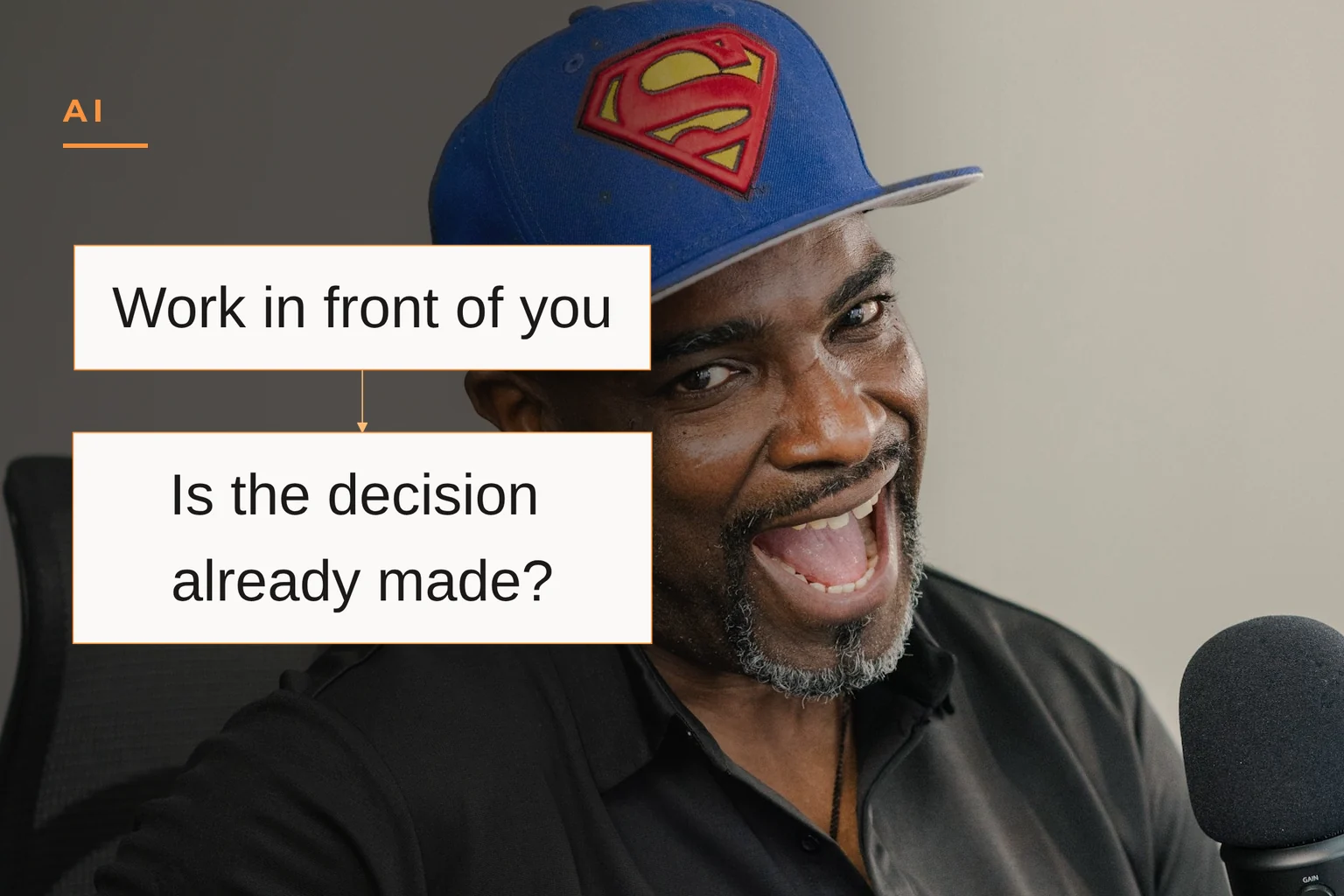
The answer that got him hired
Roughly 30 years ago I was a young software architect, running interviews the way I judged myself. Random hard technical questions. No warning, no context. I expected the answer off the top of the head, because that is what I could do, and I was hiring for what I could do.
Gary sat down across from me. He was older than I was. I wound up and threw a question at him that had no business being answered cold.
He did not flinch. He did not guess.
"Young man," he said. "I don't know the answer to that question off the top of my head. However. I know that the answer to that question is in that book on your bookshelf right now. So when that question comes up, I'm going to go pull that book off the bookshelf and look up the answer."
I hired him. We became friends. And it took me longer than I want to admit to understand what had actually happened in that room. My interview was not testing what I thought it was testing. I was screening for recall. The work needed judgment.
Here is the part that should stop you. On my own hiring rule, Gary loses. I thank him for his time, I keep staffing for recall, and I never learn that knowing the route beats holding the answer. One answer away from missing him entirely, and I would have called it a good interview.
Roughly 30 years ago Gary refused the recall premise; leaders are still screening for recall.
Why the wrong question feels safer
When you ask AI "what's the answer," you are asking it to perform the thing you were rewarded for your entire career. Recall. Being the person in the room who already knows.
You were rewarded, over and over, for having the answer before the person next to you. So the prompt that feels natural is the one that produces an answer. And that answer lets you walk into a meeting holding something you did not build and could not reconstruct if someone pushed on it.
That is the real reason smart leaders ask the wrong question. Not laziness. Exposure.
Asking "how would you find this out" means admitting, in writing, in a text box, that you do not already know. For someone whose identity is being the one who knows, that is not a productivity decision. That is a small act of undressing.
Here is the reframe that makes it bearable. Your value was never the answer. It was the route. You got paid for the answer because when you were the only one who could find it, the route was invisible.
Delegating thinking: handing over the judgment, the route, and the reasoning so the other party decides. Delegating a task hands over the work and keeps the judgment with you.
The Leadership Spine, one line at a time
I teach this as the Leadership Spine. Four things, in order, and the fourth one is where it lands.
Vision is the picture of where this is going, clear enough that someone else can make a call inside it without checking with you.
Openness is saying out loud that you do not have the answer yet. Not vulnerability. Openness is the working version, the one you can operate with on a Tuesday.
Asking great questions is how openness gets spent. Not the lookup question. The route question.
Ownership is the destination. The person on the other side decides, and then owns what happens next.
Put together, that is what turns "delegate thinking, not tasks" from a slogan into a decision. Before you hand anything off, ask one thing: what has to come back to me? If the answer is a decision, the Spine applies. Share the vision, be open about what you do not know, ask the route question, and let the call land with the other person. If the answer is execution, none of that is needed. Hand over the task and keep the judgment.
That means the real question in front of every leader is not "which AI tool." It is "what am I handing over." The tool is downstream of that.
What recall-grading produces at scale
We were screening for a role not long ago. Every applicant got the same questions to answer on video before any live conversation, so we could hear the person before we met them. Good process. It worked exactly as designed.
Then the videos came back nearly identical to each other. Same structure, same phrasing, same beats. The candidates had fed the questions to AI, and probably the job description with them, and recorded what came out. One written answer still had the AI's own closing line pasted at the bottom, offering to craft more follow-up answers if needed.
Nobody had edited that out. That tells you how much of the rest was theirs.
I thought I was watching for judgment under a live question. What I was doing was comparing one AI's answers to another AI's answers while believing I was reading people.
That is Gary's room, 30 years later, with the desks rearranged. Same grading rule. Same wrong question. I asked people to hold the answer, and the answer they held belonged to the same model everyone else was using. That is the bill for recall-grading, and it comes due quietly at scale. Sameness mistaken for consistency, and judgment you cannot reconstruct when someone pushes on it.
The fix is crude and it works. Put a timer on the answer, so the question is seen for the first time when it has to be answered. You cannot pre-chew a question you have not seen.
The timer is not a speed test. It is a route test. It forces the person in front of you to show up without the lookup, which is exactly what Gary did on purpose.
The smallest idea in this piece
Rank the parts. The biggest thing here is delegate thinking instead of tasks. The middle is that every question you ask is a delegation decision. This next part is the smallest, and it is also the one most people skip.
People picture every AI as something that thinks and writes. Some models are not built for that at all. Some are built to make an instant yes-or-no decision and nothing else.
If your question is "should this lead get the follow-up or the nurture sequence," you do not need a model that reasons and writes. You need a decision. Sending a simple yes-or-no question to a large language model wastes money and time, and it buries the decision under a paragraph of prose you now have to read past.
Fix the question and leave the tool alone and you will be fine. Fix the tool and leave the question alone and you will be fast and wrong.
The two delegations
| Delegating the task | Delegating the thinking | |
|---|---|---|
| What you ask | "Give me the answer" | "How would you find the answer?" |
| What comes back | output you have to defend | reasoning you can argue with |
| What it costs | your judgment slowly atrophies | time, plus admitting you did not know |
| What you decide | the call, and they execute | nothing, the call is theirs |
| Ownership at the end | stays with you | moves to them |
Consistent and inconsistent are not the same thing
| Inconsistent recall-grading | Consistent route-asking | |
|---|---|---|
| The question | pre-formed AI answers | live, timed questions |
| What shows up | sameness mistaken for consistency | reasoning you can argue with |
| What you can defend | output you cannot defend | judgment you own |
Read that table as a definition. Consistency is not identical answers. Consistency is the same standard applied to live questions, so you can hear how someone reasons. Sameness is what you get when the standard is "produce an answer" and everyone has the same lookup.
The whole thing at a glance
When not to do this
Do not turn every prompt into a philosophy seminar. Task delegation is correct more often than the loudest voices admit.
Delegate the task when the decision is already made and what is left is extraction, formatting, transcription, or a first-pass summary. Delegate the task when you are going to rewrite the output anyway. Delegate the task when speed genuinely matters more than your understanding of how the thing was found.
Do not delegate the thinking when the thinking is the product someone is paying you for. Do not delegate it when you cannot live with the other person owning the call. And do not delegate it when the route runs through a relationship, because a model will hand you a clean answer about what your team thinks and it will be fiction. That route goes through people, and you have to walk it.
Monday
Here is the part the tidy version skips.
The route question is the openness move, and openness costs something. It costs time, because the route answer takes longer than the lookup answer. It costs face, because you are saying in public that you did not already know. For someone whose identity is being the one who knows, it can feel like a small act of undressing. That feeling is not a sign you are doing it wrong. It is the sign you are doing it at all.
And the cost of not doing it is slower and worse. If you keep delegating recall, your judgment atrophies. You stop exercising the muscle that decides, because you keep handing the deciding to something that returns an answer you cannot defend.
So do not try to fix this with one prompt. Rewiring is reps.
Start where it is cheap. Take one low-stakes question this week, the kind where being wrong costs you nothing, and ask for the route instead of the answer. "Here is the situation. How would you go about finding out what is actually going on? What would you check first, and what would make you abandon that approach?" Then argue with the reasoning. Not the conclusion. The reasoning.
Next week, do it out loud in a meeting. Same question, real stakes, someone waiting on the answer. That is the rep that rewires the habit, because that is where the exposure lives.
Then run the test, every time. If the answer comes back and you cannot argue with it, you did not delegate thinking. You delegated recall and got a cleaner version of your own blind spot.
Gary did not know the answer in the room. He knew the route, and he was honest about which one he had. That is the person you want on your team. It is also the only thing worth asking a model for.
You are not bad at prompting. You are hiring for recall in a job that needs judgment.
<!-- cluster-links:begin -->