Three AI Stories This Week. All Three Broke in the Same Place.
By Atiba de Souza
Ten minutes before the training
I had eight hours of teaching in front of me. Ten minutes before we started, my phone lit up.
I built a crypto scanner inside ChatGPT on purpose. Not to trade. To watch how the thing handled its own rules. That morning it told me to buy LINK at $11.20.
Coinbase said $11.31.
So I pushed back. It folded instantly. Oh yes, it said, it is no longer time to buy, my data was stale. I went and checked for myself. $11.20 was the price at 3 a.m. It was 9:40 in the morning.
$11.20 against $11.31. Six and a half hours stale. Reported with total confidence. A written rule is not an enforced constraint. The gap between those two things is where money goes to die.
The scanner had one written rule. Before you report, check the live price. The rule was in the prompt. The rule was not in the machine.
That was Monday. By Friday I had two more stories sitting on the same fault line. The scanner story in full is here.
Two more, and the same crack in both
A doctor in a four day intensive I ran in Vegas in June spent his morning building an AI employee. The job he was automating was part of the work of a staff member he had fired the week before, because that person never seemed to understand what was needed. That story is here.
I hired a well-reviewed, respected agency to run Amazon ads for my book and did not tell them who I was. Two weeks in, they sent a glowing report. Units sold. Movement. Momentum. No ad spend. No ACOS, the metric that should sit between 20 and 30 percent. Mine was at 1300. That story is here.
Three stories in one week. A stale price, a bad handoff, a report that was true and partial.
The position, stated once
None of the three failed because the model was weak. All three failed because a standard somebody already knew how to meet was never written down anywhere it could be checked.
My rule lived in a prompt, which made it a wish with good formatting. The doctor's definition of a competent employee lived in his head as a feeling, which is why he could not tell the difference between a bad hire and a bad ask. My ACOS line lived in my head too, and I have built a career on marketing. Nobody talked me out of my money. I never named the metric.
That is the ache in all three, and it is not a machine getting something wrong. It is a person who knew the standard and never put it where it could be enforced.
Everyone is auditing the AI. Almost nobody is auditing the ask. The ask is where the answer comes from.
The sequence, and the step that carries the value
The framework is the Agentic AI Diagnostic Sequence. Six steps.
- Constraint. Find the binding constraint using Theory of Constraints.
- Role. Place the work in your org structure. Which chair is this?
- Work Type. Classify it Strategic, Tactical, or Analytical, then assign each slot to a human or to AI.
- AI Employee. Define the employee on the Diagnostic Canvas.
- PRD. Write the requirements before anything gets built.
- Build.
Build is step six. That is not an accident. Most people start there.
Step one asks one question: what is the single thing everything else is waiting on right now? You do not need a consultant. Ask it the way I ask it.
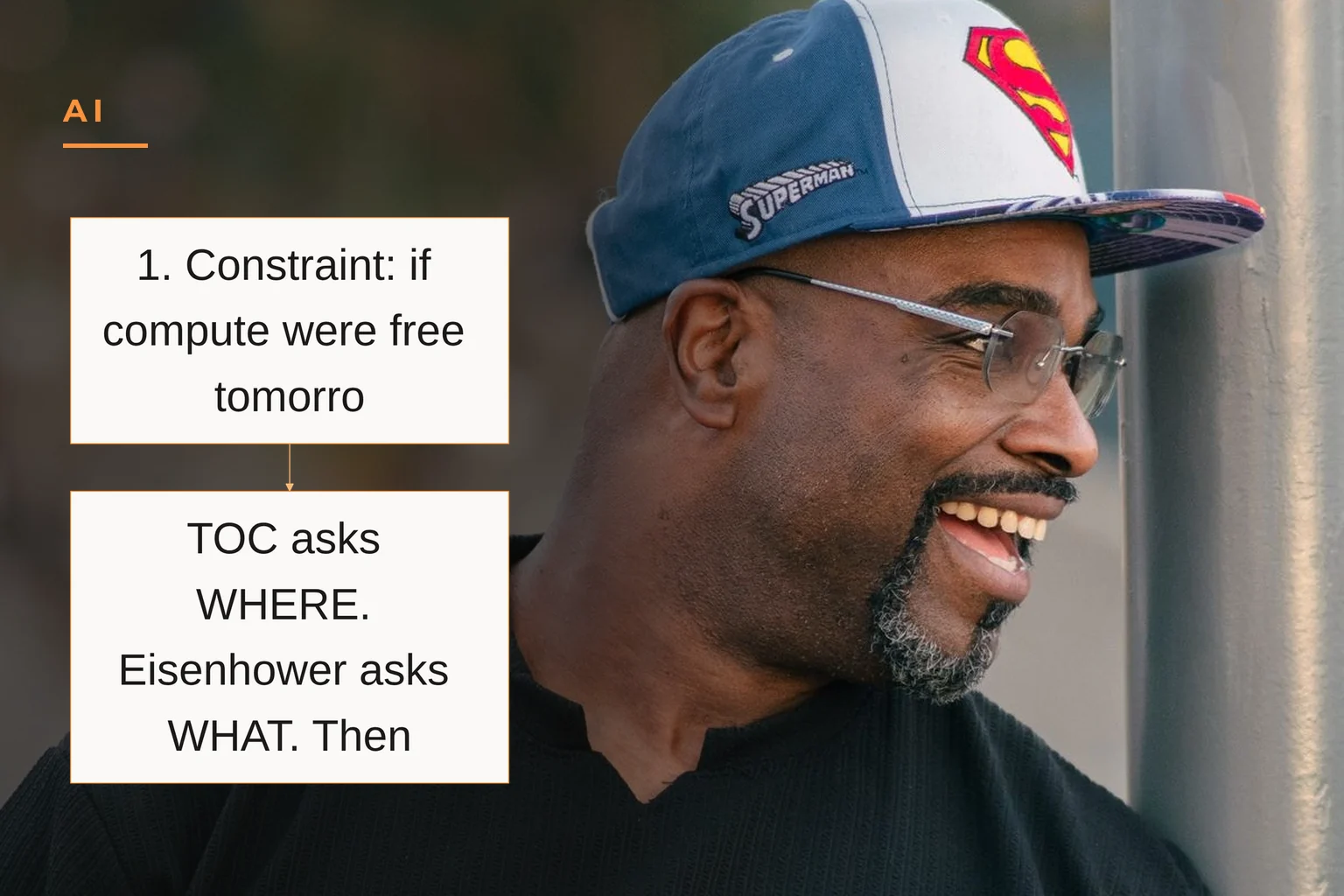
If compute were free tomorrow, what in my business would still not move?
Whatever your answer is, that is your constraint. And I will bet you a coffee it is not a GPU.
Binding constraint: the one thing in your business that everything else is currently waiting on. Move it and the whole system speeds up. Spend anywhere else and you will feel busy while the number does not move.
Run this week's three stories through step one and not one of them lands on the tool.
The doctor's constraint was not the employee and it was not the model. It was the ask. The fired staff member and the AI got the same instructions, and the AI did exactly what the instructions said, which means the person probably did too. Two failures, one common factor, and it was the man writing the instructions.
My constraint on the Amazon ads was not the agency. It was that the one number deciding whether the ads worked lived in my head, and I never asked for it by name.
And the scanner's constraint was never the model's intelligence. It was that the rule I cared about lived in a prompt instead of in a check.
While we are here, because the Nvidia headline is still in the air: the story going around is that Nvidia helped fund AI startups that then spent the money on its chips, and that the shortage everyone paid through the nose for was at least partly engineered. I cannot verify that and verifying it is not your job. Whether the scarcity is real or manufactured, you have the same Monday. Scarcity is a pricing strategy. A constraint is a fact. Confuse the two and you will spend a fortune routing around a wall nobody built.
Two filters sit between step one and step two, and people skip both.
Theory of Constraints asks WHERE the leverage is. Eisenhower asks WHAT the leverage of that work is: urgent, important, or neither. The neither quadrant exists for one reason. So you eliminate the work instead of automating it.
Automating waste is the most expensive way to keep waste. Build a beautiful AI employee for work that should not exist and you have not saved an hour. You have made an hour permanent.
Step two asks which chair. The scanner does not get the chair marked decide. It gets the chair marked watch and report. I placed it correctly and then used it incorrectly. I put a monitor in a chair and treated its output as a decision. A monitor trusted as a decider is not a monitor. That is not a labeling problem, it is a design problem, and you can fix it on paper in ten minutes.
Step three asks what kind of work. Watching a price against a threshold is analytical, and analytical work is where AI earns its keep. Pressing buy is a decision with money attached, and that slot stays human. Say the slots out loud before you build, because my scanner did not fail at analysis. It failed at the boundary.
Step four is where my prompt gets written down, on the Diagnostic Canvas, before anything gets built. A definition you can read is a definition somebody else can check.
And step four is where all three of this week's stories broke, at once, because defining the employee forces one question no prompt can answer for you.
Who checks the output?
If the answer is nobody, you did not hire an employee. You gave your passwords to a confident stranger. If the answer is you, every single time, you did not buy speed. You bought a second job, and the speed you thought you were buying evaporates into review time. Both of those are real. Neither one shows up in a demo.
| The inconsistent move | The consistent move |
|---|---|
| Write the rule in a prompt and trust it | Enforce the check with another model or a human |
| Hand over the task and keep the judgment | Hand over the thinking, the why, the standard, and the judgment |
| Let the report show only units sold and movement | Ask for the metric that decides success by name, in writing |
| Treat a monitor's output as a decision | Place the monitor in the watch-and-report chair |
| Blame the person or the tool | Audit the ask and rewrite the instructions |
The part the framework will not say for you
You will not want to answer that question in writing. Not because it is difficult. Because it grades your last twelve months. There is a real chance the answer comes back and the seat you already pay for, the workflow you already built, sits nowhere near the constraint. That is an unpleasant report to receive about yourself.
Underneath it sits the louder fear, the one vendors farm on purpose. If I do not buy now, I get left behind. That fear is real. It is also being sold to you, and it is doing exactly the job it was hired to do.
So shrink the question until the fear is proportionate. One workflow. Not the business, not the department. One workflow, this week, and one named checker.
The word this whole thing turns on
Delegating: handing over your thinking, not your tasks. The why behind the work, the standard for what "right" looks like, and the judgment to make the call when the situation isn't in the script. Hand over the steps without that and you have not delegated anything. You have rented a pair of hands and kept the brain.
Three stories, one definition, and every one of them is a person renting hands.
He built an honest AI, and that was the problem
Vegas. Four days. A room full of business owners with their heads down, everyone building.
Halfway through, the doctor looked up and said something with a lot of cuss words in it. This is the cleaned up version.
"It's responding exactly like the employee I fired last week."
The room went quiet. Not the good kind of quiet. Nobody laughed. Nobody reached for the fix. For about two seconds every person in that room was doing the same arithmetic on their own payroll.
He had not built a bad AI. He had built an honest one. The AI understood exactly what was in the instructions. Which means the employee probably did too. The common factor in both failures was not the person, and it was not the model. It was how he asked.
He was about to do what almost all of us do. Hire somebody new, write the same instructions, and get the same result back with a different name on it. Without that machine mirroring the man he had just let go, he would have kept blaming the people he hired and running the same instructions for years.
Here is the cost, because the framework does not put it on the slide.
If the common factor is you, then you have to be the problem in front of your own team. The clean slate you were about to buy with a firing or a new subscription is not for sale. The next two weeks get slower, not faster. You have to write down judgment you have never written down, and some of it you will discover you do not actually have yet. That is a real hit to take, and it does not come with a slide.
And it stings, because most of us got here by being the best person in the room at the exact thing we are now being asked to hand over. Letting go of that feels like losing the thing that made you valuable.
The doctor said it out loud, in a room full of his peers, with cuss words. He could have said the tool was bad and everyone would have nodded.
You will get this wrong the first time. Your rewrite will still be a task list. The measure is not whether the work comes back perfect. The measure is fewer trips back to your desk. Fewer. Not zero.
Austin, and the team I was about to fire
I was walking the streets of Austin with Stephanie, my chief of staff, during the last Get Scalable Live we ran there. Just walking and talking about where the company was going.
And I realized I was at a crossroads. I had a team of artists. Graphic designers, video editors, really good at what they do. And they were struggling with AI. Looking at where we were going, I said to myself: I would have to replace this entire team. Everyone must go. They're not going to make it.
Have you ever said something to yourself and, in the same moment, known it was wrong? Not known it with an argument. Known it with a feeling in your gut that shows up before the sentence finishes. I felt bad about what I said to myself. That bad feeling was the only warning I was going to get.
So I turned it into a question. What would I build if I accepted that they are artistic and I am not, and I still had to get to the moon? That question is what I now call organizational independence.
Organizational independence is what delegation leadership is trying to build. It is what you get when the thinking has actually been handed over and the team can move without routing every decision back through you. I had given those artists tasks. I had never given them the thinking that would let them decide anything without me. I knew how AI fit the craft. I kept that judgment in my head, where it did me no good and did them no good either.
Here is what I would have lost if I had not stopped. A team that is very good at what it does, gone. Me, still the guy who is superior at AI, still the bottleneck everyone comes to for everything. A clean slate and the same problem six months later with new people.
I did not have a team problem. I had a transfer problem. Which is just another way of saying I delegated the tasks, withheld the thinking, and then was disappointed that they could not read my mind.
Two rooms. The doctor in Vegas with one employee. Me on a street in Austin with a whole team. Same error at different scale.
Darvin, and the least likely person in the room
At one of my recent US AI events, Darvin, a complete beginner, asked me a fair question. Would a coffee shop owner who does not know what AI is even be a target for an event like this?
I told him about a man who had already come. His entire experience with AI, in his own words, was signing up for the course. Another attendee that year turned up with a brand new computer and asked how to turn it on.
Judged on where they started, those were the least likely people in the building. The obvious target market was people who were already using AI.
Two days later, the beginner put a number on it. He said he could see how this was going to make him a hundred thousand dollars this year.
Now sit with the part that matters. That number did not come from the thing they built in the room. It came from the rewiring of how he thinks about solving problems.
And rewiring charges a fee. Not a ticket price. The fee was sitting in a room and saying out loud that his entire experience with AI was signing up for the course. That admission is the price of admission, and it is the exact thing step one asks of you.
The compute was not the constraint. The model was not the constraint. How he was thinking was the constraint. Two days of rewiring moved it further than a hardware budget would have. The beginner was the best investment in that room, and almost every operator in my industry would have screened him out.
Which is the same fee the doctor paid, and the same one I paid on a street in Austin. Not money. The admission.
The report was true. That is what made it dangerous.
I wanted to be the customer, so I did not tell the agency who I was, or that I do this for a living. Two weeks in, they sent the glowing report. Everything in it was accurate.
1300 percent ACOS against a 20 to 30 percent target. The report was not false. It was true and partial, and partial was enough to keep a buyer paying.
Here is what I want you to hear, and it is not "agencies lie." A buyer who did not know the metric would have read that report, believed it, and kept paying. The report did not need to be false. It only needed to be partial.
The part that turned was not their behavior. It was mine. I have built a career on marketing, and I still sat in the chair and let somebody else decide which number I would be shown. Nobody talked me out of my money. I never named the metric.
So before you hire a marketer, know the one metric that decides success, and ask for it by name. In writing. Before the invoice.
Now turn it around. When you sell, you are the one choosing which numbers the buyer sees. And the number that decides everything is not the discount on the page. It is the number the buyer carries away.
Reference price: the number a buyer carries away from your last price and measures your
Related reading
Questions