The OpenAI Board Asked Whether AI Can Be Trusted. A Doctor in Vegas Asked a Better Question.
By Atiba de Souza
The argument in the boardroom, and the sentence in the workshop
The people who fired Sam Altman have made the case that we still can't trust an AI to run a company. I am not going to argue with them about whether that is true.
I am going to show you why the question, as asked, cannot be answered. And I am going to use a doctor in a Las Vegas conference room to do it.
In June I ran a four day intensive in Vegas. A room full of business owners, heads down, everyone building. Halfway through, one of them, a doctor, had spent the morning building an AI employee. The job he was automating was part of the work of a staff member he had fired the week before. The reason he fired the person: they never seemed to understand what was needed.
Then he looked up and said something with a lot of cuss words in it. This is the cleaned up version.
"It's responding exactly like the employee I fired last week."
The room went quiet. Not the good kind of quiet.
He had not built a bad AI. He had built an honest one. The AI understood exactly what was in the instructions. Which means the employee probably did too. The common factor in both failures was not the person, and it was not the model. It was how he asked.
He was about to do what almost all of us do. Hire somebody new, write the same instructions, and get the same result back with a different name on it. Without that AI mirroring the person he had just let go, he would have kept blaming the people he hired and repeated the same instructions for years.
Everyone is auditing the AI. Almost nobody is auditing the ask. The ask is where the answer comes from.
The framework: delegate thinking, not tasks
Most delegation advice sounds sensible. Write the SOP. Hand it off. Check in on Fridays.
That is not delegation. That is renting hands.
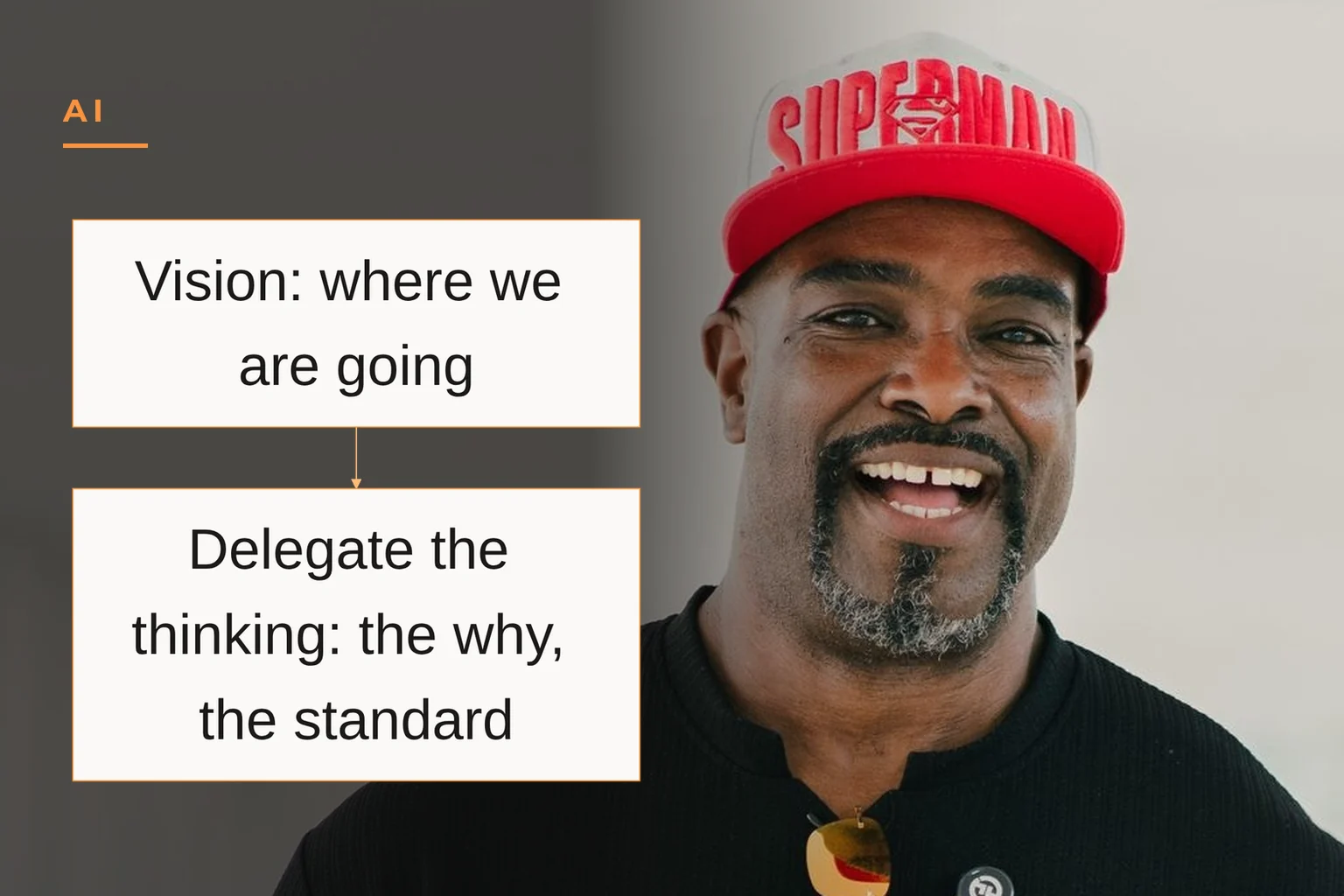
Delegating: handing over your thinking, not your tasks. The why behind the work, the standard for what "right" looks like, and the judgment to make the call when the situation isn't in the script. Hand over the steps without that and you have not delegated anything. You have rented a pair of hands and kept the brain.
If you hand over the steps and keep the judgment, then every situation that isn't in the steps comes back to you. You become the routing table for your own company. The work comes back wrong, not because the person is bad, but because everything they needed to make the call stayed in your head.
Here is the whole model at a glance:
Now look at the boardroom argument through that lens. We keep asking whether the machine can be trusted to think like a leader. We almost never ask whether the leader ever handed over the thinking in the first place. Those are two different questions. Only one of them has an answer.
Austin, Stephanie, and the team I was about to fire
I was walking the streets of Austin with Stephanie, my chief of staff, during the last Get Scalable Live we ran there. We were talking about where the company was going. Just walking and talking.
And I realized I was at a crossroads. I had a team of artists. Graphic designers, video editors, really good at what they do. And they were struggling with AI. Looking at where we were going, I said to myself: I would have to replace this entire team. Everyone must go. They're not going to make it.
Have you ever said something to yourself and, in the same moment, known it was wrong? Not known it with an argument. Known it with a feeling in your gut that shows up before the sentence finishes. I felt bad about what I said to myself. That bad feeling was the only warning I was going to get.
So I turned it into a question. What would I build if I accepted that they are artistic and I am not, and I still had to get to the moon? That question is what I now call organizational independence.
And here is the part I had to sit with, because it is the same lesson as the doctor's. Organizational independence is what delegation leadership is trying to build. It is what you get when the thinking has actually been handed over and the team can move without routing every decision back through you. I had given those artists tasks. I had never given them the thinking that would let them decide anything without me. I knew how AI fit the craft. I kept that judgment in my head, where it did me no good and did them no good either.
Here is what I would have lost if I hadn't stopped. A team that is very good at what it does, gone. Me, still the guy who is superior at AI, still the bottleneck everyone comes to for everything. A clean slate and the same problem six months later with new people.
I did not have a team problem. I had a transfer problem. The thing I failed to transfer was independence in the work. Which is just another way of saying I delegated the tasks and withheld the thinking, and then was disappointed that they couldn't read my mind.
Two rooms. The doctor in Vegas with one employee. Me on a street in Austin with a whole team. Same error at different scale.
The only test that actually settles it
Here is the test every AI effort in a business has to pass. Does it make money.
If AI is not showing us the money, there is no point. We are in business for profit, not to be cool.
That test cuts through the trust argument in a way that no amount of op-eds will. You can debate a feeling forever. Nobody argues with a number. So when the AI does not show up in the profit, you have two places to look. Is the tool good enough. Or did I hand over the task and call it delegation.
Nine times out of ten, if you are honest with yourself, you already know which one it is. The problem is that nobody has ever made you write the answer down.
Inconsistent versus consistent: what we do when work comes back wrong
| Inconsistent: blame shifts | Consistent: the ask gets audited |
|---|---|
| Replace the person | Rewrite the ask |
| Blame the tool | Audit the instructions |
| Add more steps to the checklist | Transfer the judgment behind the steps |
| Ask "why don't they get it?" | Ask "what did I never say out loud?" |
| Hire again with the same instructions | Expect the same answer again |
| Demand trust | Demand the money |
Ranked: what matters here and what doesn't
Most important. When the same result comes back from different people, or from a person and then a machine, the ask is the variable. Not the delegate. That single shift will save you more money than any tool you buy this year.
Second. AI is an unusually honest mirror. It reflects your instructions back with no social filter. Your employee softened it, filled in the gaps, guessed what you meant because they know you. The model will not guess. It will do exactly what you said. That is uncomfortable, and it is a gift.
Least important. The wording. Do not spend three weeks on prompt engineering. The judgment and the standard are the work. The verbs are decoration.
When NOT to do this
Do not turn "my instructions were bad" into an excuse to keep somebody who will not do the work. There is a real difference between a person who never got the thinking and a person who got it and won't act on it.
So rewrite the ask. Give the why, give the standard, give the judgment. Do it twice if the first pass was still a task list in disguise, which it will be. And if it still comes back wrong from a human who has everything they need, that is a fit problem, and replacing them is the right call. Delegation leadership is not a vow of endless patience. It is a discipline of checking your own side of the handoff first.
And if the work genuinely has no judgment in it, a checklist is fine. Don't over-engineer a job that is actually a job.
What this costs you, because nobody puts this on the slide
If the common factor is you, then you have to be the problem in front of your own team. That is expensive.
It means the clean slate you were about to buy with a firing or a new subscription is not for sale. It means the next two weeks get slower, not faster. You have to write down judgment you have never written down, and some of it you will discover you don't actually have yet. That is a real hit to take, and it does not come with a slide.
And it stings, because most of us got here by being the best person in the room at the exact thing we are now being asked to hand over. Letting go of that feels like losing the thing that made you valuable.
The doctor said it out loud, in a room full of his peers, with cuss words. He didn't have to. He could have said the tool was bad and everyone would have nodded.
You will also get this wrong the first time. Your rewrite will still be a task list. The measure is not whether the work comes back perfect. The measure is whether it needs fewer trips back to your desk. Fewer. Not zero.
What to do Monday
Pick the one piece of work that keeps coming back wrong. Not the biggest piece. The one that keeps coming back.
Before you replace the person, the tool, or the process, answer three questions in writing. In writing is the part people skip, and it is the only part that works.
- What does "right" look like when it's done? Describe it the way you would describe it to yourself.
- What judgment am I making here that I never said out loud?
- What should they do when the situation isn't covered?
Do not expect clean answers. At least one will come back blank, and one will be something you would rather not admit. Write "I don't know yet" in the blank and go find it. That blank is the thinking you were keeping. Blank is not failure. Blank is the whole point of doing it on paper.
Rewrite the ask with those three answers inside it. Send it. Watch what comes back.
And when it comes back better, do not credit the model and do not congratulate yourself on a clever prompt. What came back is the judgment you had been sitting on the entire time. The tool just refused to pretend it could read your mind.
The boardroom can keep debating whether a machine is fit to run a company. That argument has no bottom, and it will still be running when the next AI model ships. The question with a bottom is the one in your own building: did I hand over the thinking, or did I hand over the steps and keep the brain?
Skip it and nothing dramatic happens. You hire again. You buy another tool. You write the same instructions with new enthusiasm, and you get the same answer back under a different name. Then you spend another year being the person every decision has to route through before it can move.
That is the actual price. Not a failed project. A company that cannot move without you.
Start with the one thing that keeps coming back. It will tell you the truth about your ask faster than any boardroom ever will.
Questions