The Real Reason You Can't Take a Two-Week Vacation (It's Not Your Team)
By Atiba de Souza
The update that ate a week
The week of July 21, 2026, I lost every scheduled Claude task I had running, every project, every instruction inside every project. Not because anything broke in the sense you'd expect. I ran a routine application update, and the update destroyed the install. Everything I had was sitting on my own desktop machine. One update. One week, gone.
Here's the part that matters for you: it wasn't the update that cost me the week. It was where the work lived. Those same jobs run in the cloud now. If they'd been running there then, the update would have cost me nothing. A machine crashing has nothing to do with work stored somewhere that survives the crash.
Now swap "desktop machine" for "your head." Swap "scheduled task" for "the decision only you know how to make." Same failure, different install. You're not on vacation for two weeks because, somewhere under the vacation-planning, you know the company is running on your local machine. If you go down, or go dark, the whole install goes with you.
That's not a trust problem with your team. It's an architecture problem with your company.
The word this whole thing turns on
Organizational Independence: building a company that can think without you.
Not run without you for a day while you're at a conference with your phone off. Think without you. Make a call you didn't pre-approve, at a moment you weren't watching, and be right anyway.
Most leaders are optimizing for "doesn't burn down while I'm gone." That's a much lower bar, and it's why the vacation still feels like a risk instead of a rest.
The three questions, in order, and why the order is the whole point
Organizational Independence isn't a culture initiative. It's three questions, answered in sequence, with a loop that feeds the answer back to the start.
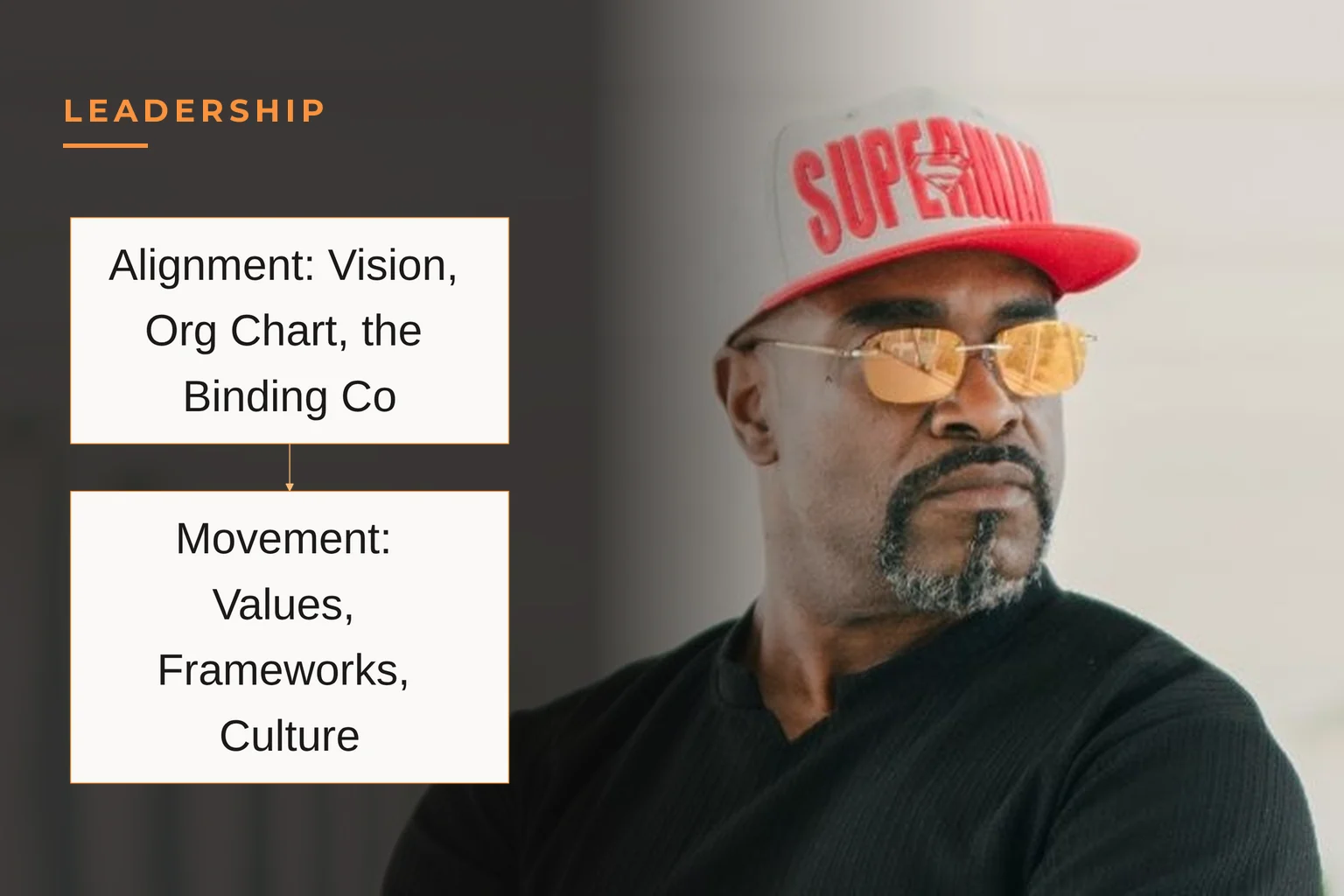
1. Alignment asks: do we know where we're going, and who owns what thinking? Vision, org chart, and the one constraint actually limiting the business right now. This last part has a name: Theory of Constraints, and inside it, a practice worth stealing called the Big 3. You don't sit with the twenty problems on your whiteboard and try to fix all twenty. You force the list down to the three real candidates for what's actually capping your output, then you find which one of the three is genuinely binding, and you put everything else down until you fix it. Most companies skip Alignment entirely and go straight to culture posters, which is a way of building on a vision that only ever lived in your head.
2. Movement asks: can they decide and act without me? Values, frameworks, culture. This is where you find out if "aligned" was ever true, or just something people said in the all-hands.
3. Measurement asks: can we tell if we were right? This has two halves, and most people only build one of them. Everyone has a KPI, a signal that exists whether you look at it or not. But before you assign a single KPI, you have to start past the end: define what winning actually looks like, then work backward from that finish line to the number that tells you you're near it. Skip that step and you get KPIs that measure activity instead of the win, dashboards full of numbers going up that have nothing to do with whether you got where you said you were going. The decision this forces on a Monday: don't build the scoreboard first. Write the finish line first. Then decide what number is allowed to represent it.
Then the loop: measurement feeds back into alignment. And this is where the framework stops being a diagram and starts costing you something. The loop is asking you to let a KPI, a number produced by somebody else's work, override a vision you wrote from instinct and have been proud of for a year. That's not a paperwork update. That's you admitting the plan needs to move because a signal you don't fully control just told you it does. Most founders will protect the vision from the data before they'll let the data touch the vision. The loop only works if you're willing to be the one who's wrong.
Rank this honestly: alignment matters more than the other two combined. If the org chart is fuzzy about who owns what thinking, no framework and no KPI dashboard saves you. You'll have built movement and measurement on top of confusion, and confusion measured precisely is still confusion.
When you should NOT do this
If you're pre-product-market-fit, or your team is under five people, stop. You are the alignment engine right now. Writing a formal org chart and assigning KPIs to a three-person team building toward its first real customer is theater, not independence. You'll spend a week in Notion instead of a week talking to customers.
But be honest about why you're tempted to build it anyway. At five people, an org chart is sometimes not preparation, it's avoidance. It's easier to draw boxes than to sit with the fact that the constraint on the business is you, your attention, your bandwidth, and admitting that out loud feels like admitting you're the bottleneck by choice, not by circumstance yet. Do this when the constraint the business is actually hitting is genuinely you. Not before, and not as a way to feel productive while you dodge the harder conversation about what only you are still doing.
The diagnostic hiding in plain sight
Here's the test for whether "aligned" is real or something people say to you in meetings: two people can hold the exact same stated value and spend their day on almost nothing in common. Two people who both say "I care about my health," one runs an 18-step skincare routine, the other logs 20,000 steps. Same value. Zero overlap in behavior. The value tells you what someone believes. It tells you nothing about what they'll actually do with their Tuesday.
Run that same test on your team. Two people can both say "I'm aligned with the vision." One spends the day chasing your approval before moving. The other spends the day making a call you'd never have made yourself, and it works out fine. Same words. Opposite behavior. The words were never the signal. The calendar is the signal.
If you want to know whether you've built alignment or a slogan, don't ask what they believe. Look at what they did this week without asking you first.
The binding constraint, made visible in four hours
Back at my desk on a Monday after a weekend off, running a $200-a-month Claude plan, I decided it was time to actually build something I'd been circling for weeks: a learning agent. In four hours I burned through the entire month's $200 in API credits.
Four hours. $200 in credits, gone. More shipped in that afternoon than in the entire week before it.
The obvious reaction is panic. Mine wasn't, once I looked at what those four hours produced. This is the Big 3 exercise, run on myself. The build had never been waiting on a model, a budget, or a team's bandwidth. Those were the plausible constraints, the ones that look like the answer. The actual binding constraint was the rate at which I let myself ship something I'd already built. The moment I stopped rationing my own output, the whole system's throughput jumped, because the constraint was never anywhere but in my hands.
The line that came out of my mouth was "that's nuts, we're not about to have a $3,000 week." Notice what that sentence isn't. It isn't "we need to slow this down." It's a founder doing math on what it costs to sustain a pace that just proved, in four hours, how much the old bottleneck was costing everyone by being the only place decisions and work could pass through.
Naming the actual fear, because the framework won't do this part for you
You will not build this because you don't know the three questions. You now know the three questions. You will not build it because doing so means admitting that the reason you can't leave for two weeks is you, by design, not your team, by deficiency. That's a harder thing to sit with than "my team isn't ready."
The cost is real too. Building alignment, movement, and measurement takes weeks you'd rather spend doing the work yourself, because doing it yourself is fast, familiar, and doesn't require you to watch someone make a call differently than you would have. Watching that, and being okay when it works anyway, is the actual rewiring. The org chart is paperwork. Tolerating a decision you didn't make, and a vision the data just told you to move, is the muscle.
The two companies, side by side
| Owner-dependent | Organizationally independent | |
|---|---|---|
| Alignment | Vision lives in your head; org chart informal; constraint undiagnosed, hidden in a list of twenty problems | Vision, org chart, and the one binding constraint (the Big 3, narrowed) are written down and owned |
| Movement | Every real decision routes through you | Values and frameworks let people decide and act without asking |
| Measurement | KPIs measure activity because no one defined the win first | You start past the end, define the win, then everyone has a KPI tied to it |
| The loop | Data that contradicts your instinct gets ignored or argued with | The vision moves when the data says it should, even when that costs your pride |
| Where the work lives | On your desktop, in your head, in your calendar | In a system that survives an update, a crash, a vacation |
The Monday move
Don't start with the org chart. Start with the calendar. Pull your last two weeks and mark every decision that routed through you that didn't need to. That list is your actual binding constraint, not the one you'd guess in a strategy offsite, and reading it honestly is uncomfortable. It's a list of the calls you're afraid to hand off, dressed up as busyness.
Building the process to route those decisions elsewhere is the easy part. It's a checklist. The hard part is what comes after you build it: someone else makes one of those calls differently than you would have, and you have to let the result stand instead of quietly overriding it. That tolerance, not the process, is what Organizational Independence is actually asking you to build.
Then ask the real question the vacation is testing. If that list disappeared tomorrow, would your company get slower, or would it, like a learning agent finally allowed to run at its own pace, do more than you expected in less time than you budgeted for.
If you don't know the answer, that's the whole article. You haven't built a company yet. You've built a very good job, and you're the only one who can log in.