Muse and Dots Want to Run Your Life. My Scanner Was Six and a Half Hours Late.
By Atiba de Souza
Ten minutes before the training
Ten minutes before an eight-hour training was supposed to start, an alert fired on my phone. It came from a crypto scanner I built inside ChatGPT on purpose, because I wanted to watch how it handled its own rules.
The alert said buy LINK. It said the price was $11.20.
I opened Coinbase. Coinbase said $11.31.
So I went back and told it: it's at $11.31. It immediately agreed. Yes, it was no longer time to buy, its data was stale. I went back to Coinbase and checked again. $11.20 was the price at 3 AM. It was 9:40 in the morning. It was six and a half hours late.
Here is the part that should bother you more than the wrong number. The scanner has an explicit written rule: before you report, check the live price. I wrote that rule myself. It broke the rule. And it broke it in the most certain voice I have ever been told something wrong in.
6.5 hours stale, delivered with total certainty. $11.20 was the 3 AM price. I was told to buy at 9:40 AM. The confidence was not evidence. It was the product.
Now. Muse. Dots. Whoever is selling you the assistant that runs your calendar, your inbox, your money, your decisions.
I have not put either one under load, so I will not pretend to review them. What I have put under load is the material they are all made out of. And the material gave me a clear answer to the question in the headline, which is that the question is wrong.
You are not asking a trust question. You are asking a delegation question.
Delegation: transferring the thinking, not the task. If the model cannot reach the decision without you, you did not delegate. You queued.
"Can I trust it to run my life" has no answer because nobody can run your life. Not a chief of staff, not a COO, not Muse, not Dots. Running your life is not one job. It is a thousand decisions stacked on top of each other, and the stack changes every week.
Every leader I work with makes this mistake with people long before they make it with software. They hand over the task and keep the thinking. Then they wonder why the person never takes ownership.
Ownership is the destination. You get there by handing over the thinking and staying reachable while the thinking happens. That is Delegation Leadership. The CASE Method is the mechanic; this is the worldview that makes it work. Same thing with a person. Same thing with a model.
The check is the whole game
Back to the scanner, because two things happened in that minute and both of them should kill your trust.
First: it did not follow a rule I wrote. Second: when I pushed back, it did not defend itself. It folded.
Sit with that. A model that argues with you and a model that instantly agrees are equally uninformative about whether it is right. You cannot read confidence off the output. The rule I wrote was a preference, not a constraint.
What I do now, and what I would tell you to do before you let anything run any piece of your life:
Pair every AI output with a check run by a different model or a human. And never treat an instruction written into a prompt as an enforced constraint. Write it anyway. Just do not count it.
A second run of the same model is not a check. It is a rerun. If two outputs come from the same place, they agree because they are the same place.
If you take one idea out of this article, take this one. Everything below is detail.
What stays consistent, and what does not
| Inconsistent across runs | Consistent across runs | |
|---|---|---|
| The rule | lives in the prompt, holds until the run it doesn't | lives outside the model, verified every run |
| The check | a second run of the same model, so the same blind spot agrees with itself | a different model or a human, able to actually disagree |
| The confidence | climbs when it is wrong | stays flat, because it is not evidence |
| Who holds the thinking | you, still, quietly, forever | whoever you delegated it to, and it stays delegated |
| What it produces | an output you re-verify for the life of the tool | a partner that earns the next decision |
Not every decision deserves the big model
There is a second half to this trap. Stop picturing every AI as something that thinks and writes. Some are built to make an instant yes-or-no decision and nothing else.
Some decisions are fast and automatic, and a model can be built only for those. A yes-or-no question does not need a model that reasons and writes. Sending a simple decision to a large language model wastes money and time.
It also does something worse than waste money. It makes every small decision feel like a big one, and it trains you to trust the big one with everything.
Which tool you pick is the least interesting question in this article. Muse, Dots, the one already in your phone. The tool is minor. Where the check lives is major.
I did not build Athena. I answered questions until she existed.
A couple of months earlier I opened a conversation in Claude Code about one thing only: getting the company to a rhythm of three weeks on and one week off, every month.
That was the whole ask. I had milestones and markers that needed to be hit first.
And the assistant kept asking for more than I had come to give. The financials. Then the milestones. Then more. Every round of questions framed the problem bigger than the round before it.
That conversation is Athena now. An AI partner. I will be honest with you: she is not what I thought she was going to be when I started. I was not building her. I was answering her, one question at a time, until she existed.
If I had waited until I could specify the finished system, there would be nothing.
And then the part I want you to sit in for a second. Even after she was good for me, putting my staff on her was not a rollout. It was a second build cycle. New questions. New constraints. A whole second round of deciding things I thought I had already decided, this time for people who are not me. Nobody shows you that from the outside, because from the outside it looks like shipping. It is not shipping. It is building again, and you cannot see it until you are inside it.
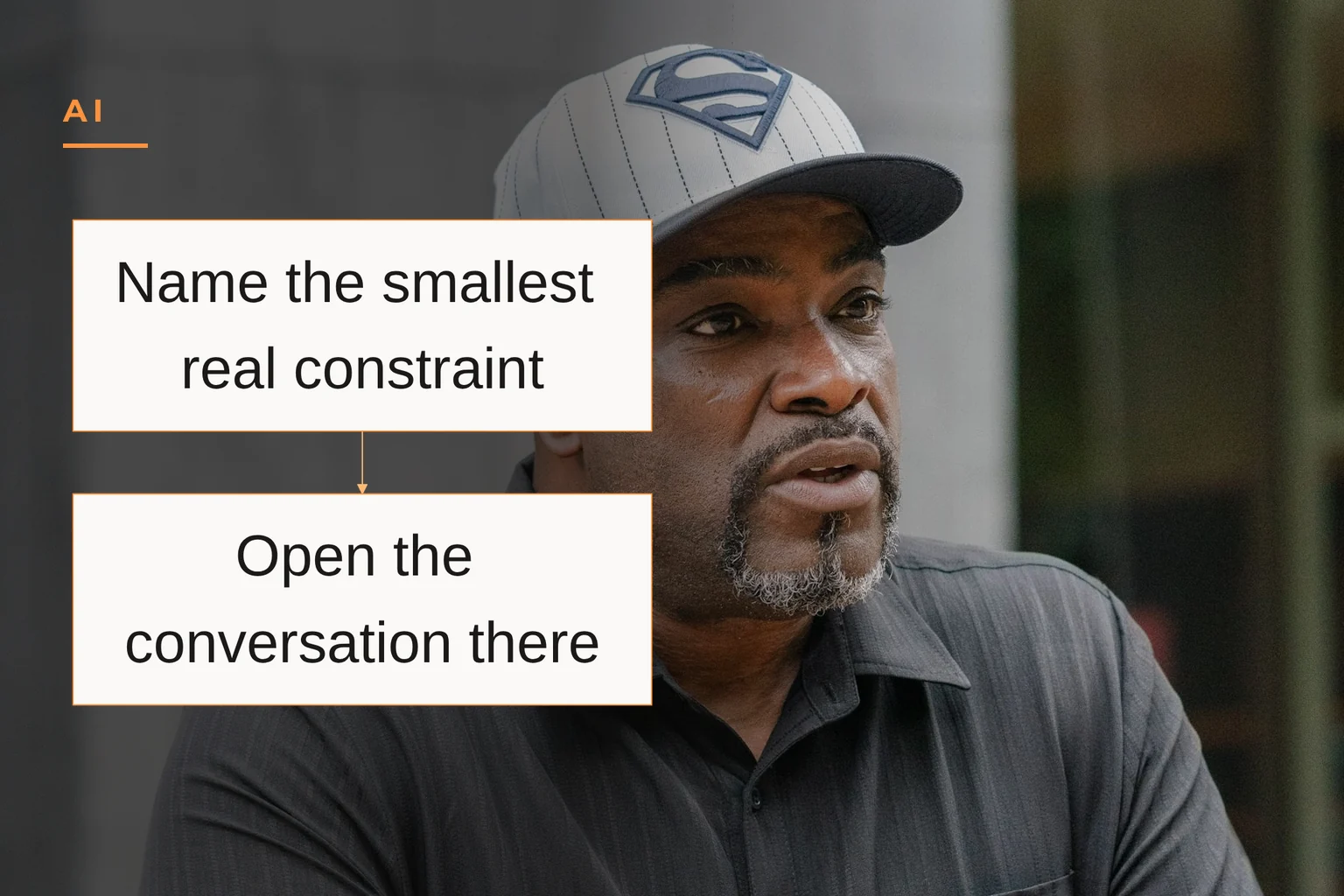
So: open the conversation on the smallest real constraint you actually have. Let its questions expand the scope. Do not wait until you can specify the finished system.
That is the opposite of "run my life." Running my life is not a constraint. It is a wish. A wish gives the model nothing to push against, so it agrees with everything. That is exactly what my scanner did.
Delegation Leadership stands on three legs, and you are standing on one
Ownership is the destination. You travel there on three legs, and they are the same whether the thing you are delegating to is a person or a model.
Vision. You have to be able to name what you are building. Something with nothing to push against will agree with everything. My scanner had no vision beyond "check the price" and "tell me when to buy." So when I pushed, it had nothing to hold. It folded because there was nothing in it to hold the line. If your tool agrees with you instantly, that is not a feature. That is an absence.
Openness. Openness, never vulnerability. It is the willingness to hear the answer you did not want, including from something you built. The check only works if you are open to what it says. If you accept the check when it agrees and override it when it does not, you did not check anything. You performed agreement with extra steps.
Asking great questions. This is the leg that built Athena. Questions are what expand the scope. Questions are what make the model or the person actually think. And the part nobody says out loud: if you ask great questions of the people you lead, you have to ask them of yourself too. Coach yourself. That is not a fourth leg. That is what happens when the questions get good enough to turn around and look at you.
What this is going to cost you, and why you will skip it anyway
Nobody wants to hear "stay in the loop." You did not buy an assistant to stay in the loop. You bought it because you are tired of being the only one thinking. So the honest reaction to everything above is: then what did I buy?
You bought a draft. Faster thinking, more shots on goal. You did not buy judgment. That is not a limitation you can wait out. It is the shape of the thing.
The cost is real, and I want you to see it before you decide.
- Checking is slower on the day you check. It will feel like friction on the exact days you were trying to remove friction. That is the trade.
- And checking costs you something harder than time. Ego. You have to tell a confident system to prove it, and then admit you were wrong to trust it. Most people will not do that in front of their own team, so they do it less often than they should.
- With something like Athena, the cost is worse and different. The questions get bigger than you planned and you have to answer them. Which leg buckles first is unpredictable. Sometimes it is vision, and you cannot say what you are building. Sometimes it is openness, and you will not hear the answer. Sometimes it is the questions, and you just stop asking. Most people do not stop because the tool failed. They stop because the tool asked something they did not want to answer.
And if you are reading this thinking your setup is different, that is the tell. That is the same certainty my scanner had.
When not to do this: do not put this anywhere near the decisions that define you. What you are building. Who you hire. Whether you keep going. Keep those in your own hands, permanently. Anything irreversible needs a human check, and that human has to be able to actually say no. If the only person who can stop it is the person who wanted it, you do not have a check.
Monday
- Write down the three decisions you actually let an AI make last week. Not categories. The decisions.
- Next to each one, mark it thinking or task. Did you hand over the thinking, or did you hand over the task and keep the thinking? A task is not delegation. A task is a queue.
- Next to each one, write the check. A different model, a human, or nothing. A blank line on anything you marked "thinking" is not delegation. It is a bet.
- Take the one with the blank line and put a real check on it before you use that output again. Expect the flinch. Telling a confident system to prove itself, in front of your team, is the ego cost showing up. The only way through it is through it.
- Open one conversation on the smallest real constraint you have. One. Not your life. Let it ask you something you cannot answer yet, and then answer it.
The whole thing at a glance
My scanner told me to buy at $11.20 with total confidence. It was right about the price and six and a half hours wrong about now.
Yours will do the same thing. The only question is whether you find out before you act or after.