The Tier Nobody Bought Was Doing the Work. Disney Just Took It Away.
By Atiba de Souza
Two days is the tell
Disney raised prices days after confirming that ads will now show up on every tier.
Everybody is arguing about the price. I keep looking at the order of events. Somebody decided to put ads on every tier. Then, days later, somebody decided to charge more. Two decisions, one direction, and nothing new in the box.
Read that as greed and you learn nothing, because you cannot copy greed. Read it as an offer problem and it gets uncomfortable, because you are probably about to run the same play.
Nothing new got solved for the buyer in that week. Nothing new got delivered. A bigger number arrived days after the reason for the old one got thinner, and the buyer is the one who notices that.
A price is not raised by announcing a bigger number. It is raised by giving the buyer a bigger reason, and the reason has to arrive before the number does.
The item on the list nobody was supposed to order
Think about the last pricing page you built. There was a top tier on it that almost nobody was going to buy, and you knew it when you wrote it.
Here is what you may not have seen. That tier was working. Every single day.
Stop thinking of the expensive tier as the one you hope to sell. Start seeing it as the reference price. It is the number that makes the tier you actually want chosen feel like a deal. People do not judge a price on its own. They judge it against the prices sitting next to it.
Which is why ads landing on every tier is not a small packaging change. If the thing someone was paying extra to avoid shows up at every price, then nothing on that ladder is different in the way that mattered. And here is the catch that makes the sequencing worse: an anchor only works if the buyer believes the top item is genuinely worth what it says. Anchor a price against a number they do not believe and you have anchored nothing.
Days later, the price went up anyway.
You do not remove the reason and raise the number in the same week and expect the buyer to answer the third question the way you want.
Offer Strategy answers three questions, and it answers them in order
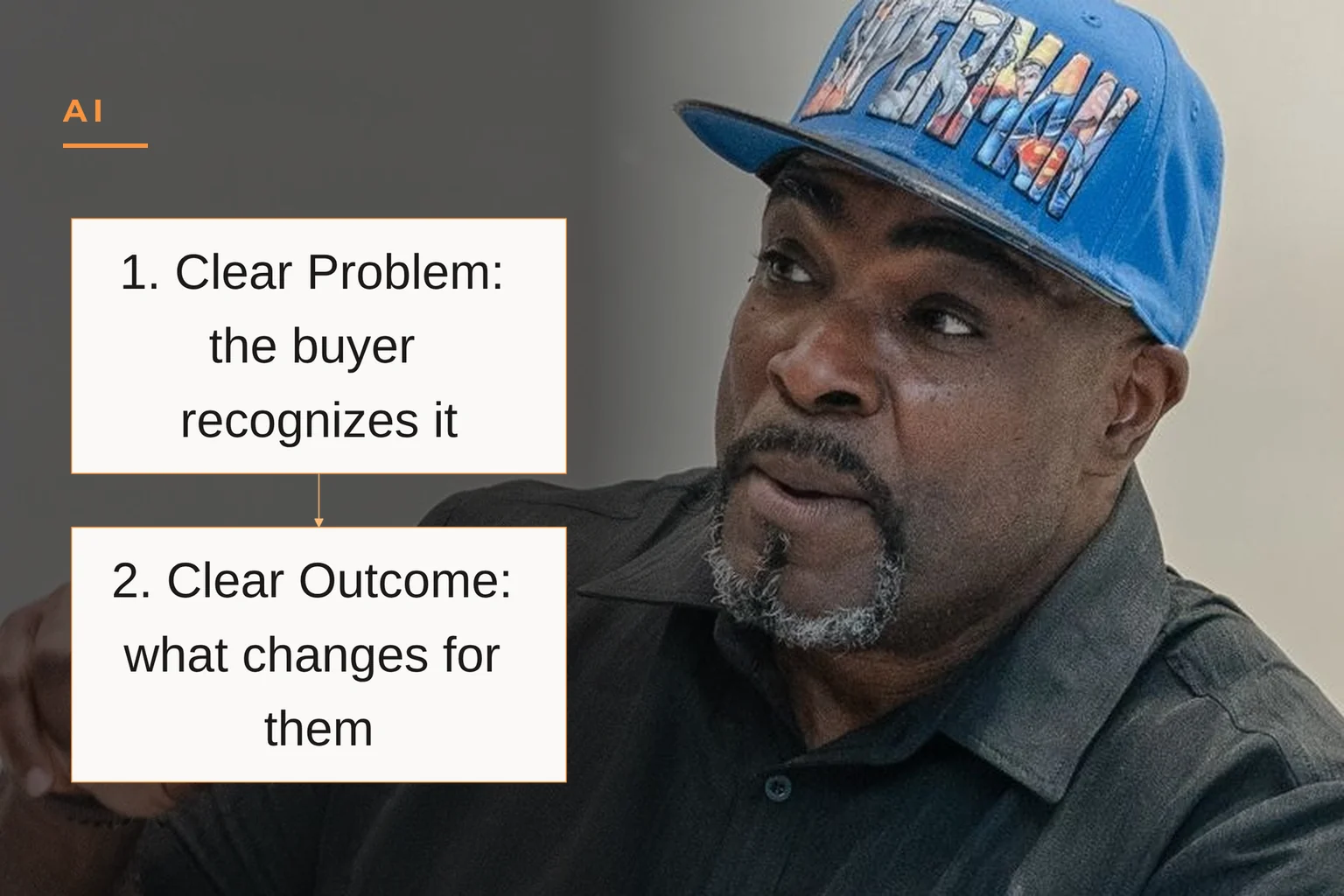
This is the method I use for every offer and every proposal we build, in every company. Nothing gets priced, packaged, or proposed without it. Three questions, in order.
- Clear problem. Whose problem is this, stated the way they would state it.
- Clear outcome. What actually changes for them, in their words.
- Willingness to pay. What they will hand over for that outcome.
It produces one of two documents, and the difference is not cosmetic. An offer is what we sell to someone who is buying. A proposal is what we show someone who is deciding.
Willingness to pay: the verdict a buyer hands down on your outcome, decided before you ever say a number, and set by what they can get instead.
Notice where price sits. Last. And notice what it is. It is not a decision you make. It is a verdict you receive. By the time you say the number, the buyer has already handed it down.
Most teams run these three backwards. They pick the number they want and work backward to a reason. That is how you end up needing an anchor you do not have and telling a story nobody asked for.
So run the Disney page through it. Offer or proposal first.
Look at the page. If it takes money without a human in the room, it is an offer. If a person has to decide after you read it, it is a proposal. Same layout, different animal, and the fork decides where the work lives. Disney's page takes the money. Nobody is standing there to explain the raise when the buyer notices it, which is exactly why the sequencing matters more here, not less.
Now the three questions, in order, against that page.
Clear problem. For a streaming buyer the problem is simple: I want the shows, and I do not want them interrupted. The cheaper tiers already carried the interruptions. The expensive tier existed to answer the other half of that problem, which is that nothing breaks the show.
Clear outcome. If the ads now arrive on every tier, the outcome stops separating the tiers in the way the buyer actually cares about. Nobody was paying for a badge at the top of the ladder. They were paying for what did not happen while they watched.
Willingness to pay. That is the verdict, and it gets delivered at renewal, in a cancellation, or in a shrug when the charge clears.
Read that way, the week was not a pricing decision followed by a packaging decision. It was one move that closed the outcome gap, and then a second move that raised the number on the closed gap. You do not get to collapse the outcome and then bill for it in the same breath.
I learned the third question at a birthday party
Around 2007 or 2008, thirteen years into owning a bakery and gift-delivery business known for elaborate multi-tier cakes, I got invited to a young cousin's birthday party at one of those bouncy-house places. On the drive over I assumed they had bought a supermarket sheet cake, because nobody had called me.
I walked in and there it was. A beautiful three-tier Lightning McQueen.
I was offended. Family. Of all people, family.
So I pulled an aunt aside and asked what they paid. Sixty-five dollars, to a friend of a cousin. My own price, even with the family discount, would have been over three hundred. And if they had called me and told me their budget was sixty-five dollars, I would have refused the job.
$65. What my own family paid someone else for the cake. $300+. What my price would have been, even with the family discount. Nobody was disloyal. The budget never matched the price.
The thing I was carrying around was a grudge about loyalty. The thing that was actually true was arithmetic. My family never could buy from me at my price. They were not disloyal. They were priced out, and they were polite enough not to make it a conversation.
That lesson has followed me ever since. Not everyone who needs your product is your customer for your business. Need and willingness to pay are two different things, and only one of them pays the invoice.
And the move I would have skipped if I had stayed offended is the move that matters. When someone who obviously needed what you sell bought from somebody else, find out what they paid before you conclude anything. Then check whether their budget ever matched your price.
Now set the headline next to that. Raising the price on a tier that just lost its reason is a bet that the people who need you will stay. My family needed a birthday cake. They still bought the sixty-five dollar one.
A recurring charge with no owner keeps firing
I was comparing notes with Roddy McGee about enterprise AI pricing and I told him about a spend spike I had chased inside my own team.
$300 in two hours. API credits gone. Every person I asked told me the truth: not us.
So I did the obvious thing. I asked my staff. Who is using Fable on these accounts? Every person told me the truth. Not me. And they were telling the truth.
What was actually happening: a scheduled task created in the expensive model keeps running in that model. You cannot change it. It was created in one place, and now it fires forever.
If I had kept hunting for the person, I would have found nobody, and the charge would have come back every time the schedule fired.
When a recurring cost has no owner, audit what created the recurring job, not who ran it. Then check whether the expensive setting can still be changed.
That is the whole lesson, and it is a cost-ownership lesson, so I will not dress it up as anything else. The number kept charging because something scheduled it and nobody owned the schedule. Hunting for a culprit produced a room full of honest people and a bill that would not stop.
Your price has the same shape. It is a recurring number, it charges every month, and frequently nobody inside the company can tell you what it is for. Asking who set it finds nobody. The number keeps firing. So do not go hunting for the person. Go find what created the recurring job, and then find out whether the setting can still be changed. An offer can be rebuilt. A price you cannot defend cannot.
What this costs you, and why you will not want to do it
Now the part where I stop pretending this is a tidy process.
Rebuilding an offer is not hard because the steps are complicated. It is hard because it makes you go find out what people actually paid, and the answer is frequently that you are not in the market you believed you were in.
Ask me how I know. I did not want to ask that aunt anything. I wanted to be right about family. Asking her cost me a story I had been telling myself about who my customers were. That is the real bill for this work, and it never shows up on the pricing page.
So name the resistance before it names you.
The fear. You will feel like raising the price is the risk. It is not. The risk is that the offer quietly aged while the price stood still, and you find out at renewal time.
The cost. You will feel like this is a pricing exercise. It is not. It is an honesty exercise. The price is a verdict, and you do not get to write the verdict.
The rewiring. You will feel like you do not have an afternoon to go ask five buyers what they actually pay for. That feeling is the whole problem. The information you need is held by people who will tell you if you ask, and asking is the part that stings.
If you only fix one of the three questions, fix the outcome. The problem statement gets you recognized. The outcome statement is what gets you paid. A clear outcome moves price further than any rewrite of your pricing page.
Know when not to do this. If your buyers can still say the outcome back to you in their own words, and they renew without a conversation, leave it alone. This work is for the offer whose number outran its reason. It is not a quarterly ritual.
And if you are ranking your effort, know that the copy on the pricing page is the least of it. I have watched beautiful pricing pages sell nothing and plain ones sell plenty. That part is the last five percent, and most teams spend all their time there because it is the part that does not hurt.
Two ways to raise a price
| The inconsistent approach | The consistent approach |
|---|---|
| Raise the price and change nothing else, so the buyer sees the same thing for more money | Name a bigger outcome first, then raise the price, so the buyer sees more thing for more money |
| Remove something and raise the price in the same week, so the buyer sees less for more | Deliver the new outcome, let them feel it, then change the number |
| Put the same limitation on every tier, so there is no clean version left to buy | Keep one tier genuinely worth its number, so the tier you want chosen reads as a deal |
| Anchor a price against a top number nobody believes | Anchor against a top tier the buyer believes, so the middle one measures against something real |
| Pick the number you want and work backward to a reason | State the problem and the outcome in their words, then receive the number |
The Monday decision
Open your pricing page. Next to every line, write the problem in the buyer's words and the outcome in the buyer's words. If you cannot write the outcome in their words, that is your answer, and it is not a pricing answer.
Then decide which document you are actually holding. If someone can buy from that page without you, it is an offer. If a human has to decide after they read it, it is a proposal. If it is a proposal, the page is not the thing you fix. The conversation is. Go rebuild the conversation this week and leave the number where it is.
Then write one more line at the bottom of that page, and make it a name, not a department. One human who owns the renewal audit. Not marketing. Not finance. A person who, before the next price change goes out, asks five buyers who renewed why they renewed and five who left what they paid instead, and brings you the answers in writing. That is who carries the cost of this work, and if nobody's name is on it, you have built the same scheduled task I did. It will fire whether anyone is watching or not.