The Real Agentic AI Methodology Is a Meeting You're Already Skipping
By Atiba de Souza
The mismatch nobody names
Every team standing up "agentic workflows" right now is doing the same thing: writing a really good prompt, handing it to a coding agent like a work order, and grading the output. When the output is wrong, they rewrite the prompt. When it's right, they scale it.
That is task delegation. I spent years building a method to get my team off exactly that pattern with humans, because it produces the same ceiling every time: a team, or a system, that executes instructions and pings you for every exception. It never produces a team, or a system, that thinks like you.
The method is called CASE Method. It was built for staff. It is also, without a single word changed, the correct methodology for building an agent that actually works.
What CASE Method actually is, and what this piece will and won't teach
CASE Method is a scheduled, structured reflection meeting you run after a task is done, once you've stayed completely hands-off while someone, or something, did it. It runs on four questions. I'm not going to pretend to unpack all four here, because that would be gesturing at a structure instead of teaching it. What I'm going to teach is the part that actually changes what you build: the timing (after, not before), the target (how they think, not what they produced), and the one question that does the most work for this specific problem: Easier Than Expected.
The whole point is captured in one line: delegate thinking, not tasks. Traditional delegation transfers output. "Do it like this." CASE Method transfers input. How to notice what matters, how to weigh it, how to decide. That's the difference between someone who can do the one thing you showed them, and someone who can do the thing you'd do in a situation you never showed them.
Easier Than Expected asks: where did this go easier than you thought it would. Not a correction question. Not a status check where you read out what they got wrong. A strengths-surfacing question that excavates how a mind is already working, so you can see where it diverges from yours and close that gap on purpose.
Input transfer: teaching a mind, human or artificial, how you notice, weigh, and decide, so it can act without you, instead of teaching it only what to produce.
That's the term this whole piece turns on. Everyone building agentic systems right now is doing output transfer and calling it a methodology.
Eight weeks of an ongoing conversation with a coding agent. Seventeen years running a business before the brain document existed. One hour, once that document was actually wired in, to produce three finished deliverables. The gap between those numbers is the whole argument.
The story: I went in for software, I got a brain
Eight weeks before writing this, I opened Claude Code with an operating problem, not a software problem. I wanted my agency to run three weeks a month and take the fourth off, and I wanted to know what would have to be true for that to hold.
I expected a plan. What I got instead was a conversation that kept asking me questions. About my philosophies. My frameworks. How I actually thought through a decision. It behaved less like a tool taking instructions and more like the reflection half of CASE Method, except I was the one being interviewed, and the thing doing the interviewing was the machine.
It never produced the plan I came for. It produced a brain of me.
And when the project-manager side of it started sending me a morning brief of what actually needed doing across every project, my brain went quiet. For the first time, it didn't have to hold all of it. It didn't have to keep every open loop spinning in the background, because the thing I'd built could hold it instead. We now call it Athena.
Here's the part that should bother you: if I'd bought one of the AI assistants already on the market, it would have cleared the routine stuff I wasn't doing anyway. Scheduling. Reminders. Busywork. And the level that actually moves my business would have sat exactly where it was, because a purchased assistant has no access to how I think. Only input transfer gets there. That's the turn: the win was never the software. The win was the same one I get when a person on my team finally thinks like me. I just didn't expect a coding agent to be the one running the meeting, over eight weeks, not one sitting.
Why it has to feel like a colleague, not a tool
The reason that conversation worked is that I treated it like a colleague I respect, not a subordinate I was issuing orders to. A colleague earns their place by helping you think, not by executing your exact order. The most valuable thing a workmate does is disagree with you, hold a different position, and make you see the situation you thought you already understood.
Nobody goes back to a teammate who hands them a bad answer once and never pushes back. That's also exactly how people abandon AI after one disappointing output: they treated it like a vending machine, got a bad snack, and never came back. Conversation and respect, not commands, are what make another mind, biological or not, useful to you. If you want an agent that thinks with you, expect it to hold a position and change your mind sometimes. If it never does, you built a very expensive command line.
The story: the brain that wasn't broken, it was unwired
A pharmacy owner of seventeen years, opening a wellness clinic, came into one of my live AI workshops having already done the hard part. She'd written her business's brain document. Real philosophies, real frameworks, the way she actually made decisions. But the AI kept producing work that didn't sound like her business, and she assumed her prompting was the problem.
It wasn't. The brain document existed. It just wasn't wired to anything. None of her projects were pointed at it, so every new project started from zero, no matter how good the document was.
We attached the folder. We named the file explicitly in the instructions. Inside one hour she produced a vetting guide, a legal-coach skill, and a launch checklist, all of it sounding like her, all of it built on seventeen years of thinking she'd already done the work to capture.
If we hadn't caught that, she walks away believing the brain document was wasted effort, goes back to prompting from scratch, and blames the model for ignoring a business it was literally never shown. That's the failure most people are one unchecked assumption away from right now.
Name what this actually costs you
Nobody resists this because it's complicated. They resist it because of what it demands.
Writing your own thinking down, in enough detail that something else can run on it, feels like exposing the machinery, not the finished product. It feels like you're making yourself replaceable. Sitting through a real reflection instead of just doing the task again yourself feels slower than it is, because correcting is fast and understanding is not. And staying hands-off while someone, or something, works through a task you know you'd do differently is genuinely uncomfortable. That discomfort is the entire mechanism. If it's comfortable, you intervened, and you're back to output transfer.
This is not a one-sitting exercise either. It took eight weeks of running conversation, not one good prompt, before Athena held enough of how I think to be useful unsupervised. If you're expecting a single session to produce a brain, you'll quit at week two and conclude the method doesn't work. The wait is not a bug you troubleshoot. It is the cost of the thing you're asking for.
When not to do this
If the task is a one-off, don't build a brain for it. Wiring an agent to your full decision-making pattern is overkill for something you'll never delegate again. This is for the recurring work, the stuff that eats your headspace every week, the decisions someone or something has to make the way you'd make them because you won't be in the room. Everything else, just do it yourself or hand it off once and move on.
| What stays inconsistent (unwired, output transfer) | What becomes consistent (wired, input transfer) |
|---|---|
| Every new project starts from zero | The brain compounds across every project |
| Good brain document, but pointed at nothing | Brain document explicitly named in every instruction |
| You correct the result each time | You question the reasoning once, and it holds |
| Quality depends on how good today's prompt was | Quality depends on how well the thinking was transferred |
| Agent/report pings you for exceptions | Agent/report thinks like an owner |
| One bad output, you quit on the whole thing | One bad output, you check the wiring first |
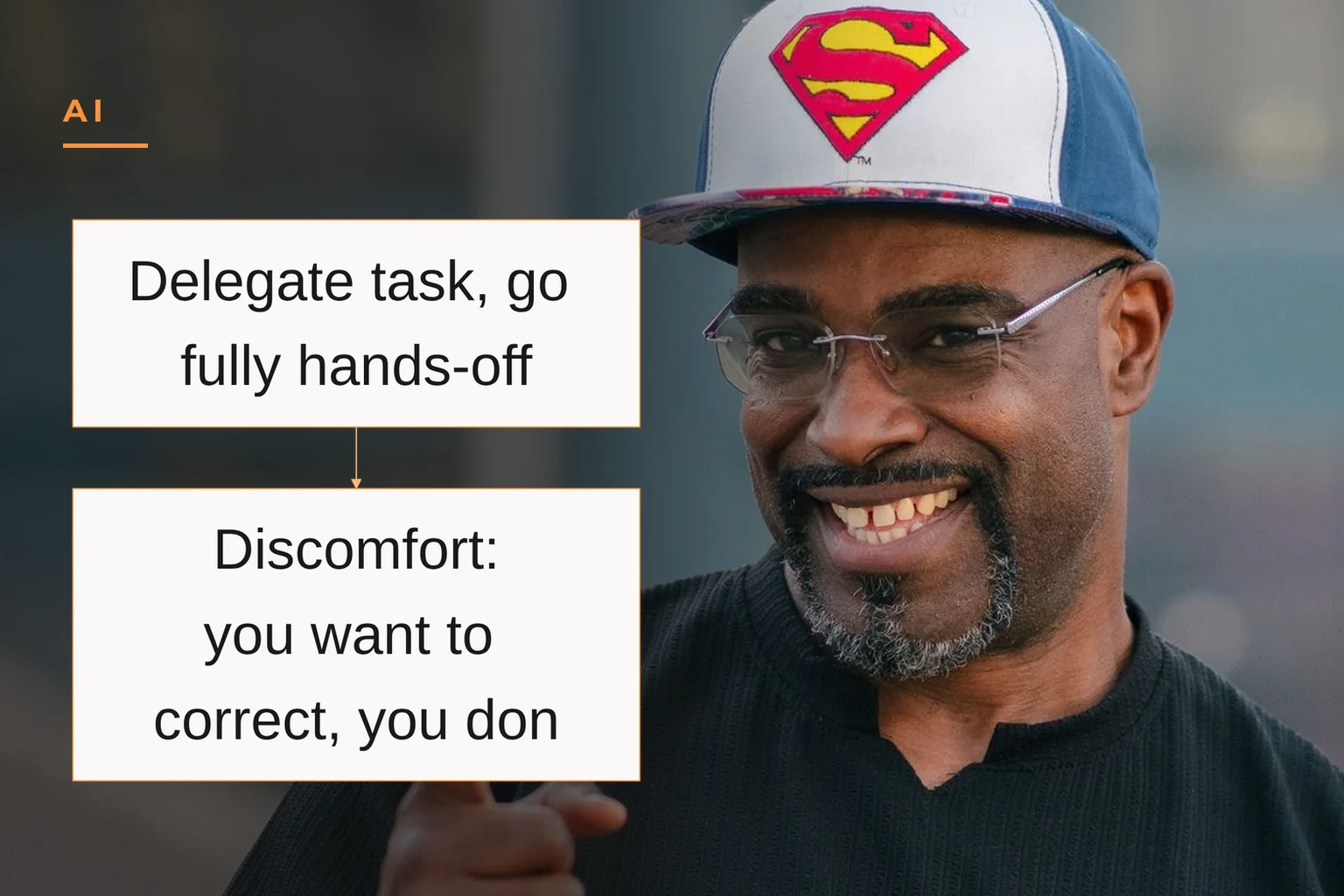
The friction node in that loop isn't decoration. It's the point in the sequence where most people quietly abandon the method, right when it stops feeling like they're doing anything.
The Monday decision
Don't resolve this into a checklist you can run without noticing what it costs. The next time your agent, or your report, finishes something, the discomfort will show up before the question does: the pull to just fix it yourself, because that feels faster than asking what went easier than expected. Sit through that pull anyway, and ask.
Then check the boring thing that actually breaks this: is the brain you already built actually pointed at the project in front of you. That check will feel like admitting you skipped a step. It probably means you did. Most failures aren't a missing brain. They're an unwired one, sitting exactly where you left it, doing nothing, because pointing it at the work is still the part everyone skips.
Questions