The $300 Nobody Spent: Ask AI for the Cost You Are Not Counting
By Atiba de Souza
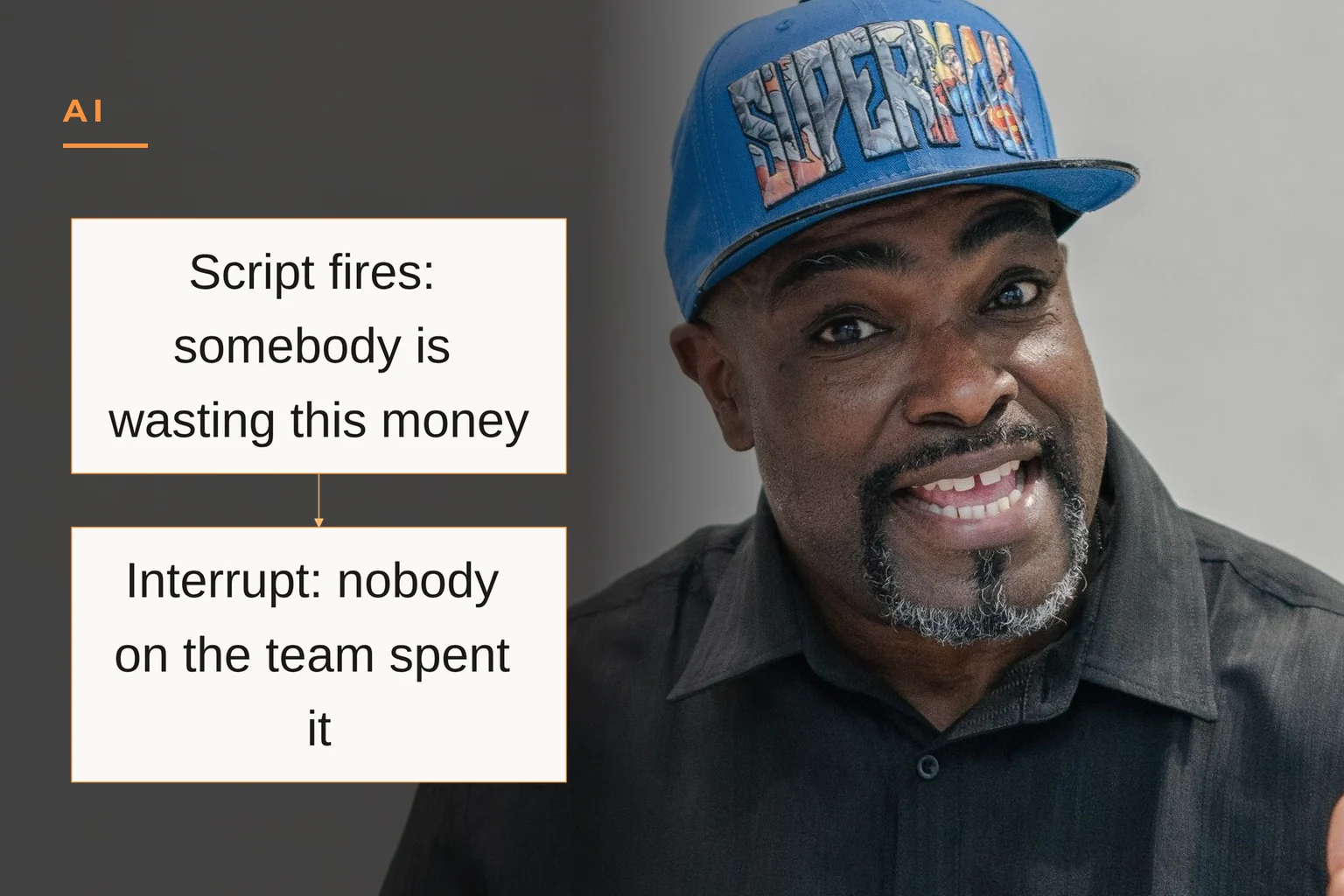
The number looked like a person
Two hours. Three hundred dollars of API credits, gone.
I was comparing notes with Roddy McGee on enterprise AI pricing when I told him about it. A spend spike had come up inside my own team, and I did what any operator does. I called everybody in and asked who was using the expensive model.
I wanted a name. I wanted the person who had decided to be careless with my money.
Every person I asked told me the truth. Not one of them was using it.
Two hours. Three hundred dollars in API credits. And nobody on the team had spent a dime of it.
So if nobody spent it, who did?
That question is where most leaders stop. It is also where the money keeps leaving.
What was actually running
We found it. Not a person. A scheduled task.
Somebody had built it in the expensive model, not out of carelessness, out of not knowing. And here is the part that matters. Once a task exists in that model, it runs in that model. Every time the schedule fires. It cannot be changed.
So the job ran, and ran, and ran. It had no owner, because the person who could be blamed had already done the only thing they would ever do, which was click create, months ago.
Keep hunting and I would have found nobody. And the charge would have come back every single time that schedule fired.
Here is the thing you were already looking at and could not see. You were not looking at a spending problem. You were looking at an ownership problem wearing a spending problem's clothes.
Now let me name what I was doing, because I was the one running a script.
Script: an automatic way of reading a situation and answering it, learned so well you no longer notice you are running it.
A bill goes up, a script fires, and the script says find the person. I ran it in front of my own staff. It felt like leadership. It was autopilot.
This is Behavioral Influence
Behavioral Influence starts with a fact about people. We run scripts, automatic ways of reading a situation and answering it, learned so well they disappear. Ellen Langer's research on mindlessness found that a small request with an empty reason, "because I have to make copies," got granted almost as often as one with a real reason. The word "because" ran the script.
Second fact. A broken script brings attention back. Judee Burgoon's work on violated expectations shows that when something does not match what a person expected, they get pulled off autopilot. That is the moment a new way of seeing the problem can land.
Which is why my staff saying "nobody is using it" was the most valuable sentence in that room. It did not answer my question. It broke it.
Third fact, and this is the one that gives you your Monday move. Naming a script weakens it. Friestad and Wright's research on persuasion knowledge found that once people can see the pattern, or the tactic being used on them, they judge it instead of following it.
Now apply that to money, honestly.
Every pressure tactic rests on something true about people. We never just do its opposite. We find the truth it rests on and use that truth in the open. Three steps.
The human truth. A cost with no owner keeps growing. That is true of every recurring bill in your business.
The corruption. The hidden version. The recurring charge stays invisible at the moment of decision. The setting that keeps billing after the click. The job nobody was shown when they said yes. Hidden, or false, or in the seller's interest, or quietly weakening your judgement. All four count.
The honest use. The same truth, used openly. Surface the recurring cost at the moment of decision. Name what owns it. Let the person decide with both eyes open.
And the test for whether you did it honestly:
If it still works when the person can see exactly what you are doing, it is honest. If it only works while they cannot, it was never yours to use.
Same spike, opposite meaning
I open my August AI workshop with one question to every attendee. Where is AI still a struggle for you?
There is a pharmacy owner of seventeen years in that room, opening a wellness clinic, and I have been teaching her AI since June. A few months ago she could barely get Claude installed. When she answered that question, she said she is now exhausting the $100 a month plan every single week.
Then she said the part I want you to hear. The value she gets back is far more than the hundred dollars.
Stop and set that next to my three hundred dollar morning.
Two spend spikes. Same shape on the bill. One is a scheduled task nobody owns. One is a person pulling more out of the tool than she puts in. Read both with the script and you call both of them waste. You would be wrong in both directions.
And there is a script on her side too. The usual arc here is the opposite of hers. Somebody fights the install, decides the tool is not for them, and quietly stops opening it. Name that script out loud, because it is running in most rooms you walk into.
The script: "If it was hard to set up, it is not for me."
Say it where people can hear it and it loses its grip. That is Friestad and Wright doing double duty across both stories. My script was "somebody is stealing from me." Hers, the one she refused to run, was "struggle means quit." The moment either one is spoken, the person running it starts judging it instead of obeying it.
So when a client tells you they are burning through their plan, do not flinch. Congratulate them. Then have them say out loud what the spend is returning. That sentence is the testimonial. It is also the test, because if the answer comes back thin, you both just heard it.
The analogy that fixes your ledger
Most people measure AI like an assistant. How much did it take off my plate?
That measurement quietly lies to you, because the tasks an assistant takes over were mostly the ones you were never doing anyway. That is why the time it gives back feels smaller than promised. You bought time on chores. You did not buy anything that moved the needle.
A second brain is a different ledger. It does not take chores off you. It reaches the work that moves the needle.
Same thing with cost. If you only measure what the tool is doing to your plate, you will never see what it is doing to your revenue.
The script, and the honest version of it
| The script, running unnamed | Naming the script and using the truth in the open |
|---|---|
| "Somebody is wasting this money. Find them." | "A cost with no owner keeps growing. What owns this one?" |
| "The bill is the problem." | "The bill is where the ownership problem showed up." |
| "If it is expensive, it is waste." | "Ask what the spend returned before you judge it." |
| "If it was hard to set up, it is not for me." | "That is the script talking. Say what it returned." |
| "We will look at it when the number gets big." | "Who owns this when the next cycle fires?" |
| "Celebrate the install." | "Celebrate the spend, and make them say the return." |
Here is both spend spikes resolving through the same honest-use test.
Ask AI for the cost you are not counting
AI's job here is not to do the math. It is to break the script. You cannot see past a script you are standing inside. AI does not share yours.
Before you approve the next thing that bills monthly, put the decision in front of it:
"Here is a decision I am about to make: [describe it]. Do not give me the one time price. List every cost this creates that keeps occurring after this week. For each one, tell me what owns it and whether its setting can still be changed later."
For a cost you already have, the question changes shape:
"Here is a recurring cost on my books. Trace it back to the thing that created it, not the person who last touched it. Then tell me what it would take to stop it from firing."
And for a spend you are secretly proud of:
"Here is a spend I am happy about. Write the one sentence that says what it returned."
Now the part I am not going to let you skim past, because it arrives in the same breath as the fix.
You are not going to want to run this. Ask what keeps costing you after this week and you may find out, and then you have to do something about it. That cost arrives before any saving does. And the second one stings more. You already called your team in. You already asked for a name. Running the trace means admitting, in front of the people you aimed that question at, that the target was never a person. That is the rewiring. You have been running the who reflex for years. Reflexes take reps. Expect to catch yourself asking who again. That is not failure. That is the awareness arriving.
So do not hand this to your team as a hero move. Do the trace first, alone, and bring back the answer instead of the hunt.
Rank these, do not weigh them equally
Three things came out of that morning and that workshop. They are not equal. Treat them that way and you will spend your energy on the cheapest one.
Most important: the recurring cost has an owner. This is the whole ballgame. My three hundred dollars kept leaving because a job was firing with nobody's name on it. If you fix one thing, fix this. Every recurring cost in your business should have a human attached to it, and that human should be able to say what it does.
Second: whether the setting can still be changed. Ownership alone does not stop the bleed. The task was created in the expensive model and runs there forever, with no way to move it. That is what turned a one time mistake into a recurring one. Before you sign anything that bills on a cycle, find out whether the expensive choice can be reversed later. If it cannot, you are not making a decision. You are making a subscription.
Minor, but do it weekly: the sentence said out loud. This one is light. It takes ten seconds and it costs nothing. It is also the only one that keeps you honest, because a spend nobody can explain in one sentence is the other kind of spike. Do not mistake its smallness for unimportance. Do not mistake it for the fix either. Saying the sentence does not stop a scheduled task. It just tells you which spike you are looking at.
And here is when not to reach for any of this. Do not run the ownership audit on a cost you already watch every week with a named owner. You will burn an afternoon proving you are already doing the thing. And do not run the out loud return sentence on a spend where nobody can say what it returned, because that is not a testimonial. That is the audit telling you the truth.
Pick the top one. Find the recurring cost with nobody's name on it. Then ask AI what created it, instead of who.
The name you were looking for was never a person. It was a setting nobody went back to check.
Questions