You Don't Have a Content Problem. You Have an Undiagnosed One.
By Atiba de Souza
The problem was in my own house
In July I went looking for the reason my own team's work had gone sideways, and I did not like what I found.
TrueMD is the venture I own marketing for. Three founders, and the marketing lane is mine. That month the team was building out TrueMD's LinkedIn presence and the assets that go with it. Then things started slipping. Tasks got dropped. Work came back that made me stop and ask what in the world we were doing. Not bad work. Wrong work.
I went hunting for a process failure. What I found was simpler and worse. Most of my team had never been told what TrueMD is. Only a subset knew. I had assumed everyone did.
I am the marketing owner. If the team did not know, that is on me. I never wrote it down, and I never walked them through it.
Sit with the part I missed for weeks. No customer ever saw that failure. Not one prospect, not one wrong asset on a stranger's screen. The breakdown happened inside my own building, upstream of the audience, before any work reached a market. I had a communication failure and I was reading it as a content problem.
Two things you are about to reach for
You are going to want to solve this with a sharper brief, a better content hire, or a new tool.
All three are content moves. All three are fast, visible, and satisfying. They keep the machine running. What they do not do is tell you whether the machine is pointed at the right thing. A content machine pointed at an undefined business will produce an undefined business's assets with impressive efficiency.
So let me name the resistance out loud, because I am not going to pretend you will adopt this on a Tuesday like it costs nothing. A diagnosis stops the machine. It asks you to sit in a room and write down what your business actually is, in front of people who may look at you like you are stalling. It produces a document instead of a deliverable. For a stretch, nobody can point at anything and call it progress. That is the cost, and it is real.
The 7 Practices of Effective Marketing, and why the order is the whole thing
The framework I work from is the 7 Practices of Effective Marketing. Notice what it is not. It is not a content framework. It is a communication framework, and it starts further back than most marketing conversations are willing to go.
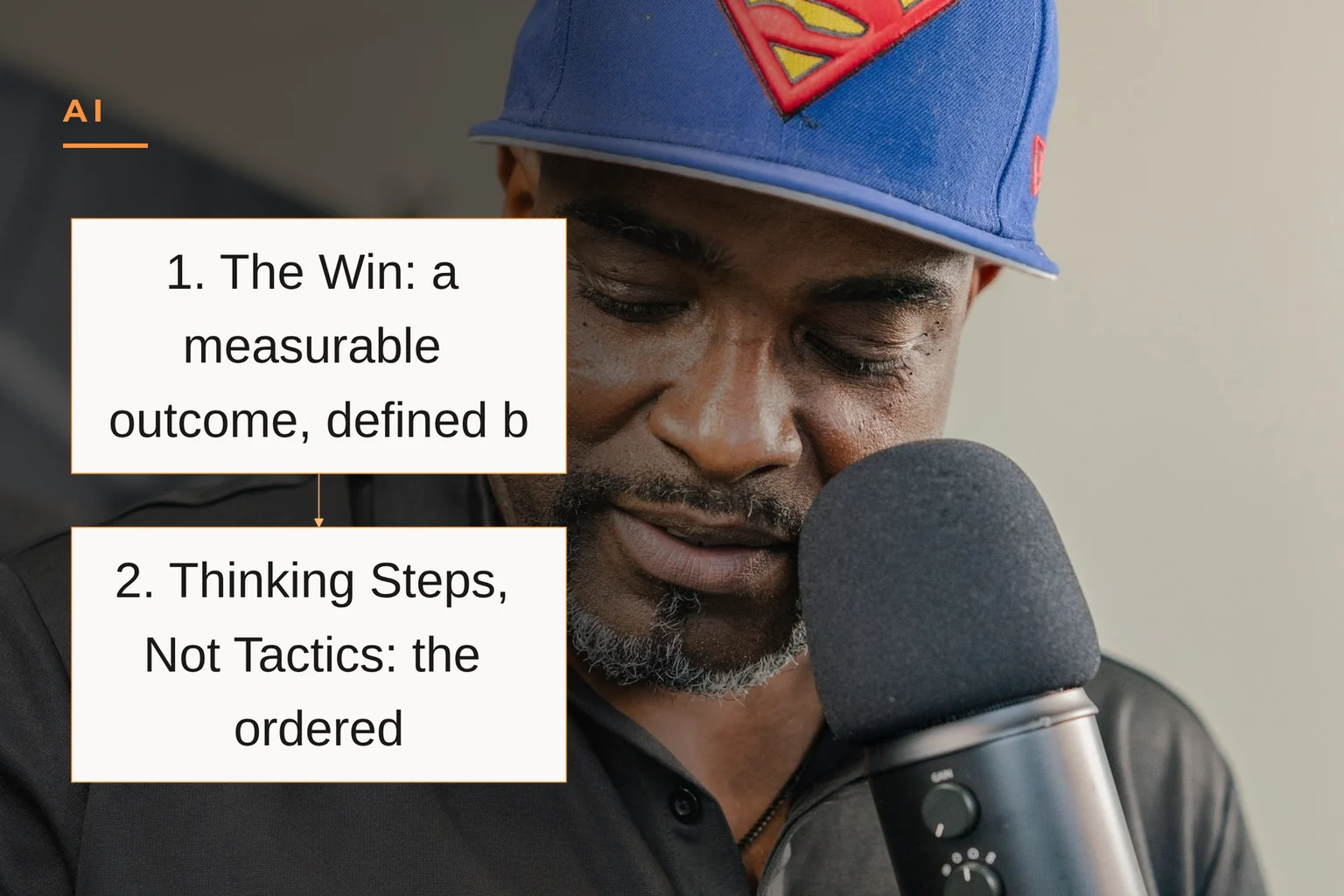
Practice 1: The Win. Every game has a way to score, and everyone playing knows what scoring looks like. Marketing is no different. Before any work begins, the Win has to be defined in terms that can be measured. Without a defined Win there is no way to tell whether a project succeeded, no way to course correct, and no way for anyone, human or AI, to evaluate the work being produced. What it produces is a measurable outcome statement that every downstream step and every artifact gets judged against.
The Win: the measurable outcome, defined before any work begins, written down where every person building against it can read it. If it lives only in your head, it is not a Win. It is a hunch.
Practice 2: Thinking Steps, Not Tactics. The instinct is to jump straight to funnels, ads, launches, campaigns. That is backwards. Before any tactic is considered, the logical steps required to reach the Win get mapped in order. Tactics are how you execute a step. They are not a substitute for the step. Skipping this is the most common reason marketing feels busy and goes nowhere. What it produces is an ordered sequence of steps from where you are to the Win, with the dependencies identified. No tactic gets proposed until that exists.
Practice 3: Narrow the Focus. At any moment there is usually more than one important thing competing for the same hours and the same people. Practice 3 is the discipline of choosing on purpose instead of running every important thing at half attention. Do not file this one under scheduling. Narrow the Focus decides which market you point the entire sequence at, and a sequence pointed at everyone is pointed at no one.
Rank these. If you take one thing from this piece, take Practice 1, because the Win is the load-bearing stone and I am coming back to that stone. Practice 2 is next, because a Win with no ordered path is a wish. Practice 3 is the one you will be tempted to skip, because it is the only practice of the three that requires you to tell somebody no.
And when not to do this: if the Win is already written down and every person building against it can repeat it back, do not stop the machine to admire the foundation. Practice 1 is a gate, not a hobby.
The three words I had been teaching other people
Once a month I get on a two-hour call with a good friend of mine. We have been doing it for years. No agenda. We just talk business. The night before I sat down to write this, we were working through why the orthobiologics funnel was not filling, and he handed me three words.
Account-based marketing.
My honest reaction was to ask myself how much of an idiot I had been. I have been teaching those three words to other people for years, and it never once occurred to me to say them to myself.
We had done the research. Our addressable market, the physicians we serve in orthobiologics, surgeons and pain management in private practice who can realistically buy from us, is about 15,000 providers across the country.
Our addressable market is about 15,000 providers. Cold outreach exhausts a list that size in a month. When a market is that countable, more volume is the wrong instrument. Account-based marketing is the right one.
Read that number the way most people read it and you hear a problem. Fifteen thousand is small, so the instinct is to widen: more channels, more lists, more leads, more spend. When the numbers fall you read it as a top-of-funnel problem, so you buy more leads into a market that does not have them.
Flip it. Fifteen thousand is countable. It is small enough that cold outreach burns the whole market in a month. The funnel was not broken. The instrument was wrong. Small and countable is not a weakness. It is the condition that makes account-based marketing the obvious answer.
Now watch what actually happened on that call. My friend did not hand me a new tactic. He handed me Practice 3. Choosing account-based marketing over mass outreach is narrowing the focus in its plainest form: same product, same message, one market chosen on purpose instead of every market at half attention. I had a sequence and I had a market, and I had never once chosen the market on purpose.
And notice where the diagnosis came from. Not from my dashboard. Not from a report my team produced. From a friend, on a two-hour call, saying three words I already knew by heart.
The stone everything else sits on
Here is the picture I keep coming back to.
Messaging work is not one task among many. It is the stone everything else is stacked on. You either lay it or you do not.
If you build the visible thing first and lay the foundation afterward, you do not get to skip the work. You get to do the visible thing twice. That is not a lesson about patience. It is arithmetic. Anything produced before the foundation was laid has to be redone once it is.
Who you are actually talking to, what they are actually up against, and how you talk to them are load-bearing. The posts, the ads, the funnel, the launch: all of it sits on top. When the thing underneath is wrong, the stuff on top is not just weak. It is confidently wrong, which is worse, because it looks exactly like progress.
That is what I got in July. Nobody on my team was lazy. They were building on a definition of TrueMD that only existed in my head. All marketing is communication, and the first audience that has to understand the message is the team in your own building.
| Inconsistent application | Consistent application | |
|---|---|---|
| The Win, Practice 1 | Nobody writes down what the venture is, so the work gets built against a definition that only exists in the marketing owner's head | What the venture is gets written down and confirmed with every person building against it before any work starts |
| Narrow the Focus, Practice 3 | Mass outreach against a market that cold contact exhausts in a month | Account-based marketing against the countable market that can realistically buy |
| What the work looks like | Dropped tasks, wrong assets, work that has to be redone | Visible work that holds |
What this actually costs you
Adopting this costs you something specific, and the price changes depending on which practice you are resisting.
Resist Practice 1 and the cost is public. You have to say, out loud, in front of the people who have been building for you, that you never wrote down what the business is. I did that in July. It is not a good feeling. It is the fastest repair available.
Resist Practice 3 and the cost is political. Narrowing the focus means somebody's priority does not make the cut. A channel gets cut. A segment gets dropped. The person who has been running the thing you are now de-emphasizing hears "not this quarter" and hears "not important." You are the one who has to say it, and nobody hands you a script for that.
Resist either one and you pay a quieter bill too. Your team is currently rewarded for output: volume, velocity, things shipped. Ask them to be rewarded for a written definition instead and you are rewiring what a good week looks like. That takes longer than one meeting. Expect the first stretch to feel like the team is standing still, because the thing they used to do first is now second.
That feeling is not the diagnosis failing. It is the price of laying the stone.
And you do not need a new role on the org chart to get it. You need the first three practices done in order, by whoever owns the work.
The framework at a glance
Watch the pause
Do one thing before you commission anything else.
Walk into your next team meeting and ask what we are winning. Not what we are working on. What we are winning, and how we would know.
Then watch the pause.
If it is short, and everyone says the same thing back, you have laid the stone and you should get on with the work. If it is long, if you get six versions of the answer, or if the answer is the thing you have been carrying in your own head and assuming was obvious, do not fill the silence. Let it sit there. That silence is the diagnosis. It is also the bill for the thing you skipped.
I have stood on the other side of that silence in my own company. It is not comfortable, and nobody is going to thank you for causing it. It is still the cheapest, fastest way I know to find out whether the machine in front of you is pointed at anything at all.