The Words Your Brand Should Never Say Out Loud Are the Safe Ones
By Atiba de Souza
The moment that was never supposed to go out
I was standing in front of food that looked good and smelled horrible, in Cebu, with a camera on me.
Glydel Shane was filming. I hired her to run Atiba Eats the World because I wanted an outside mind on a team that had always seen social media one way. And I put her somewhere safe, where a mistake would cost nothing, because that is the only place an outside mind can actually work.
So when I walked away from that plate and said, out loud, that it looked good and smelled horrible, I was not performing. I did not mean it for public.
She posted it.
Sit with that. The careful, front-facing, approved content the rest of the team was making was pulling one Facebook response a week. The unguarded moment, the unflattering one that never should have seen daylight, is the channel producing real engagement and sponsorship deals.
That is not a fluke. It is the whole lesson, and it is the opposite of the reflex.
The words you think are the problem
When people ask what words a brand should never say out loud, they want a blacklist. Synergy. Disruptive. Best in class. Leverage.
Those words are ugly, but they are not the danger. They are lazy. The dangerous words are the safe ones. The ones written to be approved by everyone in the room. The ones that hedge and soften and round the edges off the thing you actually think so that nobody can possibly object.
One Facebook response a week versus real engagement and sponsorship deals. Same team, same platform, same audience. The difference was not the tactic. It was whether the words were allowed to be true.
Nobody argues with a sentence built to be approved. Nobody repeats it, either. Nobody chooses you over the safe option because you sounded like the safe option.
The analogy that makes it click
Content that offends half the audience is what wins the other half. That is the move. You stop hedging toward being liked and you say the thing half the room will reject.
A brand with no haters has not taken a position anyone could disagree with. Being liked by everyone is the thing that makes you disappear. Nobody argues with you, nobody repeats you, nobody picks you.
Where the analogy breaks
I have to be honest about the failure mode, because it is ugly and it is common.
The analogy breaks when the polarizing line is a gimmick that announces itself. "I'm gonna lose half my followers with this post" is not an opinion. It is a stunt wearing an opinion's clothes. The line has to be an actual belief that a real person could disagree with and mean it. Otherwise you are just being loud, and loud is not the same as seen.
That distinction is the whole game, and it is why the words cannot be step one. A real opinion comes from a position you have already taken. A gimmick comes from wanting attention. Those are different sources, and they produce different results.
The words you never said out loud
"Never say out loud" cuts both ways. The second edge is the one that costs the most, and it cost me.
In July 2026 I was running the marketing lane for TrueMD, the three-founder venture. My team was building its LinkedIn presence and assets. Then work started getting dropped, and off-target assets started appearing, and I could not figure out why capable people were producing things that made no sense.
I traced it back. Most of my team had never been told what TrueMD actually is. Only a subset knew. I had assumed everyone did.
That is the expensive version of a word never said out loud. My team could not act on what never left my head. They were not dropping work to spite me. They were building toward a definition nobody had given them, so the work drifted and the assets missed.
Before your team produces anything for a new venture, write down what the venture is and confirm every person working on it has read it. Not the subset you happen to speak with. Everyone. Had I done that before any work started, the dropped tasks and the wrong assets never get made.
Marketing is communication. Communication that never leaves your head never happened.
The three practices that come before any word
The 7 Practices of Effective Marketing has seven. I am going to teach you three of them here, and I am not going to pretend I covered the other four. These three sit upstream of every word your brand says, and the words do not work until they do.
The Win
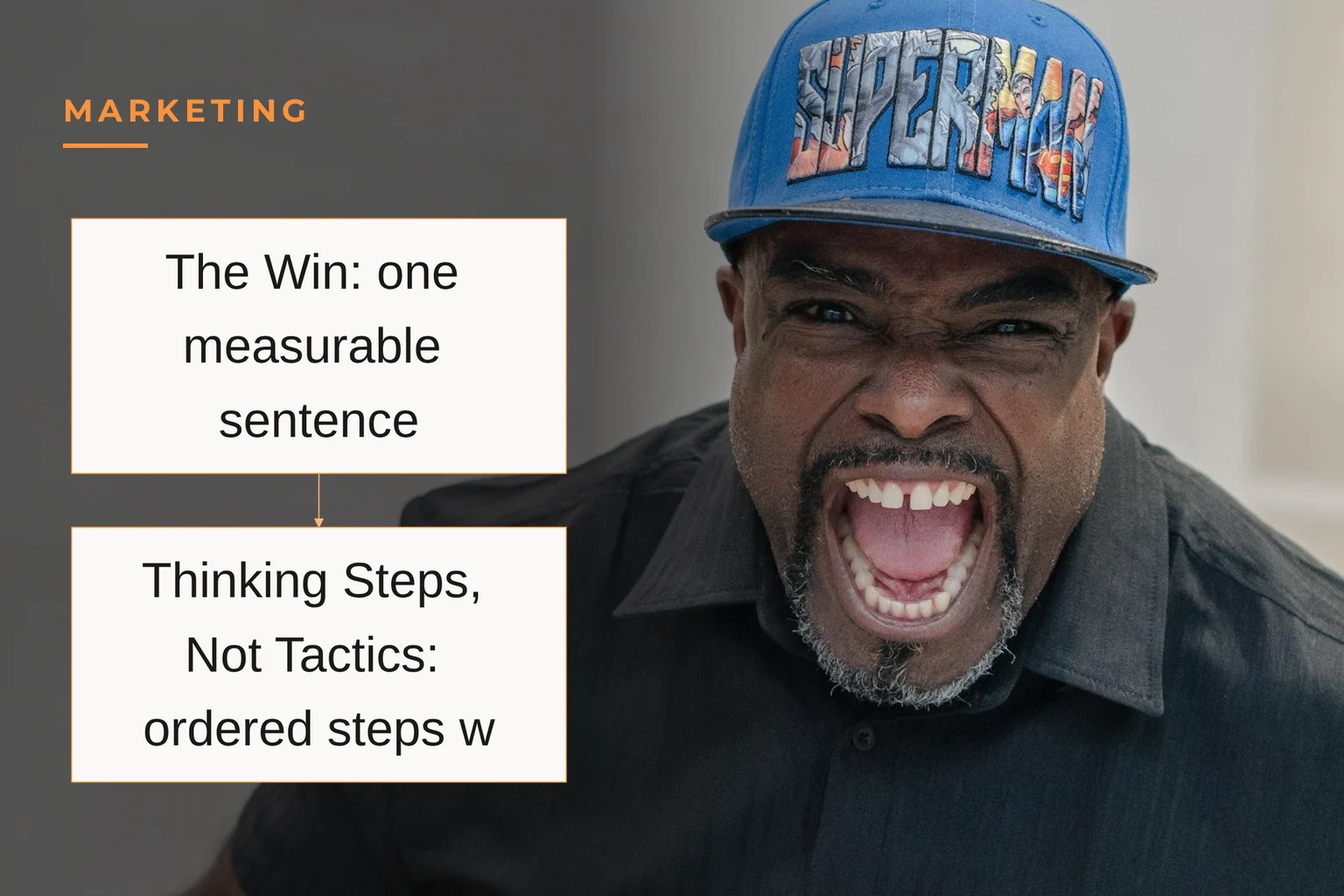
The Win: the measurable outcome you name before any work begins, stated as a single sentence specific enough that any word, asset, or post can be judged against it. If you cannot measure it, you have not defined it.
Every game has a way to score, and everyone playing knows what scoring looks like. Marketing is the same. Before any work begins, the win gets defined in terms that can be measured. Without it there is no way to tell if a project succeeded, no way to course correct, and no way to judge the sentence in front of you.
The artifact is a measurable outcome statement. Not a vibe. Not a mission. A sentence you can hold a piece of copy against and get a yes or a no.
Thinking Steps, Not Tactics
The instinct is to jump to words. What do we post, what is the tagline, what is the campaign. That is backwards. Before any tactic is considered, map the logical steps required to reach the Win, in order. Tactics execute a step. They do not replace the step. Skipping this is the most common reason marketing feels busy and goes nowhere.
The artifact is an ordered sequence of steps from where you are to the Win, with the dependencies named. No tactic gets proposed until that exists.
Narrow the Focus
At any moment there is usually more than one important thing competing for the room. More than one audience, more than one message. Narrow it. And narrowing to a position is where the words actually come from. Narrow to "everyone who might buy" and you write words that offend no one and move no one. Narrow to one position you are willing to be disliked for, and the words almost write themselves.
The artifact is one position. Not a list of values. One position a real person could reject.
Notice what these three produce in order. The Win gives you a measurable outcome. Thinking Steps gives you an ordered sequence with dependencies. Narrow the Focus gives you one position. The words are downstream of all three. The dependency order is not a preference. No tactic comes before the steps exist. No wording comes before a narrowed position exists. If you write the line first, you are decorating a position you have not taken.
The sequence at a glance
What inconsistent and consistent look like
| Inconsistent with these practices | Consistent with these practices |
|---|---|
| No measurable Win, so any line can be defended | The Win written as one measurable sentence every line is judged against |
| Tactics chosen before the steps are mapped | Ordered thinking steps with dependencies named before any tactic |
| A position broad enough that nobody rejects it | One narrowed position you can be disliked for |
| Reach and likes as the scoreboard | Comments per post, because emotion is the thing worth managing |
| A polarizing line that announces itself as a stunt | An actual opinion a real person could disagree with |
The fear you are feeling right now
You are reading this and part of you is already doing the math. If I say the thing half the room rejects, I lose half the room. Some of those people are customers. Some of them sign the check. Some of them are my boss.
That fear is correct. You will lose someone. Name them now. Not "some people." A specific person, a specific segment, a specific account you are afraid to lose. If you cannot name who you will lose, you have not actually taken a position. You have taken a wish.
But here is the part the usual advice skips. The unguarded post only worked because I put Glydel somewhere safe first, where a mistake would cost nothing. She could publish the unflattering version because the ground under her was solid. That is not luck and it is not courage. It is a condition somebody built before the moment arrived.
So before you publish the unflattering version, answer two things in writing. Who am I willing to lose? And what safe place am I creating so the person who says the true thing is not punished for it?
I will tell you what happens when you skip the second question. On TrueMD, my team could not act on what never left my head, and the cost was dropped work and off-target assets. Nobody was brave enough to say "I do not know what this is," because I had never made it safe to say it. The words never got said, and the work paid for it.
And the contrast is right there for you to choose between. The careful, front-facing team got one Facebook response a week. The unguarded post got real engagement and sponsorship deals. Be liked, or be seen. Those are not the same target, and every day you chase both, you miss both.
This is the rewiring, and it is uncomfortable. You have been measuring the wrong thing. Reach and likes measure nothing you can act on. Comments per post measure emotion, and emotion is the only thing worth managing, because emotion is what makes a person choose you over the safe option. You have to stop optimizing for approval. Approval is what you were trained to want. The Win is what you actually need.
The gated decision sequence
Do not do these out of order. Each one is a gate. The next does not open until the artifact exists.
Step one. Write The Win as one measurable sentence. Hold it up. If it cannot be measured, you are not done. Do not write a single line of copy yet.
Step two. Map the thinking steps in order and name the dependencies. If you cannot say what step comes before which, you have a tactic list, not a plan. Stop here.
Step three. Narrow to one position you can be disliked for, and write down who you are willing to lose.
Step four. Write down what the venture is and confirm every person producing work has read it. Not the subset you talk to. Everyone. This is the TrueMD precondition, and it comes before the words, not after them.
Step five. Only now write the line. It has to be an actual opinion a real person could reject, not a gimmick announcing itself.
Step six. Measure comments per post, not reach and likes. If the room does not move, the answer is not more volume. Go back to the position and change the position.
When not to do this
Do not manufacture controversy. The analogy breaks the moment the polarizing line announces itself. A stunt is not a position.
Do not do any of this before the Win is defined, because provocation without a win is noise with a megaphone. And no wording before a narrowed position exists, because clever words on top of a fuzzy position is decoration.
And not every sentence has to be a hill to die on. Fix the position first. Then say the thing. The words were never the hard part. They are what falls out when the position is real.
You already know the words you have been not saying. Write the Win. Then say the thing.
Questions