The Week Off You Haven't Taken in Three Years Is Not a Calendar Problem
By Atiba de Souza
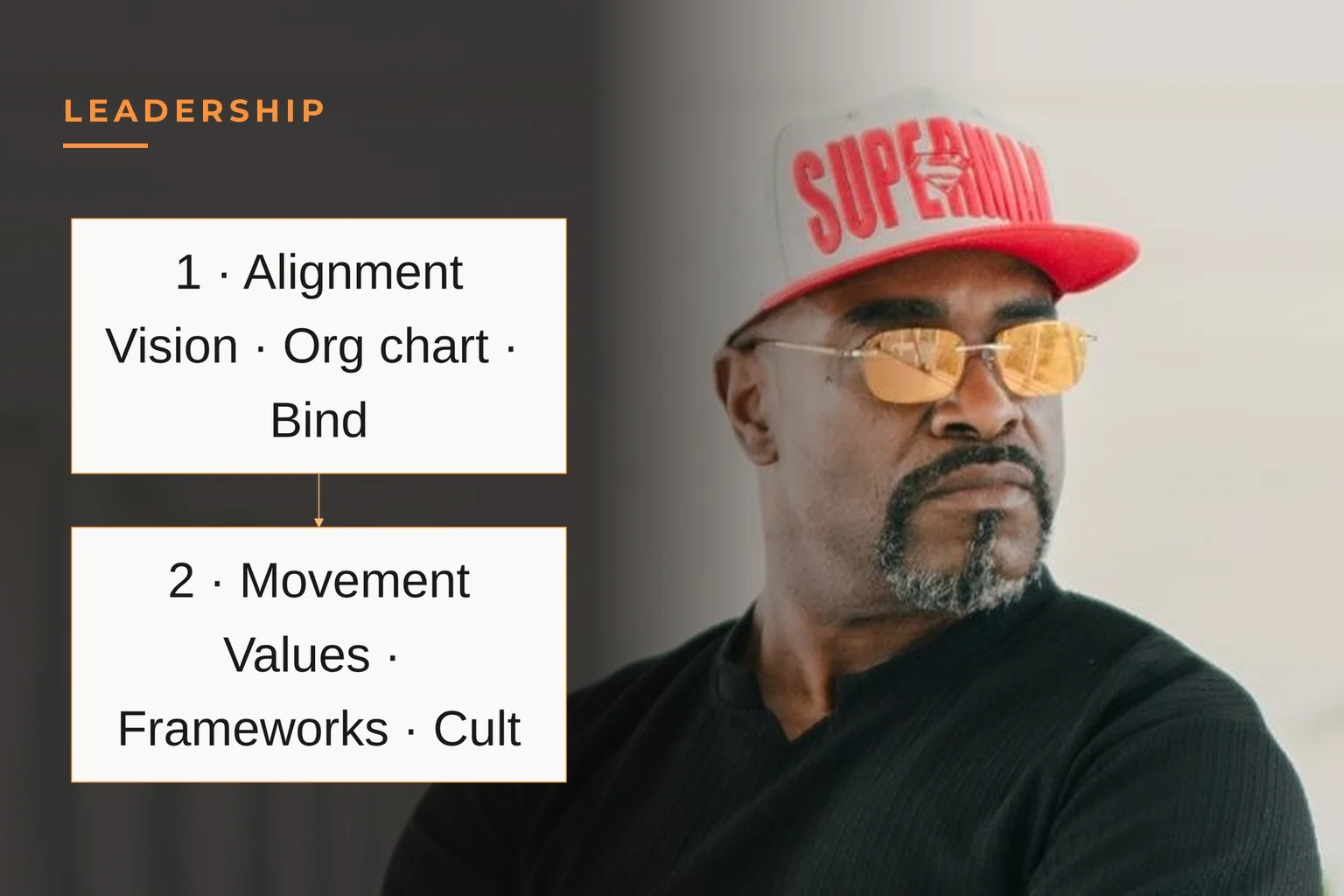
You already know which week it is
There is a week you have been planning to take for three years. You have moved it twice this year. You have a story about why: the quarter, the launch, the hire that isn't in the seat yet, the thing that only you can close.
The story isn't wrong. It's just not the reason.
The reason is that you already ran the simulation. You took the week in your head and watched what happened. The decisions queued up. The two people who always wait for a tiebreak waited. Somebody called. And you concluded, correctly, that the company cannot currently survive seven days without your hands on it.
That is not a scheduling problem. That is a diagnosis.
The week you can't take is not a failure of your calendar. It is the most honest instrument you own for measuring how much of your company lives inside your head.
So I'm not going to give you a vacation plan. I'm going to show you what that unclaimed week is telling you, and what has to be true before you can actually go.
The thing you were already looking at
Organizational Independence: Building a company that can think without you. A stronger organization. A freer you.
Notice the word. Think. Not run. Plenty of companies run while the founder is away. The work gets done, the emails get answered, the invoices go out. And then you come back and every decision that mattered is sitting in a pile on your desk, waiting, because the company could execute but it could not think.
Every road through your company runs through one toll booth, and you are the toll booth. That's the whole problem, and it is also why the week keeps losing to the quarter.
Three questions, and the bill attached to each one
None of the three below is hard to understand. All three are hard to do, because each one asks you to give up something you currently get for free. Read them and you will not feel relief. You will feel resistance, and it will arrive dressed as good judgment.
1 · Alignment: do we know where we're going and what we own?
Vision is a clear and compelling future, not a slogan. The org chart is who owns what thinking. And the binding constraint is where Theory of Constraints does its work: a system has one place that sets its throughput, which is why you focus on the Big 3 instead of the forty things. Not thirty-nine. Three. The constraint is where your attention pays. Everything else is where it leaks.
The bill arrives with the org chart. Making it real means naming a decision owner for each of the Big 3 and then not taking the call when they bring it to you. You are surrendering the founder tiebreak, which is the most comfortable power you own, and the second you name an owner you become someone who can be disagreed with. Most leaders call that delegation and never actually do it. They keep the tiebreak and hand over the tasks.
2 · Movement: can they decide and act without me?
Values, meaning our principles guide decisions. Frameworks, meaning simple ways to think and act. Culture, meaning a team that improves together.
The bill here is tolerating wrong. Once the values and frameworks are doing the deciding, someone will apply them and land somewhere you would not have landed. You will know better. You will let it stand. Not forever, but long enough for the framework to belong to them instead of to you. This is where the whole thing breaks: the leader says "use your judgment," then overrules the first judgment that isn't his, and the team learns the real framework is "guess what the boss would do." You have not lost the tiebreak. You have just made everyone pretend you didn't keep it.
3 · Measurement: can we tell if we were right?
Start past the end: define what success looks like, then work backward to today. Then everyone has a KPI, so there are clear signals for progress instead of vibes.
The bill is your phone. Define success before you leave, hand the KPI to a person whose name is on it, and then stop checking. Because once a KPI view exists and someone else maintains it, checking your phone stops being diligence and becomes what it always was: a nervous habit that tells your team you don't trust the thing you built. Sit on your hands. That is the work.
And the loop. When the numbers say you were wrong, that isn't a failure, it's an input. It goes back into alignment on three specific things: you revise the vision, you reassign ownership on the org chart, and you re-pick the Big 3. That is what self-correction looks like when it doesn't need your desk.
All of it sits inside the Brain, the place where your company's thinking actually lives. All of it stands on Trust, because none of these layers survive a team that believes you'll overrule them the moment you return.
The week I couldn't report on
I spent four days alone in Penang. No responsibilities, nobody who knew me. Lyca asked, the way she always asks, what I got done while I was away.
Four days with nothing to report.
For the first time, I had nothing to report. No bright idea. Nothing built. I wandered around the streets of Penang, aimlessly, for four days. For me, that is very odd.
That is the entire story, and it should bother you a little. An operator who measures every day by what it produced, handed four empty days, and what he notices is how odd it feels. There is a version of owner-dependency that runs inward: the company cannot say what it is without you, and you cannot say what your week was without a list of what it shipped. If that ledger is the only one you keep, you will never take the week, and if you take it anyway you'll spend it manufacturing something to report so the ledger balances.
The version of this that costs a working week
The week of July 21, every one of my scheduled Claude tasks and every project instruction lived on my desktop machine and nowhere else. Then a routine application update didn't improve the tool. It destroyed the install.
One working week lost, to a routine update.
Every scheduled task, every project, all the project instructions inside them, gone with the install. The update wasn't the disaster. The update was the inspection. It found the architecture: one location, no second copy, nothing to re-clone from. Had those jobs been running in the cloud, as they now do, the same update would have cost me nothing at all.
Your company has that architecture right now. The vision, the judgment calls, the reasons behind the reasons: one location. You. And nothing is going to announce the failure. There is no error message, no crash screen, no morning where it all stops. You just keep not taking the week, and everyone keeps calling that normal.
Inconsistent vs consistent Organizational Independence
| Inconsistent Organizational Independence | Consistent Organizational Independence | |
|---|---|---|
| Alignment | The vision lives in your head, the org chart is a list of people who report to you, and the binding constraint is whatever shouted last | The vision is clear and compelling, each of the Big 3 has a named decision owner, and the Big 3 are the focus |
| Movement | Values are a poster, frameworks are "whatever the boss would do," culture waits for you to come back | Values settle the call, frameworks give people a way to think, culture is a team that improves together |
| Measurement | Success is defined after the fact, by you, from the inbox | Success is defined backward from the end, and everyone has a KPI |
| The learning loop | A bad number becomes a person to blame, and the fix is you again | A bad number goes back to the vision, the ownership, and the Big 3 |
Rank these, because they are not equal
The one that matters most is alignment, and inside alignment, the org chart. Most leaders try to fix the week off with process and delegation. The week off doesn't fail at the task layer. It fails at the decision layer, and the decision layer is decided by who owns what thinking. If your org chart is really a list of people who report to you, you don't have an org chart. You have a confession.
Second is measurement. Not because spreadsheets are noble, but because measurement is what lets you leave without vibrating. You don't need to know what's happening every hour. You need to know what would tell you something is wrong, and then trust it.
Last is culture, and it gets the most airtime of the three. Culture is the slowest layer and the least installable. You don't build it directly. You build it as a byproduct of alignment and measurement being real long enough that people stop bracing for you to swoop in.
When not to do this, and the gate
Don't book the week first and hope the organization grows up around it. The vacation is the exam, not the studying.
Don't run this in the middle of a cash crisis or the week after a key person walks. You'll be building on sand and you'll conclude the whole idea is wrong.
And if you're going to check messages every two hours from the beach, don't go. Half a week off does more damage than no week off, because it teaches you the thing doesn't work while proving nothing about the company.
So here is the only test I'll give you. Don't book anything until you can answer yes to all three.
- The org chart names a decision owner for each of the Big 3, and the binding constraint is stated out loud.
- The values and frameworks are written where the team can use them without asking you what you would do.
- A KPI view exists, success was defined backward from the end, and someone other than you maintains it.
All three yes: book it, leave the phone, and find out what you're like when nothing is being produced.
Any one no: your next action is alignment, not vacation. Go fix the question that came back no, and then answer it again.
A stronger organization. A freer you.