AI Takes Everything You Type as True. That Is Why It Keeps Agreeing With You
By Atiba de Souza
The line at the bottom of the page
We screen for a role by sending every applicant the same questions and asking them to answer on video before we ever get on a live call. The point is to hear the person before you meet them.
The videos came back nearly identical to each other.
Then one came in written, and the AI's own closing line was still at the bottom of the page, offering to craft more follow-up answers if we needed them.
That line is the only reason we caught it. Edit it out and nobody spots the thing. The whole stage quietly compares one AI's answers to another AI's answers while believing it is reading people.
Nobody in that stack was being dishonest. They took our questions, fed in the job description, sent back what came out, and thought they were being prepared.
So we put a timer on the answer. The question is seen for the first time when it must be answered.
That cost us something, and I want you to know the price before you copy it. We stopped receiving the polished answer. We are now grading people on thinking out loud, on camera, cold, and some genuinely careful thinkers will look worse than they are. I will take that trade. It is still a trade, and if you cannot live with it, cut the stage entirely instead of pretending the untimed version measures a person.
Now look at what those candidates actually did. They handed a model a question that already had an answer and let it agree with them in full sentences.
You do that every week. So do I. That is the whole article.
It believes every word you type
AI takes everything you type as true.
It has no way to know that "our onboarding is broken" is your read on one bad week. It cannot tell that "the team is resistant" is something somebody said in a meeting once. You typed it, so it is a fact now, and the answer gets built on top of it, confident and clean and well organized.
Ask AI whether you should fire someone. It will prove that you should. It will hand you structure, reasons, a path, and a tone that sounds like a decision, and you made that decision when you typed the question that way.
AI does not check your premise. It builds on it. Whatever you typed as true becomes the ground floor, and everything above it stands there looking solid.
Here is the part that makes it usable: the thing breaks the moment you name it. Write plainly that a statement is your opinion, then ask the model to verify it or refute it, and it will go to work on the claim instead of on your behalf. Do not label it and you have built a machine that can only say yes, because a machine that thinks your guesses are data has nothing to disagree with.
That is the move. Not fewer prompts. Labeled ones, with the label pointed at the machine so it has permission to come back at you.
The framework this runs on
The model I laid out in The Delegation Trap is Delegation Leadership, and it is one application of a bigger idea: vision, openness, and great questions are what a leader is, in any context, with a team or without one. The Leadership Spine is the name I use for that. Aimed at a team, it builds ownership. Aimed at a model, it does something else, and it does it fast, because a model holds no politics and no fear of you.
Delegation: handing over the thinking, not the task. A task is a to-do. The thinking is what you are trying to win, what you know, what you are assuming, and what would prove you wrong. Hand over the frame unlabeled and the model treats all of it as fact. Hand over the frame labeled and you get a partner instead of a mirror.
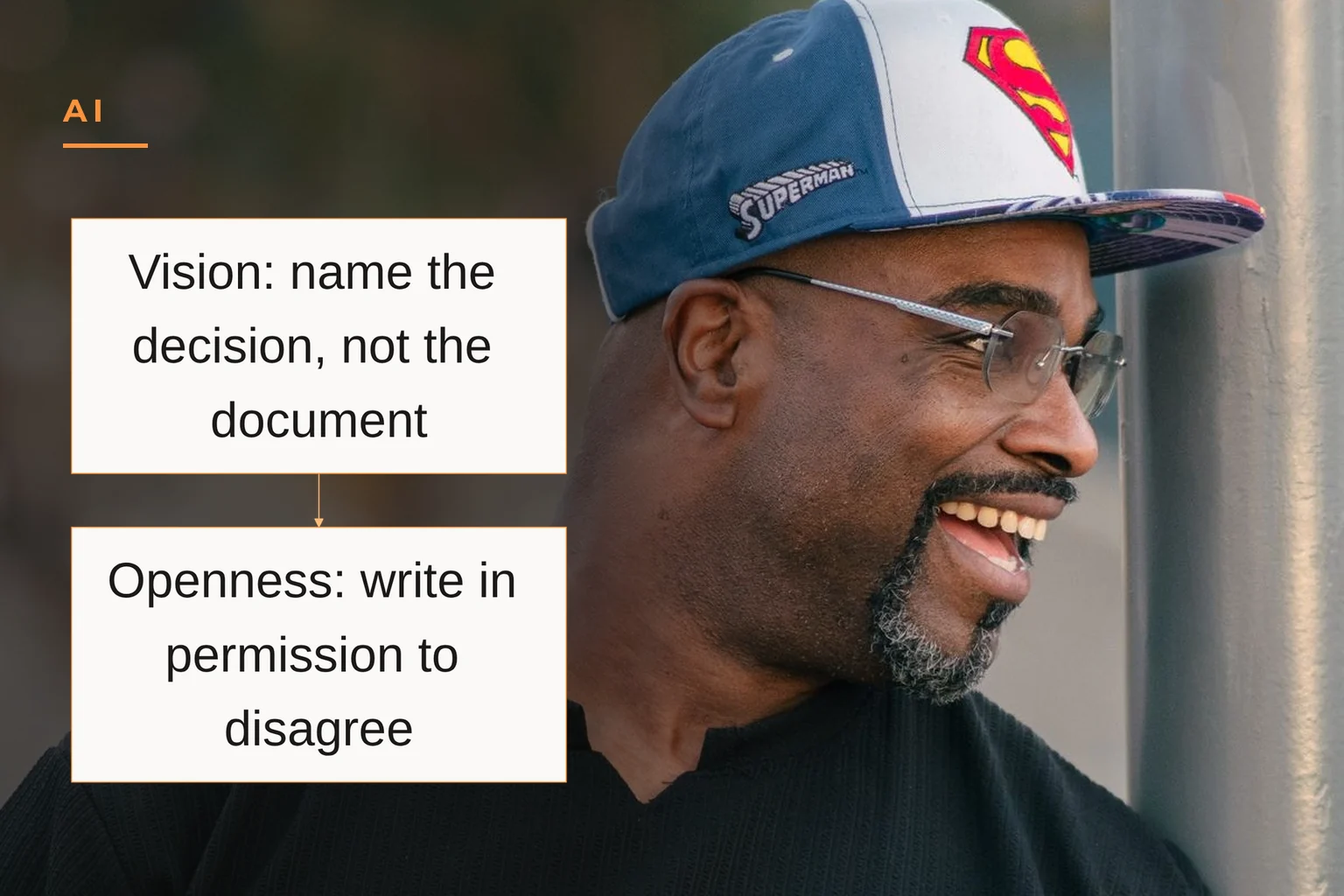
Vision is naming the decision, not the document. "Make this better" contains no decision, so there is nothing to test. "We are deciding whether to keep this contract at the current price" contains one, and now something is at stake the model can push against.
Openness is the leg people skip, because it costs something. Openness is an instruction, not a mood. With a person you leave room to push back and they usually take it. With a model the room does not exist until you write it in.
Great questions have room in them for you to be wrong. "How do we get the team to adopt this?" has no room, because the answer is inside the question and the model just unpacks it. "What would make this fail?" has room, and the model will fill it.
Now run something real through all three in order. Take the screening decision, which we actually had to make: keep the video stage or change it.
Vision: the decision is not "how do we make the video stage better." The decision is "do we keep a stage that people can prepare for with a model, and if we keep it, what are we claiming it measures." That is a decision with a stake, and it can be wrong.
Openness: write the case against me into the prompt. Here is the argument: an untimed video stage filters for people who perform well on camera and penalizes people who think slowly and well. Build that case. Then I have to carry what comes back, and some of it landed, which is why the timer exists.
Great question: "If this stage were costing us good hires, what would we see?" That has room. The answer that came back, candidates whose live conversation outruns their video, is something you can actually watch for.
The call: keep the stage, put the timer on it, and stop calling the result a read on the person. It is a read on how someone handles a question they have not seen. If that is not what you are hiring for, cut it.
The rule went exactly where I pointed
My team and I were at about 90% on the app that produces pharmacy social posts. A problem surfaced, and solving it needed a new rule. We were working in the product posts when it came up, so that is where we built the rule. The product posts got fixed.
Every other post category stayed broken.
We were 90% done. The rule was four days old. It had been applied to exactly one category, and the product posts came back fixed, which felt like proof.
The AI had applied the rule to the one category we happened to be sitting in and to nothing else. A human developer would have swept a new rule across every post category the first time, without being asked, because a human knows a rule is a rule. The model did what I said, exactly where I said it, and stopped.
We spent days against a wall before the AI said plainly it had never applied the four-day-old rule anywhere else.
Now look at what I believed during those days. I believed the rule was in, and I had evidence: I had watched the product posts come back fixed. That was not an examination of the build. That was a confirmation, and I filed it as a status update.
The fix is one line in a build. After any rule change late in the process, ask explicitly for it to be applied to every related category, then ask for a report on where it landed. That line cost us days of head-banging to find, and the general version of it is a question the model will never ask on its own.
Same failure, twice
The videos and the rule are one story. In both cases the model returned exactly what was put in, confidently, and I filed the output as evidence. Same shape. Different room.
| Situation | The consistent way, which fails quietly | The inconsistent way, which is the fix |
|---|---|---|
| New rule late in a build | Rule built where you happened to be working, applied to one category | Rule swept across every related category, then verified |
| Interview questions | Untimed, candidates compose with a model, nobody spots it | Timed, question seen for the first time when it must be answered |
| Beliefs in a prompt | Typed as fact, model builds on the premise | Labeled as belief, model given permission to refute |
And you wanted the generalization, so here it is. This applies everywhere you set a frame and never labeled what was inside it: the campaign brief you wrote from memory, the board deck that opens with the conclusion you already reached, the performance review where the story arrived before the evidence, the rule you shipped late on a Friday. The test is not which tool you used. The test is whether anything in the prompt was allowed to be wrong.
The part nobody warns you about
All of the above is easy to agree with and hard to do, and the reason is not technical.
Labeling your beliefs forces you to look at them. You built a career on conviction, and this asks you to file the edge off that conviction long enough to check it. Some of what you have been calling data is an opinion you repeated often enough that it started to sound like data. That happens in private, before anyone else sees it, and it still stings.
Then the speed goes. Confirmation is fast and it feels like momentum. Handing over the thinking is slower, and what comes back is paragraphs you have to sit with instead of a document you can send. On a bad week, the fast thing wins.
And underneath it is the thing you actually feel: you are supposed to be the one who knows, and building in something that can tell you no feels like handing that away.
I am not going to tidy that up for you. You can do everything right and the case against your decision can still be correct. Then you are the one who calls it anyway, with the argument sitting in the room and no one else to blame for the outcome. That is not a worse version of leadership. That is the job, and most people avoid it by never writing the permission in.
One more price, and it is the one that gets skipped. If nobody labels the premise, nobody spots the failure. Our whole screening stage was comparing one AI to another AI and calling it reading people, and we would have kept doing it indefinitely. The timer is what made the stage honest, and honesty cost us the polished answer we had quietly started grading on.
Monday, and what each move costs
The first move matters most. If you do only that, you have most of what this article is for.
1. Label one belief per prompt, then ask for it to be broken. One line: here is what I believe, here is why, it is a belief, so tell me where it fails. The cost is that you will find something you call data is an opinion, and the refutation may land, and you still have to walk into the meeting and call it. Do this one when you have time to sit with the answer. Do not do it thirty seconds before you present.
2. Name the decision at the top. One sentence: what is being decided, by when, what happens if it is wrong. The cost is that "what happens if it is wrong" goes into writing, which means you are admitting there is a version where you lose. If the decision is genuinely low stakes, skip this and ask for a first draft.
3. Put a timer on anything you collect from people. Our screening went to a timed answer, and the same logic holds for any questionnaire, review, or intake form you send. The cost is the one I already named: you lose the polished answer, you will grade some careful people down for thinking out loud, and you have to decide whether the thing you are measuring is worth that. If people have time to compose with a model, you are not measuring them. You are measuring the model, and then promoting based on it.
Where this goes next
The worldview is vision, openness, and great questions, and it holds whether a person or a model is on the other side of the table. But a worldview is not a workflow. The mechanic that turns it into moves you can run this week is the CASE Method, which is where I would go next.
Start smaller than that, though.
Today, before you prompt anything, write one sentence you would normally type as fact and put the word opinion in front of it. Then ask the model to tear it apart and see what comes back.
If what comes back stings, you were using AI to confirm something. Now you know the difference, and you cannot un-know it.