Your Marketing Team's Job Changed. The Briefing Never Did.
By Atiba de Souza
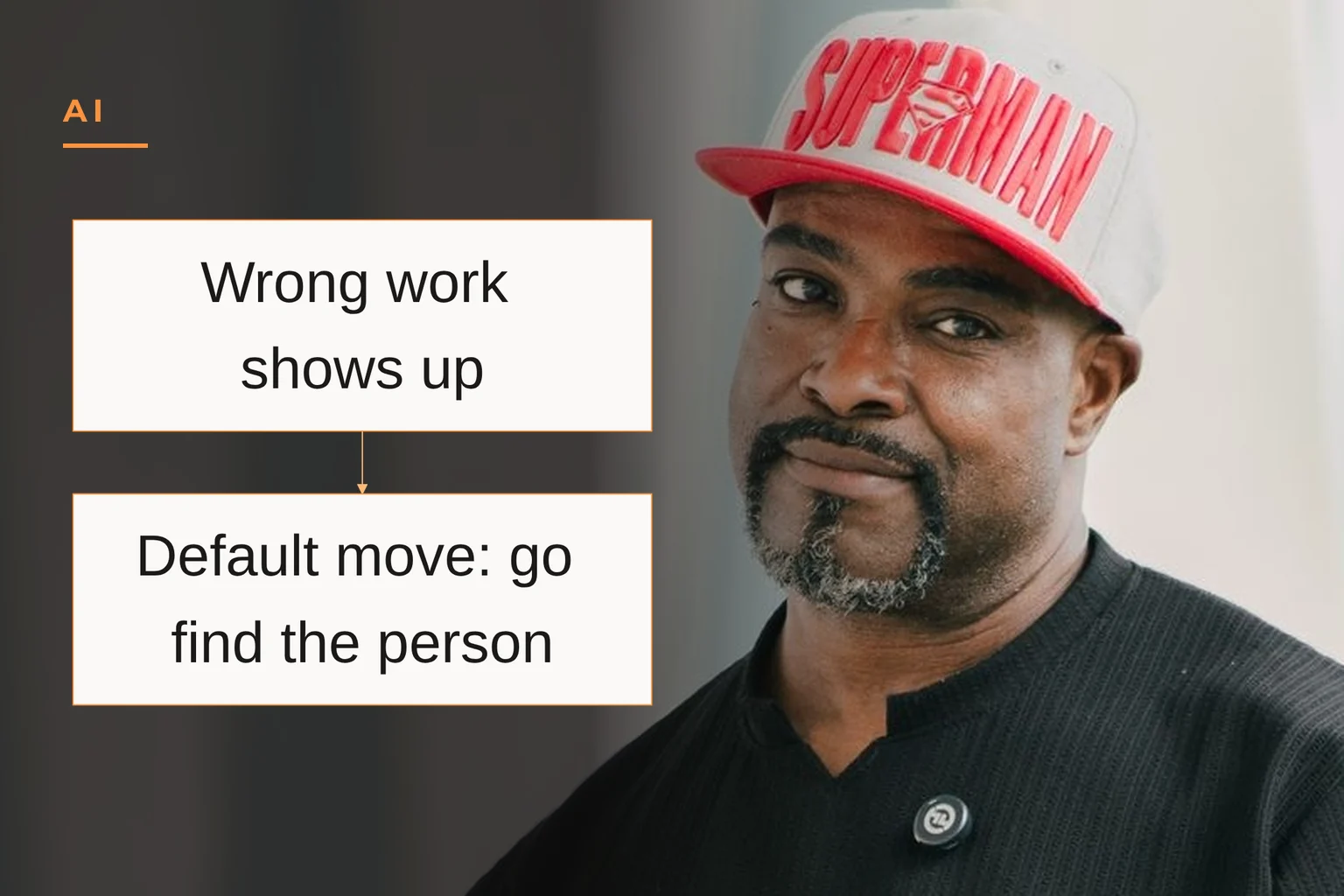
You don't have a performance problem. You have a handoff problem
July 2026. I own the marketing lane on a three-founder venture called TrueMD, and I'm looking at work coming out of my own team, saying the sentence every leader says right before they go blame a person: "Why in the hell are we doing this?"
Work was getting dropped. Assets were landing off target. Things were getting built that made no sense to anybody, including the people who built them.
The normal move is to go find the person. I went looking for the reason instead, and the reason was me. Most of my team had never been told what TrueMD actually is. Not the offer, not the feature list. What the thing is. Only a subset knew. I had assumed everyone did, because I knew, because I had said it out loud in rooms, because it had been true in my head for months.
One person told me plainly: "I didn't know what TrueMD was."
Three founders. One marketing lane, mine. And only a subset of the people working in it actually knew what the business is. The dropped tasks were not a performance problem. They were the sound of me assuming.
Here is what I actually handed that team: a task list. Build the LinkedIn presence. Produce these assets. Reasonable work, clearly stated, and not one line of it was the question. I never handed them what TrueMD is, who it is for, what we were trying to make true that quarter, or where their call began and mine ended. So they did what good people do with a task list and an information vacuum. They filled the vacuum with guesses and executed the guesses with real enthusiasm.
Had I written down what TrueMD is and walked the whole team through it before any work started, those dropped tasks and off-target assets would not exist. That is not a hypothetical. That is the same quarter, minus the rework.
Delegating thinking: handing someone the question, the context, and the authority to decide, so that when reality shifts they can re-decide without you in the room. Delegating tasks hands over steps. Delegating thinking hands over a job someone can own.
Ownership is the destination. Everything else is a route to it. You cannot get ownership out of people you have only ever handed tasks to, because ownership is a decision habit, and habits get built by deciding.
The change nobody announced out loud
Everyone thinks the marketing job changed because of AI, or channels, or the algorithm. That is the small version, and the small version keeps you busy without fixing anything.
The real change: the job moved from producing marketing to proving that enough of the right opportunities existed for somebody else to close. When that shift lands and nobody says it out loud, your team keeps doing the old job with new tools, and then you sit in a review wondering why they are optimizing things that don't move anything.
They are not confused. They are un-briefed. There is a difference, and you are the only person holding both versions, which makes you the only one who can tell which one you are looking at.
The analogy I use when somebody else does the closing
When I did agency work where the client handled the close, the only honest accountability was this: prove we delivered enough consultations that success was possible. That's it. Separate what you control from what the client controls, then be accountable without apology for your half.
Not "your close rate is bad and that's our fault." Not "here are some custom links that will explain everything." The split, named out loud.
Your in-house team lives under that same split and almost never gets told where the line is. So they do the default human thing. They take responsibility for the part they don't control and ignore the part they do.
Mekka, the custom links, and the assignment I forgot
Mekka is being groomed into the head-of-marketing seat at MMR. I'm in a 1:1 with her and I'm there to correct her aim. She wants custom links to attribute web-class sign-ups, on a web class that had almost no sign-ups to attribute. She is building precision instrumentation for demand that does not exist yet.
I'm two sentences into the correction when I realize the fault I am about to name as hers is mine. Early on, I told her to map every funnel, every stage and step in every funnel, and the KPIs at each one. It overwhelmed her. She never did it. We got busy. I never went back to check.
I said it out loud: that was me.
Now put it through the model, because this is where I got the frame wrong at the time. Mapping every funnel and every KPI is not a task. It is a question with real decisions inside it, so on paper it was a thinking handoff. In practice I handed her a third of one. I gave her the question and withheld the context, meaning why the map mattered to the seat she was growing into and not just to my curiosity. I withheld the call, meaning what she was allowed to decide once she had it. And I withheld the date. A question with no context, no authority, and no date is a task wearing a bigger word.
That is the decision you are about to make this week. If you hand someone a big question, you owe them all three, plus a date. Give them a question and skip the rest and you have not delegated thinking. You have delegated confusion and then blamed them for it.
You are expecting the ending where I gave her clarity and the numbers turned around. No. What I got was worse and more useful. I couldn't tell the difference between someone who won't and someone I set up and then forgot. That is not a nuance. That is the difference between coaching a person and writing them off, and I was two minutes from writing her off.
It had already happened, and nobody connected it
September 12. A TrueMD event. The marketing plan got built before anybody knew what the registration goal was. Same missing map, second event, different lane.
And that is the escalation, not the footnote. Nobody connected the two, because on paper they were two unrelated execution misses from two different parts of the business. They were the same miss, arriving on schedule. A foundation that was never built does not fail once. It fails wherever it is needed, and it looks like a new problem every time.
Which means my "that was me" moment in that 1:1 was not a one-off. It was a pattern with a calendar in it.
Ranked: what matters here, and what is noise
The one that matters most. Write down what the business is, then confirm every person working on it has read it. One page: what we are, who it is for, what we are trying to make true this quarter, how we will know it is working. Not a brand book. Not a deck. This is the cheapest, highest-yield move in the article, and it stops the wrong work before it starts.
The one that keeps it alive. Put a date on every assignment big enough to overwhelm someone, and check it. Skipping that is how a small gap quietly becomes a quarterly review where you are confidently wrong about a person who was never set up to win.
The noise. The tools. AI, automation, attribution. All of it sits downstream. A team that doesn't know what the business is will use every new tool to produce faster versions of the wrong thing, and they will do it with real enthusiasm, which makes it harder to catch.
When not to do this
Don't hand over the thinking when the person has no path to the context and the decision is unrecoverable. If a call can sink the company, you build the map first, then hand over a narrower question with real edges.
And don't do it in live fire. Mid-crisis, you direct, then you debrief the thinking after. Handing someone a decision they were never equipped to make and calling it empowerment is abdication with better branding. That is exactly what people are rolling their eyes at when they hear the word ownership.
What this costs you, and why you will avoid it
Two fears, both real.
The first: if they can run this without you, you find out how much of your day was being needed rather than being useful. Handing over thinking is the fastest way to discover you have been the bottleneck. That stings more than the dropped tasks did.
The second: writing down what your business is feels insultingly basic. You will want to skip it because it is obvious. It is obvious to you because you live inside it, which is exactly why it is not obvious to the person building your assets at 4pm on a Friday.
And the bill does not arrive as a document. It arrives as a meeting. Mine cost me saying "that was me" out loud, to the person I had walked in to correct. Your team can tell the difference between a leader who is accountable and a leader performing accountability, and they will price you accordingly.
| What I did when I was inconsistent | What consistent looks like |
|---|---|
| Assumed everyone knew what TrueMD is | Confirmed every person working on it had read the one page and said so |
| Handed over the LinkedIn task and the asset list, no context | Handed over the question, the context, and what they could decide without me |
| Gave Mekka the funnel map with no date and no check | Gave the same assignment a reason, a date, and a follow-up on the calendar |
| Found out in a 1:1 that the foundation was never built | Found out at the follow-up, while there was still time to fix it |
| Read two misses as two unrelated execution problems | Recognized the second event as the first failure arriving on schedule |
What to do Monday, including the part that stings
Three things, in order, and none of them are comfortable.
One. Write the one page. It will feel beneath you. That feeling is precisely why it has not been done, and it is the reason your team is building the wrong things this week. Write it anyway, send it to every human who touches your marketing, and ask for a reply that says they read it. Not a thumbs up in a channel. A reply.
Two. Pick one assignment you handed off months ago and never checked. Put a date on it, tell the person you are checking, then check. This is the step that costs, because the likely finding is that the person you were about to call a performance problem was waiting on a foundation you never laid. When you find that, say it out loud to them, specifically: "I gave you this and then forgot it." Expect it to feel worse than the page did. Say it anyway, because the alternative is managing a person you have already misjudged.
Three. In your next 1:1, ask "what were you trying to accomplish?" before you ask "why did you do that?" The order changes the entire conversation, because the first question assumes intent until proven otherwise.
Your team is not the problem you have been describing to your co-founders. They are doing exactly what you told them, in good faith, with the information you gave them. The fix is a sentence you have not said out loud yet, and saying it will cost you a small piece of the story you tell yourself about why the team needs you.
I can't hand you a clean before-and-after on this one. The page I owe my team is the easy part, and I am still paying it. Say the sentence. Then write the page.
Questions