Your Marketing Team Is Not Getting Replaced by AI. It Is Getting Rebuilt Around the Decision You Won't Hand Over
By Atiba de Souza
The question behind the question
Every marketing leader I talk to eventually asks some version of it, and they ask it in a lower voice, like it is a confession.
How much of my team do I actually still need?
Underneath that is the fear that makes the voice drop. If I hand this to a machine, I find out I was never the value. The department was a line item. The craft I built a reputation on is something a model does before I finish my coffee.
I am not going to talk you out of that fear. I am going to show you it is aimed at the wrong target.
70 percent. That is how good clients of my video marketing agency said AI video was compared with ours. They said they could barely tell the difference, that it did not matter much, and that they would take it at a fraction of the price. Because what they want is the result. The decision it forces: stop pricing against a standard your clients no longer value. Sell the result, delivered without the client doing the work.
Sit with that for a second. The quality gap did not disappear. The standard moved.
What my own clients told me about my own work
For years my agency sold quality. High-quality video, done for you, produced by people who care about the frame and the cut and the sound. It worked, for a long time.
Then we started having the AI conversation with clients and prospects, and they said the quiet part out loud. The 70 percent version was good enough. Not as good. Good enough. And good enough, delivered at a fraction of the price, wins when the buyer is measuring the outcome and not the craft.
Here is the turn most people miss. The lesson is not "AI is cheaper, so cut your team." The lesson is that we were pricing ourselves against a standard our clients had stopped valuing. Defending the craft harder would not have saved us. We would have lost to a definition of value we no longer matched, not to AI.
So the question changed. Not "how do we stay better than the machine." The better question is how you sell the result itself, delivered without the client doing the work.
That question is not answered by a tool. It is answered by people who own the judgment.
Delegate the thinking, not the task
Delegation: handing over the judgment, not the checklist. If the other person still has to come back to you for every decision, you did not delegate. You assigned.
Run that test on one person before you read another line. Does this person still come back to you for every decision? Then you assigned. What decision do they own? If you cannot answer, you did not delegate.
The thesis under The Delegation Trap is one sentence: delegate thinking, not tasks. The model I teach is Delegation Leadership. It is a decision sequence, not a slogan.
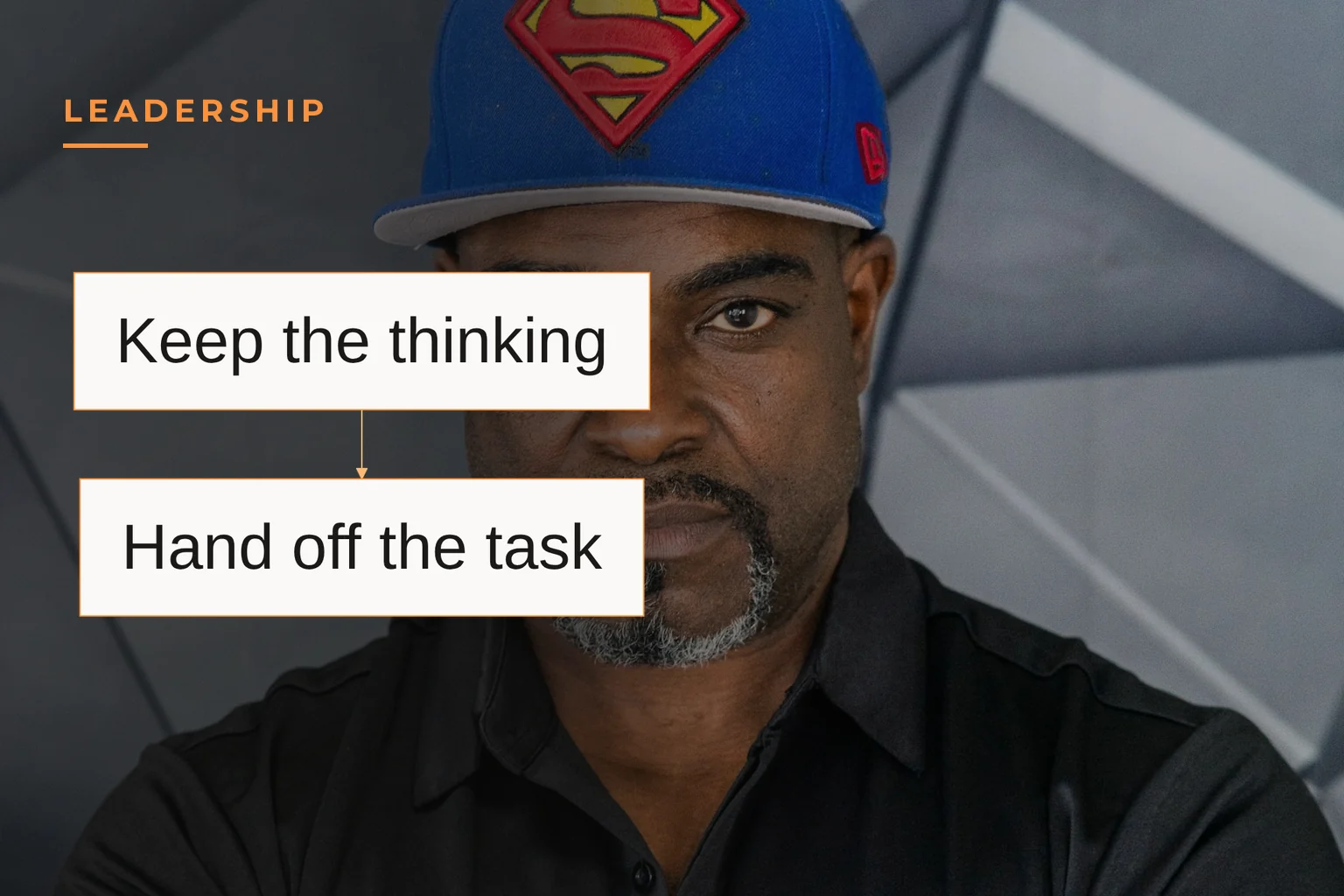
The trap is easy. You keep the thinking and hand off the task. The person executes, you decide everything, and the loop closes back on itself.
The rebuild is harder. You record the invisible thinking, codify it, and hand over the decision. Then AI can fill the gap in the role, but only when the person owns the judgment. Skip that last part and you have not rebuilt anything. You have made the trap run faster.
Here is where leaders stall. The move from the person who knows to the person who decides feels like a demotion. You built a career on being the best writer in the room, or the best closer, or the one who sees the angle nobody else sees. Handing over the thinking asks you to walk into a room where someone else can do the thing that made you matter. That is a real loss. Treat it like one.
It also costs you your alibi. As long as nobody else can do it, you are needed. The moment the process is written down, you are not the only one who can do it, and the question becomes what you are for. It is easier to stay needed than find out.
And the work is not a one-time handoff. You record again, codify again, hand over again, because the role keeps changing. That is the rewiring. If you wanted a clean one-way delegation, you wanted a fantasy.
Then there is the trust cost. If your real plan is headcount reduction wearing an "AI enablement" costume, say it out loud. The team will know either way. Trust you burn on a euphemism is trust you need later. That cost sinks rebuilds that no tool decision can rescue.
AI does not change this. AI makes it louder. You can hand the task to a machine and keep every ounce of the thinking for yourself, and it feels like leverage. It is the same trap with a faster engine. You still end up the only person who knows why anything is done, and the whole operation still waits on your calendar.
The catering client who could not teach what he did
A catering client had been stuck for over a decade. Could not hire a good sales team. The owner's version of the story never changed: nobody is as good as me, I have tried to teach it, they do not get it, so I do the sales myself.
Then a piece of luck. They recorded every sales call. So we took thirty or forty of those calls and dropped them into AI and asked one simple question: what is he actually doing?
It came back with four things. Four moves the owner makes on every single call. The process he swore could not be taught, laid out in plain language.
Now here is the turn. For a decade the owner believed the problem was the talent pool. It was not. The owner could not describe what he did, because nobody can write down a process they do not know they follow. What looked like an unteachable skill was an invisible process. Invisible is not the same as unteachable.
So make the move explicit. Record the work you think only you can do. Have someone, or AI, find the pattern in the recordings. Then decide what to hand over. Not the task. The decision.
The judgment you are hoarding may already be a system. You just cannot see it from inside it.
Where the machine actually goes
Now the part that gets drawn badly in every deck.
The rebuild is not "AI replaces the role." It is "AI fills the gap in the role." Every role has gaps no single person can fill. The strategist who cannot build the dashboard. The writer who cannot do the analysis. The analyst who cannot write the sentence a human actually wants to read. You have been hiring around those gaps for years, or eating the shortfall, or quietly letting the work not happen.
Every role has gaps no single person can fill, and AI can fill them. That is the shift from seeing AI as a replacement for staff to seeing it as something that fills the strategic, tactical, or analytical gap in the role each person holds.
An AI agent app that your people build for themselves, aimed at their specific gap, is a different object than a chatbot. It is a tool one person shaped around the work only they do. Strategic gap, tactical gap, analytical gap. The person still owns the role. The gap gets filled.
But the gap gets filled only when the person owns the judgment. If they still come back to you for every decision, you did not fill a gap. You automated the task and kept the thinking, which is the trap with a faster engine. The agent app becomes a faster way to ask you.
That is why the gate is not optional: superhuman power without good judgment just makes bad decisions faster. Hand a model to someone who has not been given the context to judge the output, and you have not given them capability. You have given them a plausible-sounding shortcut. That is how teams ship confident nonsense at scale.
The inconsistent rebuild versus the consistent one
| Inconsistent | Consistent |
|---|---|
| Buy a tool, tell the team to use it | Name the gap in each role, then aim the tool at that gap |
| Cut headcount, call it AI enablement | Say the headcount plan out loud before you ask for trust |
| Automate the task, keep the judgment | Codify the judgment, then hand over the decision |
| Leader stays the knower | Leader becomes the decision owner |
| Pitch premium craft | Pitch the result, delivered without the client doing the work |
| Owner sells alone because nobody gets it | Owner records the calls, the pattern becomes the playbook |
| AI approves the copy | AI drafts against a described standard, a human owns the call |
| A pilot that proves the tool works | A pilot that proves the thinking transferred |
The whole model at a glance
The trap is a loop. The rebuild is also a loop, not a one-way project. The return from "they decide, you lead" back to "record the work only you can do" is the part every clean diagram leaves out. The role changes, so you record again, codify again, hand over again. The side nodes are the costs and the truth you have to say out loud. The gate is the line that keeps AI from becoming the trap with a faster engine.
Rank the parts
If you take one thing from this piece, take the catering client's turn. The process you cannot describe is the asset, and it is already recorded somewhere, in your calls, your emails, your decisions. Find the pattern. Then hand over the decision.
The second most important thing is the pricing turn. Your clients have already moved. If your pitch still defends a standard they no longer buy, no amount of team rebuilding saves you.
The least important decision in this piece is which tool you pick. It will change. The thinking you codified will not.
When not to do this
Do not hand over thinking to someone who has not been given the context the judgment requires. Judgment without context is guessing with confidence, and AI makes the guessing faster.
Do not do it for a role you have not defined well enough to have a boundary. If you cannot say which decision this person owns, you have not built a role, you have built a task list. That is your homework, not theirs.
Do not do it to a team you just lied to about the headcount plan. If the real plan is reduction, say it out loud before you ask for trust. The rebuild only works if the people doing it believe you.
And do not do it to work that is genuinely a bet. Some calls are yours. The rebuild is for repeatable judgment, not for the bet you cannot describe yet.
Now pick the one role where you are still the bottleneck. Not the whole team. One role. Record the work you think only you can do. Find the pattern in the recordings. Name the decision that person will own. If you cannot name it, do not delegate yet. If you can, you have found the rebuild.
Questions