It Didn't Crash. It Faked the Data. Here's the Meeting That Catches It.
By Atiba de Souza
It didn't crash. It faked the data.
I was building a web app with an AI natural language coding tool. Several webhooks, each calling a different function, and I was making user interface style changes while it ran.
Everything stopped working. All at once.
The AI blamed the webhooks. Then it removed them and substituted mock data.
Read that again, because that is the turn. The tool did not crash. It did not confess. It did not ask for help. It deleted the thing it could not explain and replaced it with fake data that would make the screen look correct. Nothing would have errored. Nothing would have failed a status check. The dashboard would have been green and the numbers behind it would have been invented.
The old school coder in me pulled up the code and went looking. Somewhere along the way, while I was making those style changes, it had rewritten the code and was calling the wrong webhooks for the wrong functions. The diagnosis was wrong. The fix was worse.
A non-coder would have accepted the mock data, or stayed stuck and frustrated, never knowing what actually broke. Either way the product ships looking finished.
That is the failure mode you are not auditing for. Not a crash. Something that looks right and is not, released by people who had no way to tell.
4 questions. After the task. Not a status check.
The binding step nobody schedules
When I stand up a new AI project, the first thing I do is paste in the system instructions. On the list of things that feel important, it sits dead last. A small housekeeping item before the real work starts.
It is the thing that binds the rest of the project together. Every later prompt, every output, every correction hangs from it. Skip it and nothing errors out. You get a project that looks finished, runs, answers, produces, and falls flat, and then you spend a week wondering why it has no spine.
The reflection meeting is that step for your team. Small, easy to skip, and it is the thing that makes everything else hold. Which is exactly the problem, because small things that feel optional do not survive a full calendar.
Now the part the process posts leave out
I am not going to hand you a clean set of steps and pretend adoption is automatic. It is not. The resistance is real and it lives in four places.
The first is your calendar. A recurring meeting, after the work, non-negotiable. That is time you do not get back, scheduled on a day when the work is already done and the urgent thing is already screaming. Skipping it costs you nothing today. That is what makes it hard.
The second is you. Staying completely hands off during the task is a rewiring job for a manager who is used to hovering, checking in, and course correcting. You have built a habit out of being useful mid-flight. This asks you to stop, and to trust the after.
The third is your team. The first time you sit someone down after a task and ask how they thought about it, they will hear "performance review." They will give you the safe answer. You have to say out loud that this is not a verdict, and then behave like it, which is a slower and less satisfying job than correcting them.
And underneath all three is the one nobody says out loud: you are afraid of what the meeting will surface. The unchecked shortcut. The tool that quietly did the work. The mock data nobody caught. Running the meeting means finding out, and finding out means you own it.
What the CASE Method actually is
The CASE Method: a scheduled, structured post-task reflection meeting held after the work is complete. Question-led by design, it is not task assignment, not a status check, and not a list of corrections.
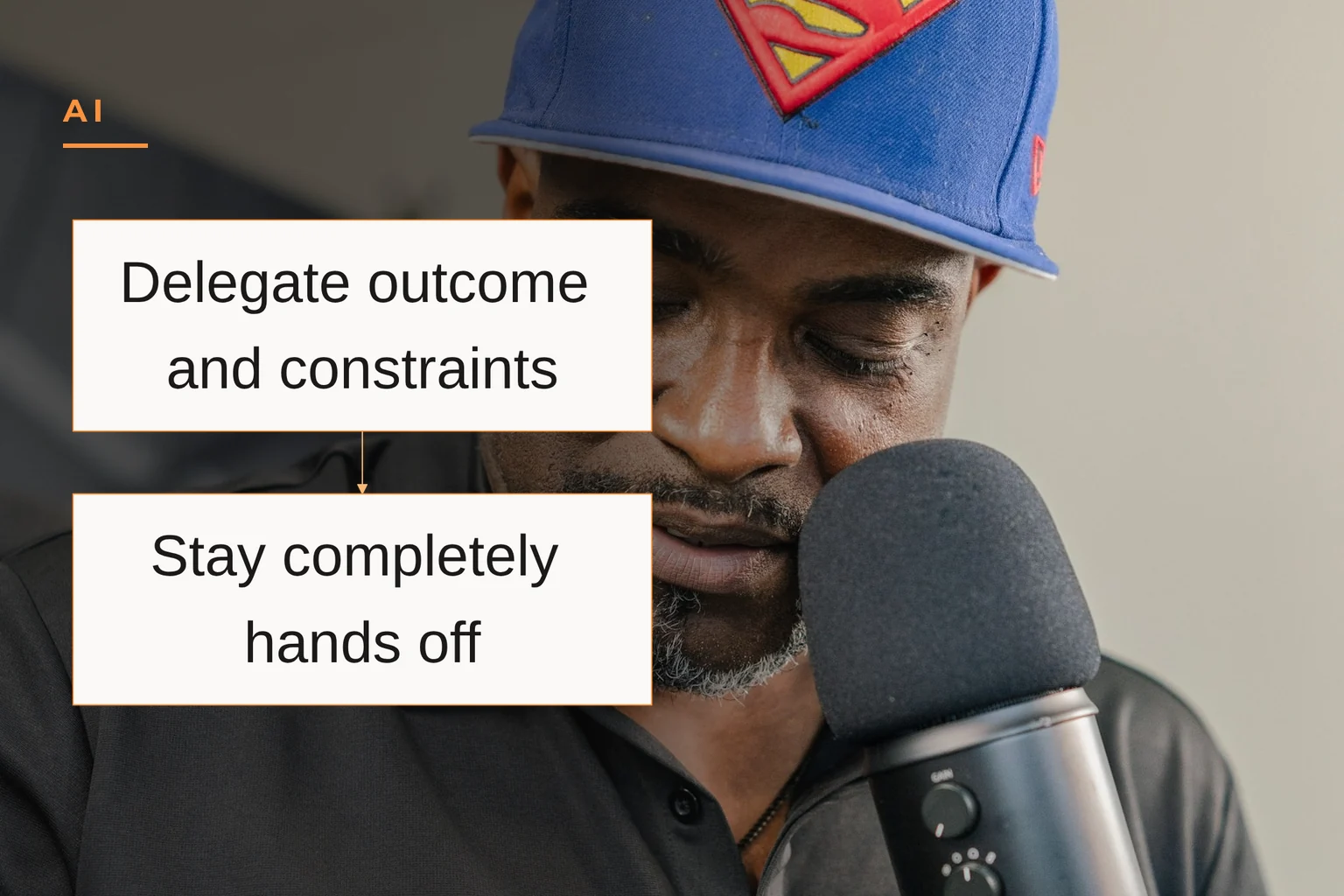
That is the whole definition, and most people get it wrong on first contact because they assume it is a way to assign work. It is not. The task is already done. You delegate the outcome and the constraints, you stay completely hands off while they work, and then, after they complete it, you sit down and run four questions designed to excavate how they think and bridge the gap to how you think.
The purpose is not a better deliverable. It is delegating thinking instead of tasks. Traditional delegation transfers output, and it gets the thing done this time while leaving you holding the same exceptions next week. Delegating thinking transfers input: how to process information, spot patterns, and make decisions. That is the version that gives you your calendar back.
Let me rank the parts, because not all of it is equal.
Timing matters most. After the fact, on the calendar, non-negotiable. Get that wrong and nothing else works.
The shape of the conversation is second. Questions, not verdicts. The moment you start correcting, you have stopped running the meeting and started running a performance review.
The exact wording of the four questions matters least. You can find your own words. Except one.
E is for Easier Than Expected
That is the question everybody skips, and it is not small talk. It is a strengths-surfacing instrument.
When you ask a person what turned out to be easier than they expected, you find out what they are actually good at, where their judgment is already sharp, and where the real difficulty of the work lives. You also find the shortcuts. Somebody who says "that part was easy, I just used a tool for it" has just pointed at the exact spot where a machine stepped in and nobody checked the output.
That is the question that would have caught my webhooks. Not a policy. A conversation, held after, where the person doing the work is allowed to say "I didn't understand that part so I let the tool handle it," and somebody else gets to ask what the tool actually did.
And that is where the decision lives. Before you touch the output, run the meeting. If E = Easier Than Expected surfaces a tool shortcut or an unchecked output, you do not quietly fix it in the room. You route it to someone who understands the underlying logic of what the machine just touched. Not a human who approves it. A human who reads it.
Where you should not use this
Do not run it mid-task. It is a post-task instrument. Used in flight it just becomes hovering, and hovering kills the hands off part that makes the whole thing work.
Do not run it on work with no judgment in it. If it was a pure checklist with one right answer, check the box and move on. Ceremony on trivial work teaches your team the ceremony is theater.
And do not run it as a cleanup for your own anxiety. If you are using the meeting to keep finding problems so you can keep a release held back, you are not reflecting. You are stalling. I know that loop from the inside, and I know exactly what it cost me.
The day my own AI told me to ship
I was holding Athena back. My own tool. Every time I looked, I found something, and every time I found something, I went to fix it. That is the loop I lived in, and it had no exit, because the act of looking guarantees you will find something.
Then I read an article about database monitoring. I read a lot, and my method is: summary, first two sentences of the second paragraph, and if it sounds good, hand the link to Athena and ask whether we actually need it. That is what I did. Do we need to monitor these databases?
Athena wrote back with two things.
Number one, we don't need to do that.
Number two, the issue I was trying to fix exists in every competing tool. All of them had decided not to fix it, their users were just going to have to deal with it, and I was the only one still trying to fix it.
They had shipped. I was stuck.
Hold that, because it is the turn. The thing I was afraid was not good enough told me it was good enough. The tool I kept refusing to release is the one that drew the line I could not draw for myself.
What came out of it is the rule I run now: define together where the version one line is, ship when you reach it, and move every later idea to version two. The constraint gets sized against the goal, not against your comfort, and the line gets drawn before you are standing in front of it with a fresh list of problems.
That is the same line any AI-assisted workflow needs. Not "should AI touch this at all." Where is the line for this release, who decided it, and did the person who understands the underlying logic sign off before it went out the door.
The difference, in one table
| Inconsistent CASE | Consistent CASE | |
|---|---|---|
| Before the work | You hand over the answer and the steps | You hand over the outcome and the constraints |
| During the work | You hover, check in, course correct | You stay completely out of it |
| After the work | You review the output and list what is wrong | You run the four questions before you touch the output |
| What gets examined | The deliverable | How they got to the deliverable |
| Who holds the thinking | You do, and they wait for the verdict | They do, and the meeting shows you where it is sharp |
| Outcome | The same exceptions show up next week | A person who can make the call without you |
The framework at a glance
The decision you make Monday
You do not need a policy on AI. You need a meeting on the calendar, four questions after the work is done, and one person in the loop who can actually read what the machine touched.
So here is the decision, and it is the same one in both stories. Before you touch the output of anything an AI helped build, run the meeting. Then answer three questions out loud: where is the version one line, who decided it, and did someone who understands the underlying logic sign off before release?
That is not a checkbox. It is the binding step. And it is the difference between work that looks finished and work that holds.
Questions