Why the Best AI Leadership Advice Sounds Like a Question, Not an Answer
By Atiba de Souza
The videos came back identical
We sent every candidate the same interview questions before any live conversation. Record your answers on video and send them over. The whole point was to hear the person before we met the person.
The videos came back nearly identical.
Not similar in tone. Identical. People had taken our questions, fed them to AI along with our job description, and pasted the results back into a camera lens. One written answer still had the AI's closing line sitting at the bottom, offering to craft more follow-up answers. Nobody had thought to delete the receipt.
We built a stage designed to show us a human, then stood there comparing one AI's answers to another AI's answers while telling ourselves we were reading people.
That is not a hiring problem. That is a design problem. We asked for the wrong output, and we got it, perfectly. The screening stage asked for WHAT before WHY and HOW. It got WHAT.
You are running that same experiment on yourself
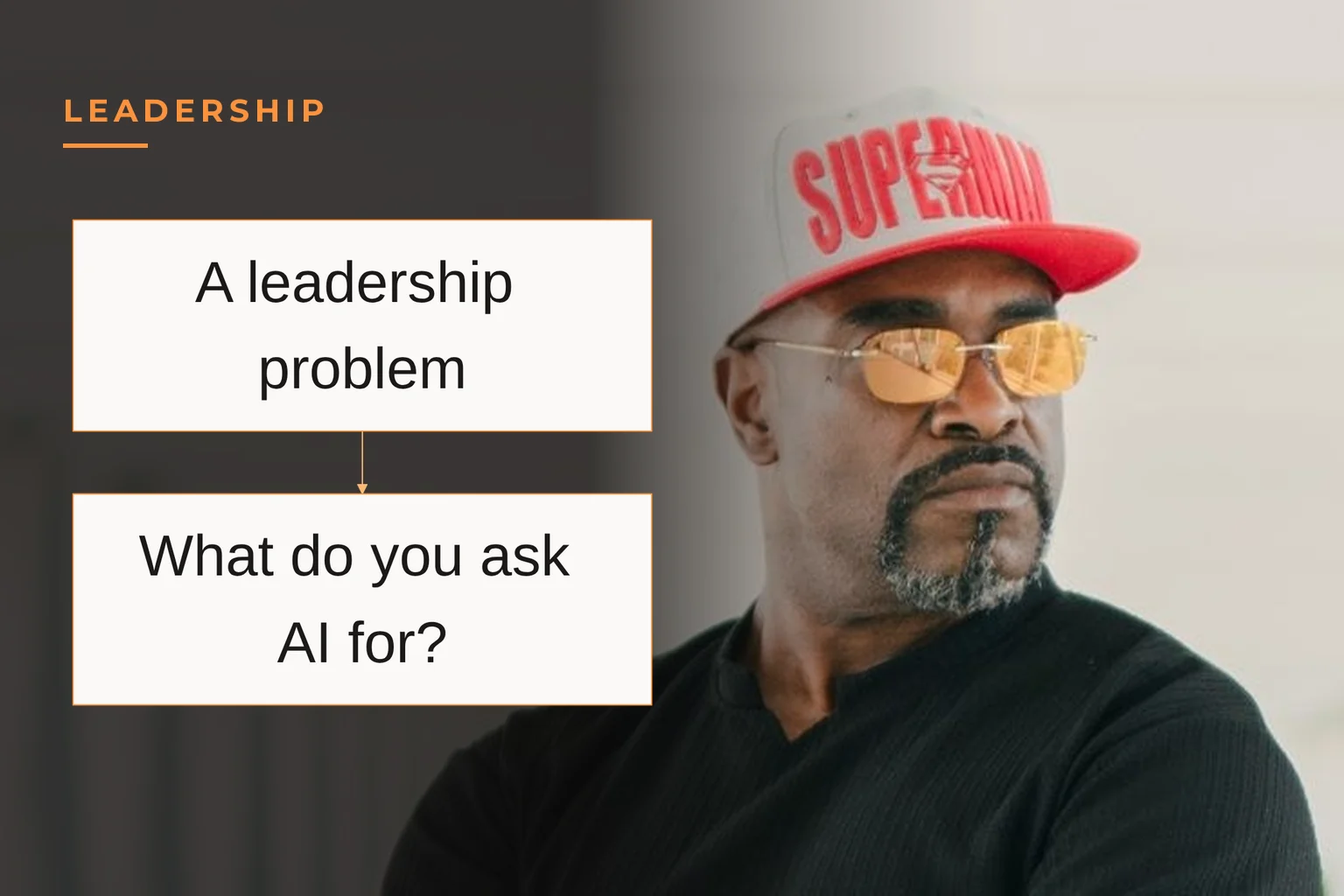
Here is what I catch myself doing, and what I watch sharp people do all day. A leadership problem shows up. I open a chat window and type it in. "How do I get my team to care about this?" Then I wait, and out comes a clean, confident, well-structured answer.
It reads like leadership. It is an answer for everybody.
The average answer: a prediction built from everyone who came before you. If you do not fit the prediction, the answer will not fit you.
That is not the model misunderstanding you. That is the model doing exactly what prediction does. It finds the middle of the room and describes it in excellent prose. The AI did not misunderstand you. It gave you the average person's answer, and you are not the average person.
If your problem lives in the middle of the room, congratulations, you got a real answer. If it doesn't, you got a beautiful answer for a leader you have never met.
The instinct here is to blame the tool. Don't. The tool is fine. What you asked it for is the problem.
70% of the work is shaped like a question
I run content through one engine: WHY, HOW, WHAT. It is the part of my Story Strategy system that moves a stranger through three states, Know, then Like, then Trust. Every piece of content is one of those three types, and the split by volume is not close.
70% WHY. 15% HOW. 15% WHAT. Ask AI for the plan before anyone has raised a hand, and you are spending the smallest slice and calling it leadership.
WHY is awareness. Values, the philosophical side of the brand, the reason any of this matters. One pain point per piece, tied to one of the three basic human motivations: relationships/sex, status, or money. Then explain why that pain matters and why it needs solving. The call to action is not a purchase. It is low-commitment self-identification. Raise your hand. Which one of you feels this.
HOW is the Like layer. WHAT is the Trust layer: the proof, the demonstration, the work itself. You earn the right to ask.
Now look at what you get when you ask AI for leadership advice. You get WHAT. The plan. The three-step framework. The tactic for Monday morning. Polished, structured, and worth 15%. You asked for trust and got handed the proof stage before anyone believed a word of it.
Nothing is wrong with the 15%. The 15% is fine. It just cannot do the job of the 70%, and an answer cannot ask.
That is why the best AI leadership advice sounds like a question. The layer it should be serving, the 70%, is question-shaped by design. Awareness only works if the person on the other end identifies themselves, and people identify themselves by answering, not by being told.
Here is the decision rule I use. Before you send the next team message or type the next prompt, classify the touch. Is this Know, Like, or Trust? If it is WHAT and the audience has not had the WHY, stop. Rewrite it as one WHY piece. One pain point. Tie it to relationships/sex, status, or money. Explain why it matters and why it needs solving. End with a low-commitment self-identification CTA, a question that lets people raise a hand. Then let that classification drive the prompt. Ask AI to help you find the pain and the question for the WHY, not to generate the WHAT you already planned to send.
What the flip looks like
| The answer-shaped move | The question-shaped move |
|---|---|
| Type the problem into AI, take the answer | Give AI the situation, ask for the question |
| Open with the announcement and the deadline | Open with the pain you can see and who it lands on |
| Grade a hire on what they know cold | Grade a hire on how they would go find it |
| Send the questions a week ahead | Put a clock on the answer |
| Ask for the decision on the first touch | Earn the right to ask by giving the WHY first |
Every row is the same trade. The left column buys speed. The right column buys the right to be believed.
Gary refused the premise
Roughly thirty years ago I was a young software architect running interviews the way I judged myself. Random hard technical questions pulled from the deep end. Answer off the top of your head or you are not the hire. That was not a hiring philosophy. That was me assuming every brain in the room worked like mine.
Gary was older. I asked him something built to be answered cold, and he looked at me and said:
"Young man. I don't know the answer to that question off the top of my head. However, I know that the answer to that question is in that book on your bookshelf right now, and so when that question comes up, I'm going to go pull that book off the bookshelf and look up the answer."
On my own rule, I reject Gary.
I hired him. We became friends. And the standard I had been screening for, the one I was so sure of, turned out to be the wrong standard entirely.
Gary never gave me an answer. He gave me a route. I was grading recall. He was showing me judgment. Recall is holding the answer. Judgment is knowing where it lives.
The failure in that interview was not that Gary needed a book. It was that I needed him to already know. I was grading recall and calling it judgment. The move that saved the hire was Gary being willing to ask, and knowing where to look.
AI is the bookshelf now. It is a route to the answer, not a substitute for judgment. The mistake is using it to fake instant recall you do not have. The better use is to ask it to surface the question, the route, the thing you should be checking. Same Gary standard. Be willing to ask. Do not fake the answer.
The fix was a clock, not a better question
What we landed on for the videos was not a sharper set of interview questions. It was a timer. Put a clock on the answer so the question is being seen for the first time at the moment it has to be answered. You cannot pre-load a live question. What comes out is the person, not the corpus.
That same move works on you. Stop handing AI the question in advance and asking it for the answer. Hand it the situation, the person, the pain you can actually see, and ask it for the question you should be asking. Then answer that one yourself, out loud, with your name on it.
The move, with the cost attached
Here is the move on Monday. I am going to attach the cost to each step, because the cost is the reason you will skip it.
1. Ask AI for the question before you ask it for the answer. Before you type the problem, label the touch: Know, Like, or Trust. If it is WHAT before WHY, stop. Hand AI the situation, the person, the pain you can see. Ask it: "What question should I be asking here?" The cost is the status hit. You are admitting you do not know off the top of your head. You will feel my old interview reflex right there, the jolt that says just give them the plan. Ask anyway. The plan is the 15%. The question is the door to the 70%.
2. Ask the question out loud, and let the wait be visible. This is the one leaders hate. An answer lets you move. A question makes the room wait, and it makes you wait in front of them. Do not fill the silence with a plan. The silence is the price. If you fill it, you are back to WHAT.
3. When the room gives you the answer you were avoiding, do not grade it against your old standard. Someone will say the thing you did not want to hear. The old reflex is to overrule it and go back to the announcement. That is my young architect asking for instant recall. The new move is to write it down and ask what it tells you about the WHY you skipped. You do not have to like the answer. You have to use it.
4. Audit ten messages and rewrite one as WHY. Pull up the last ten things you sent your team. Count the WHY. If they are all announcements, deadlines, KPIs, here is what we are doing, you have been running a 15% operation and calling it leadership. Take one and rewrite it as one WHY piece. One pain point. Tie it to relationships/sex, status, or money. Explain why it matters and why it needs solving. End with a low-commitment self-identification CTA, a question that lets people raise a hand. The cost is that you have to own a position, not just issue an instruction.
What matters most, and what barely matters
If you take one thing, take this and let the rest go: change what you ask AI to produce. Ask for the question, not the answer. That single shift moves you out of the 15% and into the 70%, and nothing else here does much if you skip it. The cost is the status hit. You have to be willing to say you do not know off the top of your head and ask anyway.
The second thing, worth doing this week: audit the ratio. Pull up the last ten things you sent your team and count the WHY. If every one of them was an announcement, a deadline, a KPI, a here is what we are doing, you have been running a 15% operation and calling it leadership. Take one of those ten and rewrite it as WHY. One pain, one of the three motivations, one question they can raise a hand to. The cost is that you have to say what you actually believe, not just what you want done. If it is WHAT before WHY, stop and rewrite it.
The minor thing: the timer. It is a good tactic for an interview. It is not the idea. Do not confuse the tactic with the shift.
When not to do this
- When it is on fire, give the order. Awareness work is for the 70%, not for the ninety seconds after the outage. Nobody wants a conversation about values while the site is down.
- When you already know the answer, do not pretend to ask. People can hear a fake question, and it costs you more trust than the answer would have cost you.
- When the room has not seen the pain yet, do not ask them to buy the solution. That is WHAT before WHY. Go back to the WHY.
Questions