Your Last Ten Mistakes Aren't Ten Mistakes. They're One Habit Wearing Different Clothes.
By Atiba de Souza
The videos that gave it away
We were screening candidates by video. Same questions, sent to everyone, answered before any live conversation, so we could hear the person before we met them.
The videos came back identical. Not similar. Identical. Different faces, same sentences, same structure, same phrasing choices, over and over. People had taken our questions straight to AI, gotten an answer, and read it back to a camera.
One candidate didn't even clean it up. Their written answer still had the AI's own closing line pasted at the bottom, offering to draft follow-up responses. We weren't screening people anymore. We were comparing one AI's output to another AI's output and calling it a hiring process.
Nothing about that failure required a bad candidate. It only required a predictable question and a tool built to hand back the most predictable answer to it. That's not a hiring problem. That's what happens every time you ask a prediction engine an obvious question and mistake the reply for insight.
What CASE Method actually is
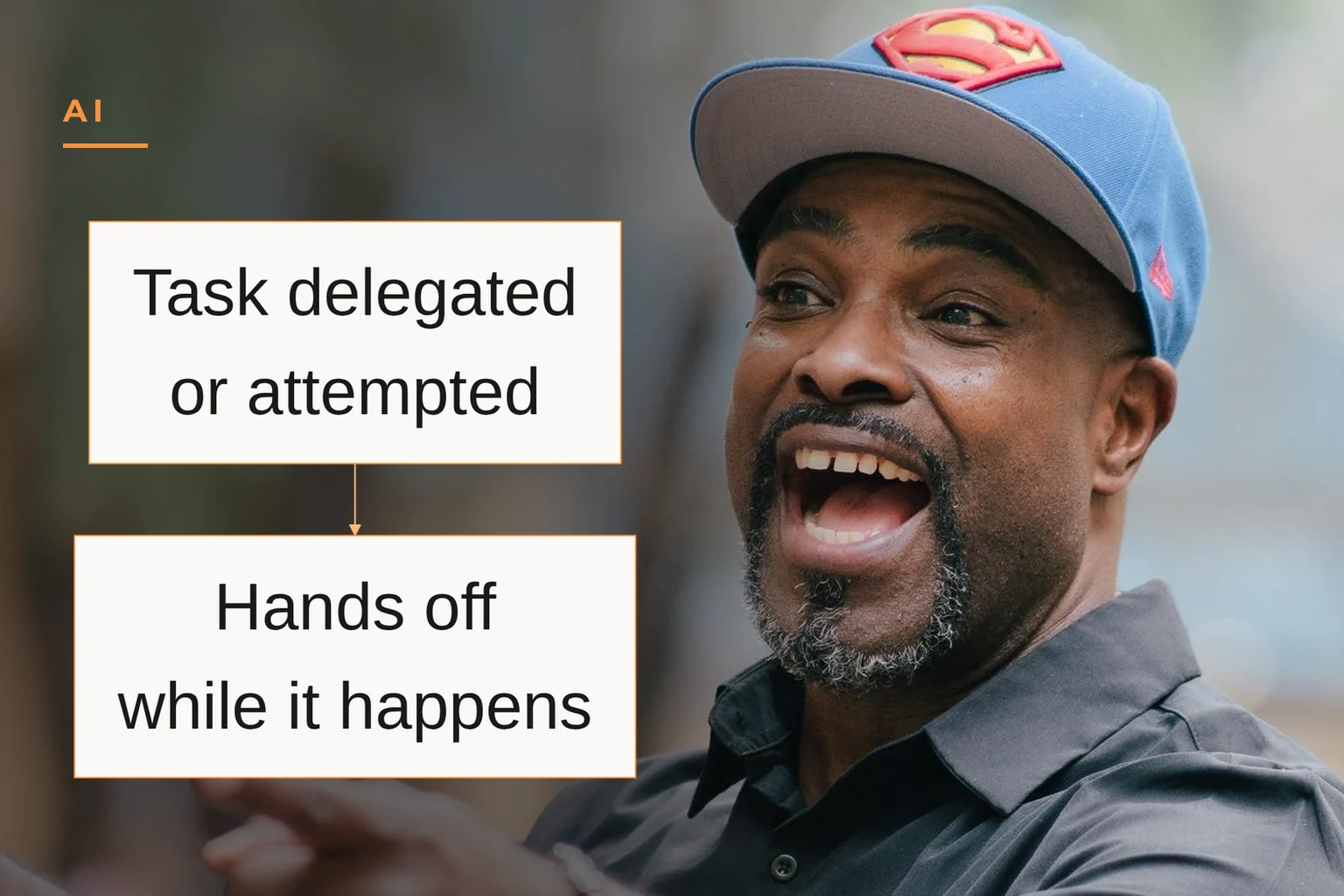
CASE Method: a scheduled meeting held only after a delegated task is finished — you go completely hands-off while someone does the work, then run four questions built to excavate how they thought, not what they did. The goal isn't correcting output. It's transferring how you think so they stop needing you to think for them.
Most people mishear this as a way to assign work more clearly. It isn't. It's a reflection meeting. You don't intervene mid-task, you don't read out a list of corrections, and you don't run it as a status check. You wait until the thing is over, then you ask questions.
One of the four questions is E: Easier Than Expected — you ask what turned out easier than they thought it would, because that question surfaces a strength neither of you knew was there. Notice what it is not. It's not "what did you get wrong." It's reflection, aimed at the thinking underneath the work, run only once the work is done.
The insight hiding inside that one question
Here's the move that generalizes: one instance of anything looks like an isolated event. Ten instances, laid out side by side, stop looking like ten separate events and start looking like one habit re-enacted in different outfits. You can't see that from inside instance number seven. You need distance, and you need all ten in front of you at once.
That's the entire logic behind handing AI your last ten mistakes and asking it to find the pattern. Not a CASE Method meeting in mechanism, there's no delegation, no hands-off window, no other person. But it borrows CASE Method's central move: stop correcting the single event, create distance, and ask a reflective question instead of a corrective one.
One mistake is an excuse. Ten mistakes, examined together, are a fingerprint.
Why the obvious prompt gives you the interview-video problem again
Most people who try this get the interview-video result instead of the pattern. They open a chat window and type "here are my last ten mistakes, what should I do differently." AI has an answer for that exact phrasing, and it's the statistically most common answer to it, which means it's generic, which means it could belong to anyone. "Communicate more clearly." "Delegate earlier." "Set expectations up front." True. Useless. It's the closing line pasted at the bottom of somebody else's response.
I teach this with GPS. Ask GPS for a route and it doesn't give you the best route, it gives you the most predicted one, the one most people take. If you know the back roads, you override it and explicitly ask for something else. That override is a phrase: ask for the obviously most useful answer for everyone involved, not the most common one. That single phrase changes what the engine searches for. It found me a route that saved seven minutes the default prediction never offered, because I asked a different question than everyone else asks.
Where this goes wrong before it goes right
Ranked, so you don't waste effort on the wrong half: the phrasing is the minor move. The major move is doing this on ten mistakes, not one. A single mistake gives AI nothing to triangulate against. It'll invent a pattern out of one data point because you asked it to, and you'll walk away with a confident, wrong answer dressed as insight. Ten isn't an arbitrary number I'm attached to. It's the minimum honest sample size before "pattern" means anything more than "vibe."
And here's when not to do this at all: mid-crisis, while you're still inside the decision. Reflection requires the thing to be over. Feed AI a mistake you're still making, still defending, still emotionally inside of, and you get a rationalization, not a pattern. Wait until it's actually done. Then look back.
Running this on someone who isn't you
The solo version, running your own mistakes through AI, is training wheels. The version that actually changes how your team operates is running the same discipline on a person, and that one costs you something the solo version doesn't.
Delegate a task. Then go silent while they do it. Not silent-and-checking-in. Silent. If you see them heading somewhere you wouldn't go, you say nothing until it's finished. That's the part people quietly skip, because it doesn't feel like leadership, it feels like abdication. You will want to correct them mid-task. That urge is real and it is not a character flaw, it's the fear of watching a mistake happen in slow motion when you could stop it with one sentence. Say the sentence and you've taught them nothing except that you'll always be the one to catch it.
Once it's done, you hold the meeting. Four questions, not a list of what they got wrong. You ask what was harder than expected, what was easier than expected, and you listen for how they arrived at their decisions, not whether the decisions matched yours. That meeting produces a decision point of its own: either you change what you delegate next time, or you change how you explained it the first time, because the gap you just heard is the actual thing to close, not the surface mistake you almost corrected out loud.
That's the trade. You give up the certainty of catching the mistake in real time. You get, if you hold the discipline, a person who starts catching it themselves.
The resistance you will feel, and why it isn't optional to name
Nobody avoids the solo version because it's technically hard. You avoid it because of what it might tell you. Ten mistakes side by side, with a pattern extracted, means the problem probably isn't ten different situations that went sideways for ten different reasons. It's you, making one decision on a loop, calling each occurrence a coincidence.
Nobody avoids the version with a report because it's technically hard either. You avoid it because it asks you to sit on your hands while someone you're responsible for does something you could stop, and trust that the discomfort of watching it happen is cheaper than the cost of never letting them learn it. Both versions cost you the same thing in different clothes: the story you've been telling yourself, either that these things keep happening to you, or that you have to be the one who catches everything.
I know exactly how long that resistance can hold. I watched it hold for five years.
Three hours, several times a week, collapsed into thirty seconds. Five years of being told the right answer changed nothing. One structured session, where she found it herself, changed everything.
What actually moves someone who won't hear it
My daughter had been on a path I told her was wrong for five years. I have a rule with my kids: when you're ready, you come to me, I'll help you, but I'm not chasing you. So I didn't chase. I said my piece once and held the line while she kept going the way she'd been going.
Then she came to one of my AI workshops with two of her siblings. In that room, not from me, she rebuilt a task she'd been sinking three hours into, multiple times a week, into something that ran in thirty seconds. She said it out loud, amazed. All I could say back was that this is what I'd told her five years earlier.
This wasn't a CASE Method meeting. There was no delegated task, no hands-off window, no four questions. It was a workshop epiphany, nothing more mechanically. But it's proof of the exact principle CASE Method is engineered around: telling someone the answer and structuring the conditions for them to find it themselves are not the same intervention, and only one of them actually transfers. Five years of me repeating the correct answer moved nothing. One session where she did the reflecting herself moved everything.
Correction versus reflection
| The default move (correction) | The CASE Method move (reflection) |
|---|---|
| Steps in mid-task to fix it in real time | Stays hands-off until the task is finished |
| Reviews one mistake right after it happens | Reviews ten mistakes together, after distance |
| Asks "what did you do wrong" | Asks what was easier and harder than expected |
| Accepts AI's first, most common answer | Explicitly demands the obviously most useful answer |
| Produces generic advice anyone could get | Produces a specific belief you keep re-enacting |
| Feels like leadership because you acted fast | Feels like losing control, which is the actual cost |
| Repeats forever, one incident at a time | Breaks the loop, because the habit finally has a name |
The loop, laid out
Monday morning
Two versions. Do the smaller one first, but don't stop there.
Write down your last ten real mistakes, not the ten easiest to admit. Feed them to AI in one prompt. Don't ask what you did wrong. Ask it to find the pattern in how you decided, and close the prompt asking for the obviously most useful answer for everyone involved, not the most common one. Sit with what comes back before you defend against it.
Then pick one task you'd normally correct mid-stream for someone you manage. Delegate it. Say nothing while it happens, even when you want to. When it's done, hold the meeting, four questions, ask what was harder and easier than expected, and let the decision about what changes come from what you hear, not from what you almost said out loud halfway through.
You've probably already told yourself the first answer once or twice, the way I told my daughter for five years. It didn't land then because telling isn't how this works. Neither is catching. Structured reflection is.
<!-- cluster-links:begin -->